
Claude Shannon Biography Quotes 4 Report mistakes
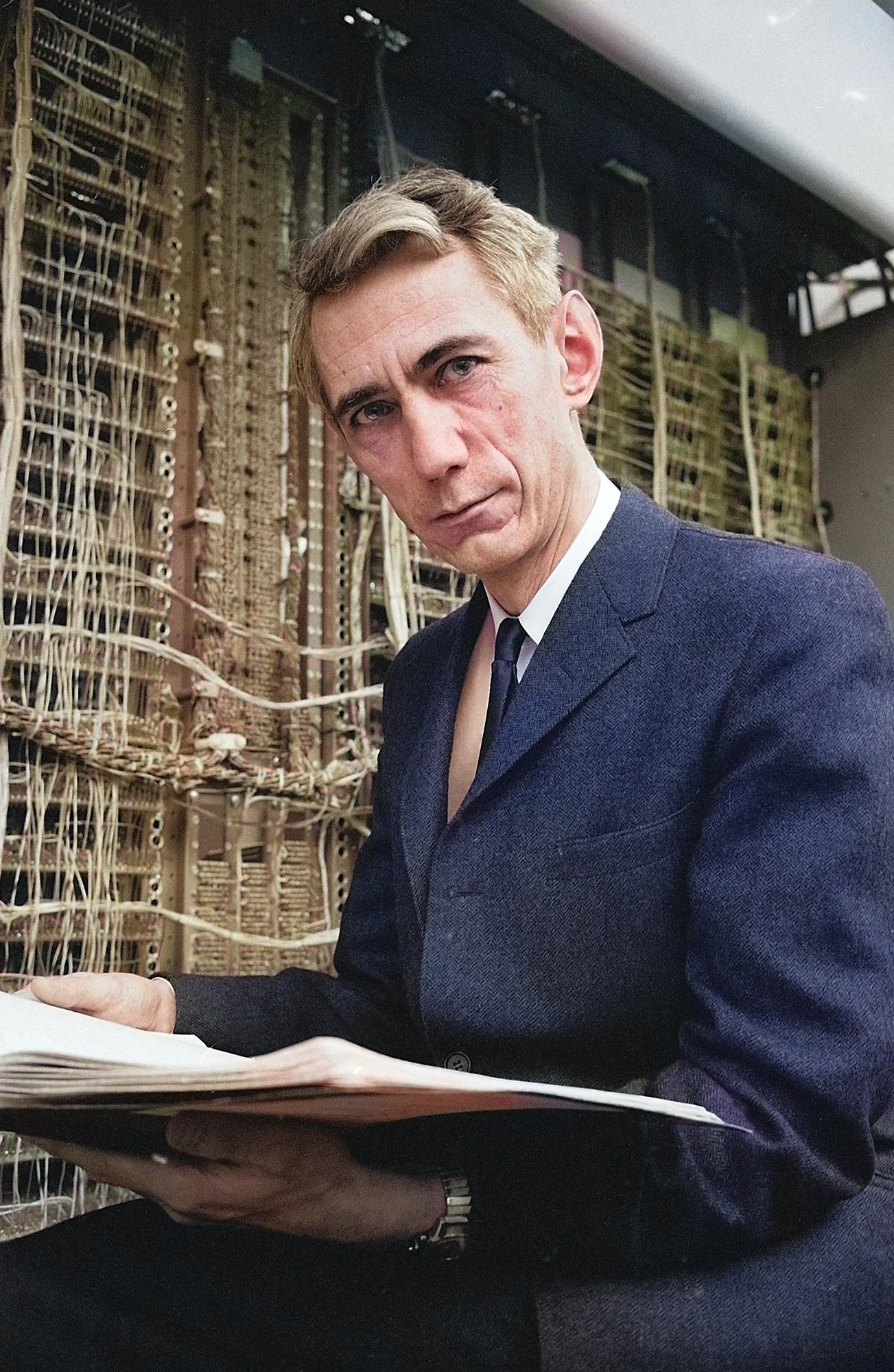
| 4 Quotes | |
| Born as | Claude Elwood Shannon |
| Occup. | Mathematician |
| From | USA |
| Born | April 30, 1916 Petoskey, Michigan, USA |
| Died | February 24, 2001 Medford, Massachusetts, USA |
| Cause | Alzheimer's disease |
| Aged | 84 years |
| Cite | |
Citation Formats
APA Style (7th ed.)
Claude shannon biography, facts and quotes. (2026, February 25). FixQuotes. https://fixquotes.com/authors/claude-shannon/
Chicago Style
"Claude Shannon biography, facts and quotes." FixQuotes. February 25, 2026. https://fixquotes.com/authors/claude-shannon/.
MLA Style (9th ed.)
"Claude Shannon biography, facts and quotes." FixQuotes, 25 Feb. 2026, https://fixquotes.com/authors/claude-shannon/. Accessed 5 Mar. 2026.
Early Life and Background
Claude Elwood Shannon was born on April 30, 1916, in Petoskey, Michigan, and grew up in nearby Gaylord, a small railroad town where practical mechanics sat close to wilderness and weather. His father ran a business and later worked in probate; his mother was a school principal. The combination mattered: Shannon inherited respect for instruments and systems, but also for the clear, almost moral demand that ideas be explainable.As a boy he built model airplanes, improvised gadgets, and wired contraptions in a shed, learning by taking things apart and making them behave. That rural, hands-on childhood left him with a lifelong preference for tinkering over posing - an inward confidence that a deep principle could be teased out of a concrete mechanism. Even when his work later became abstract, it kept the smell of solder and the feel of switches.
Education and Formative Influences
Shannon studied electrical engineering and mathematics at the University of Michigan (BS, 1936; BS, 1937), then went to MIT for graduate work at a moment when American engineering was becoming a theory-driven, wartime discipline. At MIT he served as a research assistant on Vannevar Bush's Differential Analyzer, a huge analog computing machine whose electromechanical guts forced Shannon to think in circuits, logic, and noise all at once. His 1937 master's thesis, "A Symbolic Analysis of Relay and Switching Circuits", made the audacious connection between George Boole's algebra and relay networks, showing that switching design could be treated as a rigorous symbolic calculus - a foundational step toward digital logic and practical computation.Career, Major Works, and Turning Points
After earning his PhD at MIT in 1940 with work touching genetics and cryptographic ideas, Shannon joined Bell Telephone Laboratories, the industrial research powerhouse of mid-century America, and spent the war years on fire-control and secure communications problems that sharpened his instincts about signals, secrecy, and interference. In 1948 he published "A Mathematical Theory of Communication", introducing a quantitative definition of information, the bit, and core limits such as channel capacity and reliable transmission with coding; it reframed communication as an engineering problem with provable bounds rather than ad hoc cleverness. A companion 1949 paper on secrecy systems drew lines between cryptography and information measures. Beyond the famous theory, he kept a parallel life of play that was never merely recreational: juggling, the "Throback" juggling machine, maze-solving mice, and chess-related devices were experiments in feedback, search, and embodiment, anticipating later conversations about artificial intelligence without surrendering to hype.Philosophy, Style, and Themes
Shannon's inner life was marked by curiosity without self-dramatization - a temperament that preferred questions to manifestos and proof to proclamation. His own retrospective key is almost childlike: “I just wondered how things were put together”. That line captures both method and psychology: he distrusted mystique, believed any system could be decomposed into parts and rules, and found joy in the moment the mechanism clicked. In an era when electronics and war demanded reliability, he turned wonder into discipline, but never lost the playful impulse that kept his abstractions grounded.His deepest theme is the separation of meaning from transmission. For Shannon, information was not what a message meant but what it did to uncertainty, and he insisted on definitions sharp enough to be engineered. “Information is the resolution of uncertainty”. The austerity of that stance was radical: it allowed language, telephony, radio, and computing to share one mathematics, and it made noise and redundancy measurable rather than metaphysical. He pushed this further into a probabilistic worldview - “Information: the negative reciprocal value of probability”. Read psychologically, the formula is a kind of disciplined impatience: he wanted the world of communications to stop arguing about intangibles and start counting what could be counted, even if the counting forced uncomfortable conclusions about limits. Yet his work never felt cold; it was animated by the belief that clarity itself is a form of freedom.
Legacy and Influence
Shannon died on February 24, 2001, in Massachusetts, after years of illness, leaving a legacy that underwrites modern life so thoroughly it can become invisible: digital circuits designed with Boolean logic; compression standards that trade redundancy for efficiency; error-correcting codes that make deep-space telemetry, mobile phones, and data centers reliable; and the conceptual backbone of cryptography and networked communication. He also offered a model of scientific character - the engineer-mathematician who treats play as a research instrument and insists that even the most human forms of communication can be studied with exactness. If the 20th century built machines that talked, remembered, and calculated, Shannon explained the price of those miracles and the surprising generosity of the laws that make them possible.Our collection contains 4 quotes written by Claude, under the main topics: Science - Knowledge - Artificial Intelligence.
Other people related to Claude: Warren Weaver (Scientist), George Gilder (Writer)
Frequently Asked Questions
- Claude Shannon von Neumann: Claude Shannon and John von Neumann were both key figures in the development of the digital computer, and von Neumann encouraged Shannon to link his work on information theory with thermodynamics.
- Claude Shannon entropy: Claude Shannon introduced the concept of entropy in information theory as a measure of uncertainty or information content.
- Where did Claude Shannon live: Claude Shannon was born in Petoskey, Michigan, and lived in many places including the Massachusetts area while working at MIT.
- Why is Claude Shannon important: Claude Shannon is important for establishing the field of information theory, which influences telecommunications, data compression, cryptography, and many modern technologies.
- Claude Shannon chess: Claude Shannon made significant contributions to computer chess, developing one of the first theories for chess-playing algorithms and writing influential papers on the subject.
- What did Claude Shannon invent: Claude Shannon invented the concept of digital circuit design theory as well as foundational theories in information theory, including the binary digit bit as a unit of information.
- Claude Shannon information theory: Claude Shannon is known as the father of information theory, which he introduced in his seminal 1948 paper 'A Mathematical Theory of Communication'.
- How old was Claude Shannon? He became 84 years old
Claude Shannon Famous Works
- 1956 The Bandwagon (Essay)
- 1951 Prediction and Entropy of Printed English (Essay)
- 1950 Programming a Computer for Playing Chess (Essay)
- 1949 Communication Theory of Secrecy Systems (Essay)
- 1949 The Mathematical Theory of Communication (Book)
- 1948 A Mathematical Theory of Communication (Essay)
- 1940 An Algebra for Theoretical Genetics (Non-fiction)
- 1937 A Symbolic Analysis of Relay and Switching Circuits (Non-fiction)
Source / external links