
Clement of Alexandra Biography Quotes 7 Report mistakes
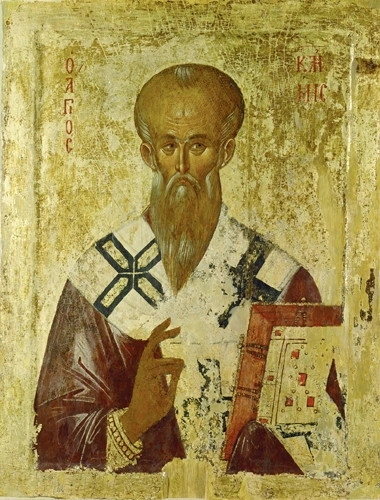
| 7 Quotes | |
| Born as | Titus Flavius Clemens |
| Known as | Clement Alexandrine |
| Occup. | Theologian |
| From | Greece |
| Born | 150 AC Athens, Achaia, Roman Empire |
| Died | 215 AC Jerusalem, Syria Palaestina, Roman Empire |
| Cite | |
Citation Formats
APA Style (7th ed.)
Clement of alexandra biography, facts and quotes. (2026, February 11). FixQuotes. https://fixquotes.com/authors/clement-of-alexandra/
Chicago Style
"Clement of Alexandra biography, facts and quotes." FixQuotes. February 11, 2026. https://fixquotes.com/authors/clement-of-alexandra/.
MLA Style (9th ed.)
"Clement of Alexandra biography, facts and quotes." FixQuotes, 11 Feb. 2026, https://fixquotes.com/authors/clement-of-alexandra/. Accessed 12 Feb. 2026.
Early Life and Formation
Clement of Alexandria, born Titus Flavius Clemens around the middle of the second century, is traditionally associated with the Greek world and is often linked to Athens, though the precise city of his birth remains uncertain. His own writings suggest a classical education of unusual breadth. He knew the poets and dramatists, cited philosophers with ease, and moved fluently among the schools of Hellenic thought. Before his Christian career in Egypt, he is said to have sought instruction in various centers across the Mediterranean, a pattern consistent with his literary portrait of a seeker who tested many teachers in pursuit of truth. That early formation positioned him to become one of the most erudite Christian voices of his generation, a thinker who would treat Greek paideia not as an enemy but as a preparatory discipline providentially ordered toward the gospel.Arrival in Alexandria and Teachers
Clement arrived in Alexandria, a city where philosophical argument and religious speculation mixed with the commerce of a great port. There he encountered Pantaenus, a former Stoic who had become a Christian teacher and who presided over what later tradition calls the catechetical instruction of Alexandria. Under Pantaenus, Clement found the synthesis he had sought: the confession of Christ articulated with the tools of reason and exegesis. Eusebius of Caesarea, the fourth-century historian who preserves much of our information, reports that Clement revered Pantaenus and succeeded him in the work of teaching. The bishop in Clement's Alexandrian years was Demetrius of Alexandria, whose long episcopate framed the careers of both Clement and the younger scholar who would follow him, Origen.Teacher, Presbyter, and the Alexandrian Milieu
Clement is remembered not only as a teacher but also as a presbyter, a role that situated him within the pastoral life of the church. His classroom seems to have gathered students from varied backgrounds, including those trained in philosophy. Ancient sources associate Origen with Clement as a student who absorbed much from him before developing his own monumental scholarship. The intellectual climate of Alexandria, where Platonists debated, Jewish exegetes like Philo were still read, and Christian communities multiplied, sharpened Clement's sensitivity to the questions posed by cultured non-Christians and by Christians wrestling with rival interpretations of the faith.Major Works and Literary Project
Clement's surviving corpus is anchored by a trilogy that maps a journey of conversion and maturation. The Protrepticus (Exhortation) addresses seekers steeped in Hellenic tradition, exposing the limits of pagan cults while presenting Christ as the divine Logos who fulfills the aspirations of philosophy. The Paedagogus (Instructor) then turns inward to the habits of the baptized, arguing that the Logos trains believers in virtue and self-command, from temperance in food and drink to chastity and modesty. The Stromata (Miscellanies) gather notes, arguments, and excerpts into a wide-ranging meditation on knowledge, Scripture, ethics, and worship. The loose structure suits Clement's ambition: to sketch the contours of a mature Christian wisdom he calls the true gnosis, far from the secrecy and elitism of the Gnostic schools.Among his other writings, the brief treatise commonly known as Who Is the Rich Man That Shall Be Saved? reflects on the encounter of Jesus with the wealthy man in the Gospel of Mark. Clement rejects both complacent luxury and crude literalism; he counsels inner detachment and liberality rather than a legalistic rule that all must dispose of property in identical fashion. He also composed works now lost or fragmentary, including the Hypotyposes (Outlines), from which later writers excerpted comments on Scripture. Two collections, Excerpts from Theodotus and Eclogae, preserve his interactions with and criticisms of Gnostic interpretations circulating in his day.
Engagement with Philosophy and Scripture
Clement's signature claim is that philosophy functioned for the Greeks as the law did for the Jews: a divine pedagogue preparing the mind for Christ. He drew frequently on Plato, the Stoics, and other schools, and he quoted poets such as Homer not to endorse all of their content but to show that scattered truths lay outside the church's bounds and could be gathered into a fuller vision under the rule of faith. His biblical interpretation blends moral exhortation with allegorical readings designed to uncover spiritual sense beneath the literal. He was indebted to earlier Christian apologists like Justin Martyr, whose positive engagement with philosophy he extended, and he frequently invoked Moses, the prophets, and the apostles as the final court of appeal against both pagan religion and heterodox speculation.Controversies and Opponents
Clement's classroom and books confront the theological movements of his Alexandrian environment. He names and critiques Valentinians, followers of Basilides and Carpocrates, and the positions of Marcion. He cites and corrects Heracleon and Theodotus, Valentinians whose interpretations of the Gospel of John and other texts had gained currency. Against them, Clement insists that salvation is not an escape from creation but its healing; that the one God is the maker of the world; and that the church's rule of truth, received from the apostles, sets the boundaries for speculation. His concept of the Christian gnostic answers the elitist claim of the Gnostic schools by affirming that deep knowledge is available within the life of virtue and worship, not by secret rites but by growth in charity and contemplative understanding.Moral Teaching and Christian Life
Clement's ethical counsel is demanding yet moderate in tone. He advocates fasting, simplicity, and chastity but does not equate holiness with harsh extremity. He argues for the goodness of marriage and family life, countering those who treated sexual abstinence as the only Christian ideal. In questions of wealth, adornment, and recreation, he urges freedom from the passions: use without slavery, discipline without pride. The Paedagogus in particular offers vivid pages on speech, laughter, music, and clothing, presenting the Christian as one trained by the Logos to become gentle, rational, and steadfast.Persecution, Exile, and Final Years
The calm of study in Alexandria did not endure. During the persecution associated with the emperor Septimius Severus around 202, 203, Clement left Egypt. Eusebius preserves a letter from Alexander, who would later serve as bishop of Jerusalem, commending Clement and indicating that he had provided care and instruction during a season when Alexander himself had been imprisoned. Those notices place Clement in the eastern provinces in his final period, received by respected churchmen and continuing to teach. The details of his last years are sparse. Tradition sets his death around 215, and the location is uncertain. What is clear is that he remained in communion with leaders such as Alexander and under the broad oversight of Demetrius of Alexandria, whose long episcopate framed Clement's Alexandrian tenure and the subsequent prominence of Origen.Reception and Legacy
Clement's reputation in antiquity rested on the elegance of his Greek, the wealth of his citations, and his capacity to draw Christian doctrine into conversation with the best of the classical heritage. Eusebius treated him as a trustworthy witness to earlier teachers such as Pantaenus and to customs in the churches of Egypt. Later readers sometimes debated aspects of his thought, especially in fragments from the Hypotyposes where his adventurous exegesis could perplex. Yet his main writings remained valued as an early, serious attempt to give an account of Christian faith in the language of a learned culture without surrendering the authority of Scripture or the confession of one God, maker of heaven and earth.Clement's influence can be traced through his student Origen, who developed a more systematic scriptural scholarship; through Alexandrian habits of allegorical reading; and through the continuing Christian effort to discern what of philosophy may be received in service to the gospel. In a city where sects and schools competed for minds, he portrayed the church as the true academy, with Christ the living Teacher. From Pantaenus he had learned to welcome truth wherever it might be found; under Demetrius he taught and served; in the time of trial he was sheltered by Alexander of Jerusalem; and in the pages preserved by Eusebius and others he remains a voice of early Christian learning. His life stands at the confluence of Greece and Egypt, Scripture and philosophy, persecution and pastoral care, shaping a model of theological work that would mark the Alexandrian tradition long after his death.
Our collection contains 7 quotes written by Clement, under the main topics: Hope - Knowledge - God - Bible - Wealth.
Source / external links