
Coco Gauff Biography Quotes 11 Report mistakes
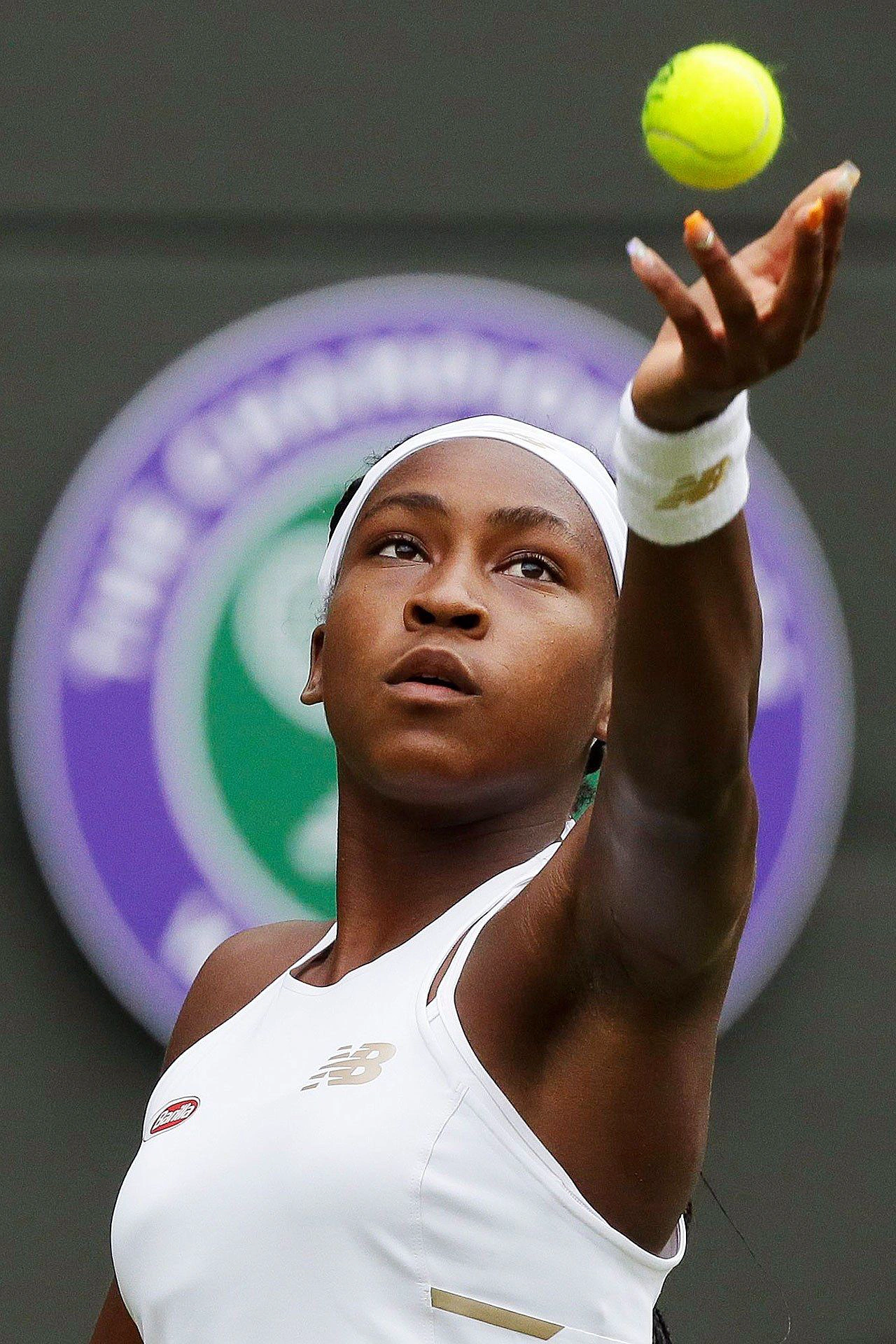
Attr: Coco Gauff Portrait
| 11 Quotes | |
| Born as | Cori Dionne Gauff |
| Occup. | Athlete |
| From | USA |
| Born | March 13, 2004 Delray Beach, Florida, USA |
| Age | 22 years |
| Cite | |
Citation Formats
APA Style (7th ed.)
Coco gauff biography, facts and quotes. (2026, March 17). FixQuotes. https://fixquotes.com/authors/coco-gauff/
Chicago Style
"Coco Gauff biography, facts and quotes." FixQuotes. March 17, 2026. https://fixquotes.com/authors/coco-gauff/.
MLA Style (9th ed.)
"Coco Gauff biography, facts and quotes." FixQuotes, 17 Mar. 2026, https://fixquotes.com/authors/coco-gauff/. Accessed 7 Apr. 2026.
Early Life and Background
Cori Dionne "Coco" Gauff was born on March 13, 2004, in Delray Beach, Florida, into a family that understood elite sport from the inside. Her father, Corey Gauff, played basketball at Georgia State; her mother, Candi, was a track and field athlete at Florida State before becoming an educator. That household gave her two durable inheritances: athletic literacy and emotional discipline. She was raised in the orbit of Black American striving in the post-Serena Williams era, when tennis was still expensive, global, and often coded by class, but no longer imagined as unreachable for a gifted Black girl from Florida. Her nickname, Coco, softened the public image of a prodigy; the player beneath it was methodical, competitive, and unusually self-possessed.The family soon recognized that her hand-eye coordination, speed, and appetite for repetition were exceptional. Inspired in part by watching Serena Williams win the 2009 Australian Open, Gauff committed seriously to tennis while still a child. The decision reshaped family life. Her father became deeply involved in coaching, and the family made practical sacrifices to support a training path that was never guaranteed to pay off. Unlike many child prodigies whose early fame becomes their identity, Gauff developed in a close-knit domestic world that emphasized faith, work, and accountability. That grounding mattered later, when global attention arrived before adulthood and every result threatened to become a referendum on destiny.
Education and Formative Influences
Gauff was largely homeschooled as her tennis demands intensified, a common route for young elite athletes but one that also accelerated her psychological separation from ordinary adolescence. Training in Florida, including time at Patrick Mouratoglou's academy in France, exposed her to a cosmopolitan, high-performance environment where tactical detail and bodily maintenance were as important as talent. Her formative influences were both technical and symbolic: the Williams sisters showed what Black female dominance could look like in a sport long resistant to it; Venus in particular became an early benchmark, making Gauff's later Wimbledon win over her in 2019 feel almost mythic. At the same time, the junior circuit taught her the harder lesson - that precocity creates expectations, and expectations can distort self-worth long before a player has fully formed a self.Career, Major Works, and Turning Points
Gauff's rise moved with rare speed. She became the youngest player to qualify for Wimbledon in the Open era in 2019, then, at 15, defeated Venus Williams and reached the fourth round, turning overnight from prospect to phenomenon. She had already won the 2018 French Open girls' title, confirming that the breakthrough was structural rather than accidental. Her professional career then unfolded under unusual scrutiny: WTA titles in singles and doubles, a run to the 2022 French Open final, and a growing reputation as one of the fastest defenders and best returners in the game. The decisive turning point came when immense promise hardened into major-champion authority: she won the 2023 US Open singles title, defeating Aryna Sabalenka in a final that displayed not only speed and resilience but tactical maturity. She also became a force in doubles, won the 2024 WTA Finals, and rose to the top tier of the sport while speaking publicly on race, civic responsibility, and the burden of visibility. Her career has thus far been defined less by a single upset than by the conversion of adolescent hype into durable, adult excellence.Philosophy, Style, and Themes
Gauff's tennis is built on pressure - elastic movement, deep court coverage, competitive stamina, and a return game that turns opponents' service games into negotiations. Early in her career, her forehand could break down under stress and her serve could drift, but those technical vulnerabilities also revealed the deeper drama of her development: she was trying to become a complete player while the world treated her as a finished one. The central theme in her public life has been recalibration - learning to distinguish ambition from perfectionism, and performance from identity. “I realised I needed to start playing for myself and not other people”. That sentence captures a major psychological pivot: the move from pleasing expectation to inhabiting vocation. It helps explain why her best tennis often appears when she stops chasing a narrative and starts solving a match.Her public candor has given her biography unusual interior depth. “I almost felt like if I didn't win, it was a failure. After Roland Garros [last year], it took me a long time to realize that tournament was a successful tournament for me”. In that admission, one hears the classic prodigy wound: success so normalized that anything short of triumph feels like deficiency. Yet Gauff repeatedly frames growth through resilience rather than invulnerability. “I just show people what it's like to be human. I have bad days, but I think it's more about how you get up after those bad moments, and how you show up after that”. Her style, then, is not merely athletic; it is ethical. She competes as someone trying to master pressure without denying feeling, and she has become a modern sports figure precisely because she allows excellence and humanity to remain visible at once.
Legacy and Influence
Gauff's legacy is already larger than her age would normally permit. She arrived in American tennis after the Williams revolution, but she has not been merely its beneficiary; she has extended its meaning into a new media era defined by instant judgment, activism, and relentless exposure. For younger players, especially Black girls, she embodies possibility without pretending the path is simple. For the sport, she represents a valuable synthesis: elite defense and counterpunching joined to star power, intelligence, and civic voice. If her future includes multiple majors - and it plausibly does - that will deepen rather than create her significance. What already endures is the model she offers: a champion formed in public, tested early, reflective enough to revise herself, and tough enough to keep winning while doing it.Our collection contains 11 quotes written by Coco, under the main topics: Motivational - Never Give Up - Resilience - Failure - Equality.
Source / external links