
Condoleezza Rice Biography Quotes 23 Report mistakes
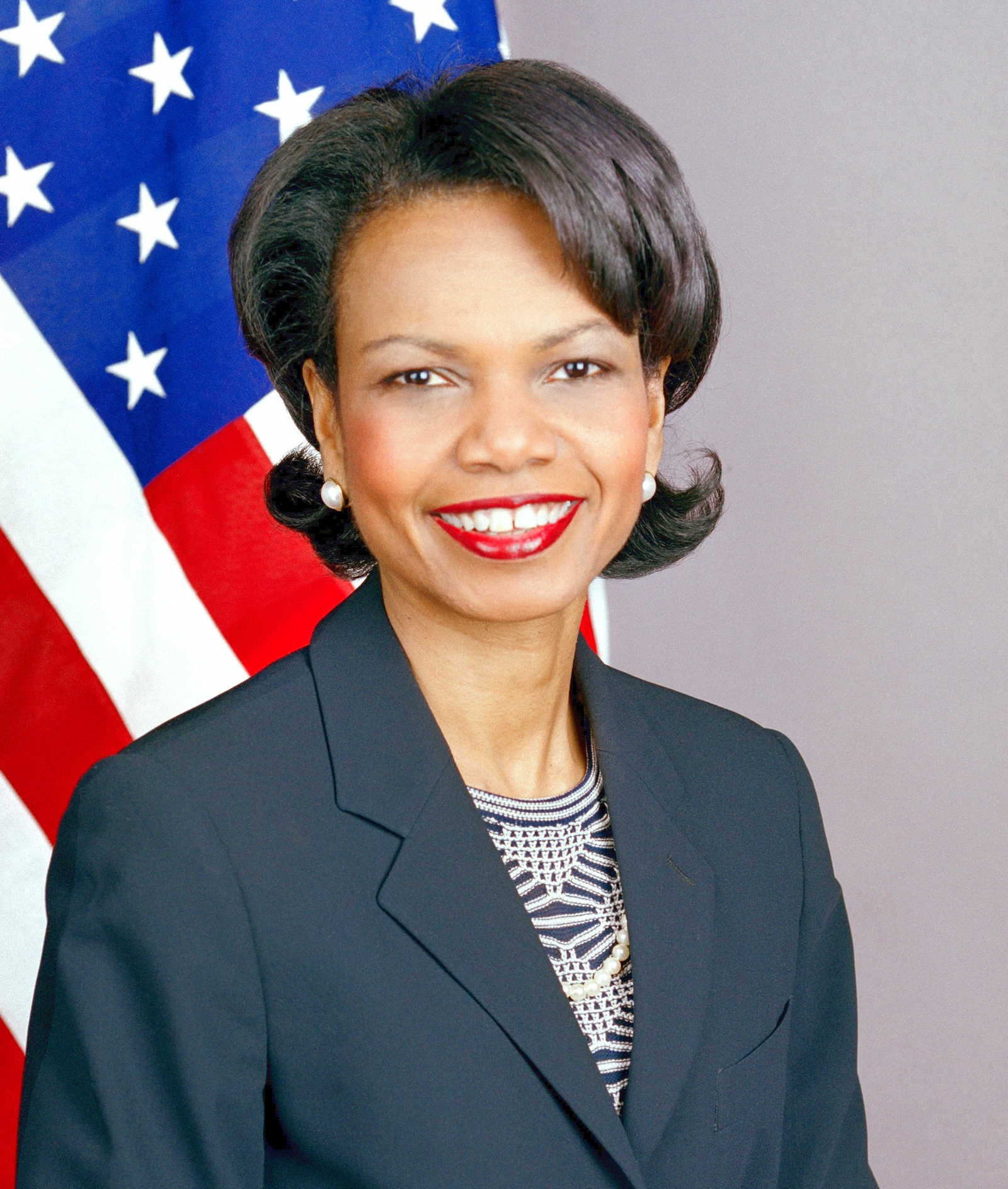
| 23 Quotes | |
| Occup. | Statesman |
| From | USA |
| Born | November 14, 1954 Birmingham, Alabama, U.S. |
| Age | 71 years |
| Cite | |
Citation Formats
APA Style (7th ed.)
Condoleezza rice biography, facts and quotes. (2026, February 11). FixQuotes. https://fixquotes.com/authors/condoleezza-rice/
Chicago Style
"Condoleezza Rice biography, facts and quotes." FixQuotes. February 11, 2026. https://fixquotes.com/authors/condoleezza-rice/.
MLA Style (9th ed.)
"Condoleezza Rice biography, facts and quotes." FixQuotes, 11 Feb. 2026, https://fixquotes.com/authors/condoleezza-rice/. Accessed 26 Mar. 2026.
Early Life and Background
Condoleezza Rice was born on November 14, 1954, in Birmingham, Alabama, into a Black middle-class family whose ambitions unfolded under the pressure of Jim Crow. Her father, John Wesley Rice Jr., was a Presbyterian minister and school administrator; her mother, Angelena Ray Rice, taught music. The household fused discipline with performance - church, study, and the piano - while the city outside taught a harsher curriculum. Rice later spoke of childhood routines shaped by segregation, and of adults who insisted that excellence was not simply virtue but armor.Birmingham in the 1960s placed violence within earshot. The 1963 bombing of the 16th Street Baptist Church, which killed four girls close to her age, became a searing reference point: a lesson that politics could be lethal and that institutions could fail. The Rices moved west to Denver, Colorado, in the later 1960s, trading the Souths overt coercion for a different set of barriers. The relocation widened her horizon and, crucially, gave her room to imagine public authority not as distant spectacle but as a vocation.
Education and Formative Influences
A prodigy trained for the concert stage, Rice entered the University of Denver at 15, first intending to become a pianist. A course with Josef Korbel, the Czech diplomat and founder of the Korbel School (and father of Madeleine Albright), redirected her toward international politics and the moral drama of state power. She earned a BA in political science (1974), an MA (1975), and a PhD (1981), with immersion in Russian and Soviet studies that fit the Cold Wars strategic, archival temperament. Study in Moscow and work on arms control questions trained her to respect hard constraints - geography, capability, adversary intention - while her musical background left her sensitive to pattern, discipline, and timing, traits that later shaped her bureaucratic method.Career, Major Works, and Turning Points
Rice taught at Stanford University, becoming provost in 1993 and one of the first women to hold that post, known for managerial rigor and a willingness to make unpopular fiscal choices. National service arrived with the end of the Cold War: she served on the National Security Council under President George H. W. Bush (1989-1991) as director, then senior director, for Soviet and East European affairs, participating in the diplomacy surrounding German reunification and the Soviet Unions collapse. In 2001 she became President George W. Bushs national security adviser, and in 2005 the 66th U.S. secretary of state, the first Black woman to hold the office. Her public record is inseparable from 9/11, the Afghanistan war, the Iraq invasion, and the doctrine of preemption; later she returned to Stanford as a senior fellow and professor, publishing memoirs and defenses of her era such as No Higher Honor (2011) and Democracy: Stories from the Long Road to Freedom (2017), attempting to frame policy as both necessity and aspiration.Philosophy, Style, and Themes
Rice governed as a realist with a moral vocabulary: she believed that democratic legitimacy mattered, but that statesmen were judged in moments when information was partial and time was short. Her decision-making style favored structured briefs, tight hierarchies, and clarity of presidential intent; she could be conciliatory in private while projecting certainty in public, a duality often required of national security officials. The tension in her inner life - between the scholars caution and the officials duty to act - became most visible after 9/11, when fear of catastrophic surprise reordered the boundaries of acceptable risk.Her rhetoric repeatedly returned to threat, credibility, and coalition discipline. “We're in a new world. We're in a world in which the possibility of terrorism, married up with technology, could make us very, very sorry that we didn't act”. In that logic, uncertainty did not counsel patience but urgency, and she gave the era one of its most memorable formulations: “The problem here is that there will always be some uncertainty about how quickly Saddam can acquire nuclear weapons. But we don't want the smoking gun to be a mushroom cloud”. Yet she also anchored American action in a language of sustained partnership, insisting, “We will continue to work together in our common fight against terror”. Psychologically, these lines reveal a stateswoman for whom fear was not merely emotion but instrument - a way to concentrate attention, align allies, and justify choices that would otherwise seem too stark, even as that same certainty narrowed space for dissent and later complicated the credibility she valued.
Legacy and Influence
Rice remains one of the defining U.S. foreign-policy figures of the early 21st century - emblematic of a post-9/11 national security state that elevated intelligence, preemption, and counterterrorism to organizing principles. Her legacy is braided: historic representation and personal discipline; intellectual seriousness and political loyalty; a career that expanded the visible possibilities for Black women in global affairs while also binding her name to the wars and intelligence failures that continue to shape public trust. In academia and policy circles, she endures as a case study in how private temperament meets public catastrophe - how a rigorous, ambitious mind navigates the permanent dilemma of statecraft: acting decisively without mistaking conviction for certainty.Our collection contains 23 quotes written by Condoleezza, under the main topics: Sarcastic - Freedom - War - Peace - Vision & Strategy.
Other people related to Condoleezza: Karen Hughes (Politician), Brent Scowcroft (Public Servant), Scott McClellan (Politician), Ari Fleischer (Public Servant), David Kay (Scientist), Javier Solana (Politician), Andrea Mitchell (Journalist), Mitchell Reiss (Diplomat), Stephen Hadley (Politician), Elliott Abrams (Lawyer)