
Constantine Karamanlis Biography Quotes 3 Report mistakes
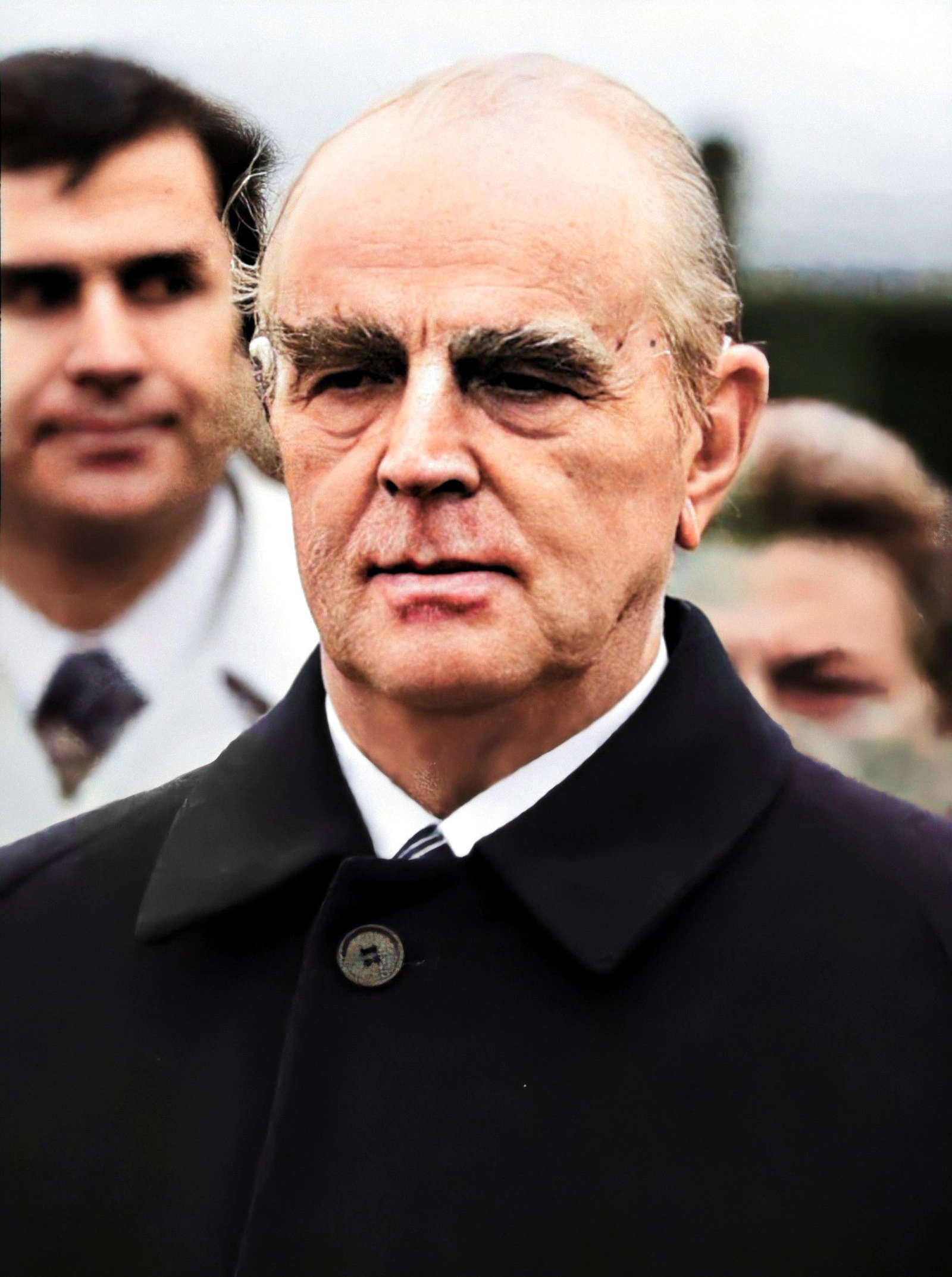
Attr: Bert Verhoeff for Anefo, CC0
| 3 Quotes | |
| Born as | Konstantinos G. Karamanlis |
| Known as | Caramanlis |
| Occup. | Leader |
| From | Greece |
| Spouse | Amalia Kanellopoulou |
| Born | March 8, 1970 Proti, Salonica Vilayet, Ottoman Empire (now Greece) |
| Died | April 23, 1998 Athens, Greece |
| Cause | Natural causes |
| Aged | 28 years |
| Cite | |
Citation Formats
APA Style (7th ed.)
Constantine karamanlis biography, facts and quotes. (2026, February 11). FixQuotes. https://fixquotes.com/authors/constantine-karamanlis/
Chicago Style
"Constantine Karamanlis biography, facts and quotes." FixQuotes. February 11, 2026. https://fixquotes.com/authors/constantine-karamanlis/.
MLA Style (9th ed.)
"Constantine Karamanlis biography, facts and quotes." FixQuotes, 11 Feb. 2026, https://fixquotes.com/authors/constantine-karamanlis/. Accessed 12 Feb. 2026.
Clarifying identity
The name Constantine (Konstantinos G.) Karamanlis evokes the towering Greek statesman who dominated much of the country's postwar political landscape. While the years sometimes get misremembered, the historically documented figure was born in 1907 and died in 1998. He was not born around 1970, but he did pass away in 1998 and was indeed a national leader. The following account concerns this Konstantinos G. Karamanlis, whose life and work are well attested in public records and contemporary accounts.Early life and entry into politics
Konstantinos G. Karamanlis was born in Proti, near Serres, then within the Ottoman Empire, and grew up in a region that would be incorporated into the Greek state after the Balkan Wars. He studied law at the University of Athens and practiced as a lawyer before turning to politics. In the mid-1930s he entered Parliament, representing the Serres region, and established himself as a pragmatic conservative determined to modernize public administration. After World War II and the Greek Civil War, he held ministerial posts focused on public works and reconstruction, where his preference for durable infrastructure and institutional order began to define his style. As Minister of Public Works under Prime Minister Alexandros Papagos, he promoted road building and public investment designed to knit together a country still scarred by conflict.Prime ministership and nation-building
Upon the death of Alexandros Papagos in 1955, and with the approval of King Paul, Karamanlis was called to form a government. He soon founded the National Radical Union (ERE) and won successive elections. His cabinets relied on able lieutenants such as Evangelos Averoff, who played a central role in foreign policy, and George Rallis, who contributed to education and later succeeded him as prime minister. Karamanlis aimed to stabilize the economy, expand infrastructure, and orient Greece toward Western institutions. Politics, however, remained contentious. His conservative camp faced a dynamic centrist opposition led by Georgios Papandreou and an emerging left-of-center current around Andreas Papandreou. The 1961 election became a watershed: allegations of "violence and fraud" by the opposition darkened the atmosphere, while the 1963 assassination of the left-leaning parliamentarian Grigoris Lambrakis exposed the reach of a reactionary parastate. Amid tensions with the palace, Karamanlis resigned and left for Paris, a decision that reflected both political strain and his rejection of royal interference.Exile and return to democracy
The 1967 colonels' coup shuttered Greece's democracy and kept Karamanlis in exile. From Paris, he maintained a measured public stance, cultivating ties in Europe and watching Greece's crisis deepen. When the dictatorship collapsed in 1974 after the Cyprus debacle, the transitional authorities under President Phaedon Gizikis invited Karamanlis to return and form a government of national unity. With assistance and encouragement from European allies, notably French President Valery Giscard d'Estaing, he flew to Athens to immense popular acclaim. He legalized the Communist Party, sought to heal civil strife, and quickly organized free elections. In that pivotal season known as Metapolitefsi, he founded the center-right New Democracy (ND), recruited figures across the democratic spectrum, and steered a referendum that peacefully abolished the monarchy, ending decades of palace-centered politics that had entangled earlier premiers, from King Paul to King Constantine II.Constitutional order and European orientation
Karamanlis oversaw the 1975 Constitution, which strengthened parliamentary democracy and codified civil liberties. As prime minister, he mapped a strategic course toward the European Communities, believing that Greece's stability and prosperity would be anchored in the European project. Evangelos Averoff again proved indispensable as foreign minister, while George Rallis and other senior colleagues managed domestic portfolios during a time of change. Karamanlis also managed delicate relations with rivals, including Andreas Papandreou, whose PASOK movement was gaining momentum with a populist program. Even as partisanship intensified, Karamanlis insisted that Greece's new democratic rules be respected and that critical issues like foreign policy and constitutional balance be handled with prudence.Presidency, consensus, and European integration
In 1980 Karamanlis transitioned from prime minister to president of the Hellenic Republic, a role designed to be above day-to-day party combat but pivotal in guaranteeing institutions. Greece signed its treaty of accession to the European Communities in 1979, and full membership took effect on January 1, 1981. The country soon experienced alternation in power, with Andreas Papandreou's PASOK winning a sweeping victory that same year. Karamanlis, as president, worked with PASOK cabinets to maintain constitutional continuity during a period of sharp ideological division. When his term ended in 1985 and Papandreou preferred a different head of state, Karamanlis returned quietly to private life, only to be elected president again in 1990 after New Democracy won power under Konstantinos Mitsotakis. During his second presidency he aimed for civility and consensus, defusing crises where possible and reminding competing leaders of the long arc of national interests.Political style, relationships, and influence
Karamanlis's governing style was austere, legalistic, and strategic. He cultivated long partnerships with figures like Evangelos Averoff and George Rallis and maintained respectful if often wary relationships with opponents such as Georgios Papandreou and later Andreas Papandreou. His ties to European leaders, especially Valery Giscard d'Estaing, facilitated Greece's path into the European mainstream at a moment when the country needed credibility and investment. He navigated the fraught triangle of government, military, and crown that had ensnared earlier leaders, ultimately helping to remove the monarchy as a political actor. While critics faulted aspects of his early electoral practices and his reliance on a tight inner circle, the broad judgment of his Metapolitefsi leadership is that he secured democracy when it was most vulnerable. His wider family also remained intertwined with public life; his nephew Kostas Karamanlis would serve as prime minister decades later, reflecting the enduring imprint of the Karamanlis name on Greek politics.Final years and death
After leaving the presidency in 1995, Karamanlis withdrew from public visibility but remained a symbol of moderation and European orientation. He died in Athens on April 23, 1998. The leaders who had once sparred with him, including Andreas Papandreou's circle and the succeeding generation around Konstantinos Mitsotakis, acknowledged his central role in stabilizing the political system. He is remembered as the architect of Greece's post-1974 constitutional order and its integration into Europe, a statesman who bridged eras: from the postwar scramble for modernization with King Paul and Alexandros Papagos, through the trauma of dictatorship and exile, to a democratic settlement robust enough to outlast the fiercest partisan battles.Our collection contains 3 quotes written by Constantine, under the main topics: Wisdom - Leadership - Work Ethic.
Source / external links