
Dag Hammarskjold Biography Quotes 45 Report mistakes
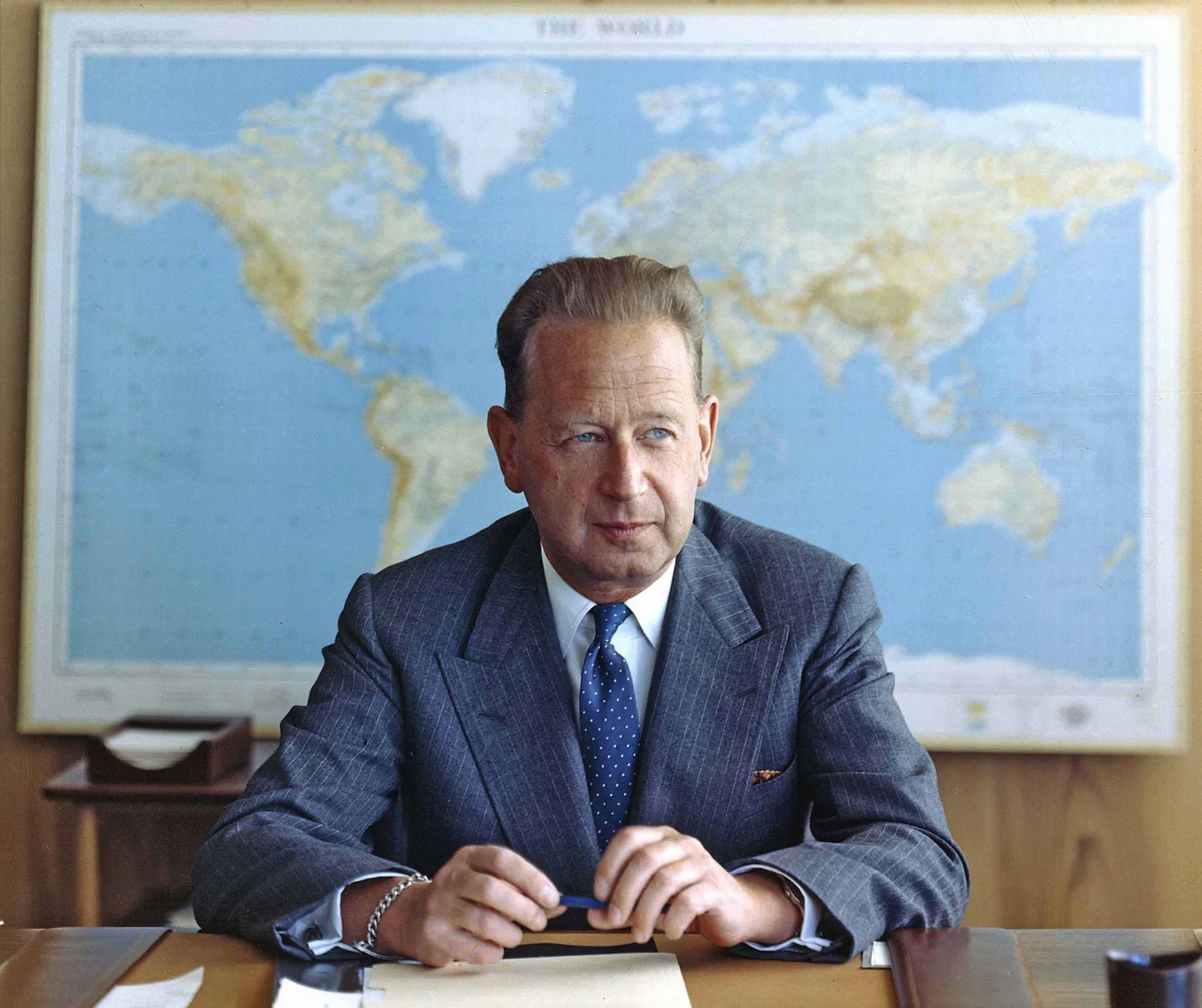
| 45 Quotes | |
| Born as | Dag Hjalmar Agne Carl Hammarskjöld |
| Known as | Dag Hammarskjöld |
| Occup. | Diplomat |
| From | Sweden |
| Born | July 29, 1905 Jönköping, Sweden |
| Died | September 18, 1961 Ndola, Northern Rhodesia (now Zambia) |
| Cause | Plane crash |
| Aged | 56 years |
| Cite | |
Citation Formats
APA Style (7th ed.)
Dag hammarskjold biography, facts and quotes. (2026, February 11). FixQuotes. https://fixquotes.com/authors/dag-hammarskjold/
Chicago Style
"Dag Hammarskjold biography, facts and quotes." FixQuotes. February 11, 2026. https://fixquotes.com/authors/dag-hammarskjold/.
MLA Style (9th ed.)
"Dag Hammarskjold biography, facts and quotes." FixQuotes, 11 Feb. 2026, https://fixquotes.com/authors/dag-hammarskjold/. Accessed 5 Mar. 2026.
Early Life and Background
Dag Hjalmar Agne Carl Hammarskjold was born on July 29, 1905, in Jonkoping, Sweden, into a family where public duty was not an abstraction but a household language. His father, Hjalmar Hammarskjold, served as Sweden's prime minister during World War I, a period of neutrality strained by shortages, diplomacy, and domestic division. That early proximity to statecraft shaped Dag's sense that politics was not theater but stewardship - the slow management of risk, reputation, and conscience.After his father's premiership, the family life centered increasingly at Uppsala, in an atmosphere of high expectations and restrained emotion typical of Sweden's educated elite. Hammarskjold grew up amid Lutheran seriousness, intellectual discipline, and the example of a father criticized for rigidity in wartime policy - a lesson in how easily public service can curdle into public reproach. The result was a temperament both reserved and intensely inward: a man trained to carry pressure silently, and to measure success less by acclaim than by whether one had been faithful to a demanding standard.
Education and Formative Influences
He studied at Uppsala University, taking a degree in French, philosophy, and law (1925), and later earned a doctorate in economics from Stockholm University (1933), combining humanistic reading with the tools of modern administration. In the interwar era - when technocracy promised stability and Europe repeatedly failed to secure it - Hammarskjold absorbed the Scandinavian idea that competent institutions could temper conflict, even as he privately pursued spiritual and literary sources that emphasized self-scrutiny, solitude, and sacrifice.Career, Major Works, and Turning Points
Hammarskjold rose through Sweden's civil service as an economist and policy planner, working at the Ministry of Finance and later in foreign economic affairs; he played key roles in postwar financial and trade negotiations and became a trusted nonpartisan official in Stockholm. In 1953 he was elected Secretary-General of the United Nations, unexpectedly succeeding Trygve Lie and quickly redefining the office as an active moral and diplomatic instrument. His tenure coincided with the Cold War's sharpest tests: the Suez Crisis (1956), where he helped craft the first UN peacekeeping force (UNEF); the 1958 Lebanon crisis; and, most fatefully, the Congo Crisis (1960-61), in which he backed UN intervention to preserve Congolese sovereignty against secession and proxy escalation. On September 18, 1961, while traveling to negotiate a ceasefire in Northern Rhodesia (near Ndola), his plane crashed, killing him and fueling lasting controversy; he was awarded the Nobel Peace Prize posthumously that year.Philosophy, Style, and Themes
Hammarskjold's public style was austere, precise, and quietly relentless - a Swedish civil servant's economy of words married to a monk-like insistence that the UN must be more than a stage for vetoes. He treated neutrality as an ethical discipline, not a lack of conviction, and he demanded that power be exercised without humiliation or vanity. “Your position never gives you the right to command. It only imposes on you the duty of so living your life that others can receive your orders without being humiliated”. That sentence captures his psychological center: authority was legitimate only when it was self-limiting, and leadership was measured by the dignity it preserved in others, including adversaries.Privately - as later revealed through his posthumously published spiritual diary, Markings (Vagmarken) - he framed diplomacy as an outward form of inward work. “The more faithfully you listen to the voices within you, the better you will hear what is sounding outside”. For Hammarskjold, introspection was not self-indulgence but a method for clarity under geopolitical noise, a way to resist both ideological intoxication and personal resentment. His recurring theme was acceptance without surrender: the world grants no ideal outcomes, but it demands integrity in the attempt. “We are not permitted to choose the frame of our destiny. But what we put into it is ours”. In that ethic, the UN was a vessel - limited, battered, often misused - yet still capable of bearing a human choice toward restraint, mediation, and the protection of the vulnerable.
Legacy and Influence
Hammarskjold left behind a template for the modern Secretary-General: independent initiative, preventive diplomacy, peacekeeping as a practical invention, and the claim that international civil servants can represent a global conscience without becoming a superpower's tool. Markings made him one of the 20th century's rare statesmen whose inner life became part of his public meaning, influencing later UN leaders and generations of diplomats who saw in him a model of principled, psychologically disciplined service. His death in Africa turned him into a symbol of the risks inherent in impartial intervention, and continuing investigations into the crash have kept his story alive - not as myth alone, but as a continuing argument about whether international order can be defended by law, patience, and personal courage when great powers prefer force and speed.Our collection contains 45 quotes written by Dag, under the main topics: Witty One-Liners - Motivational - Ethics & Morality - Wisdom - Truth.
Other people related to Dag: Barbara Hepworth (Artist), Paul Hoffman (Celebrity), Trygve Lie (Politician), Anthony Eden (Politician), U Thant (Statesman)
Source / external links