
Dale Carnegie Biography Quotes 47 Report mistakes
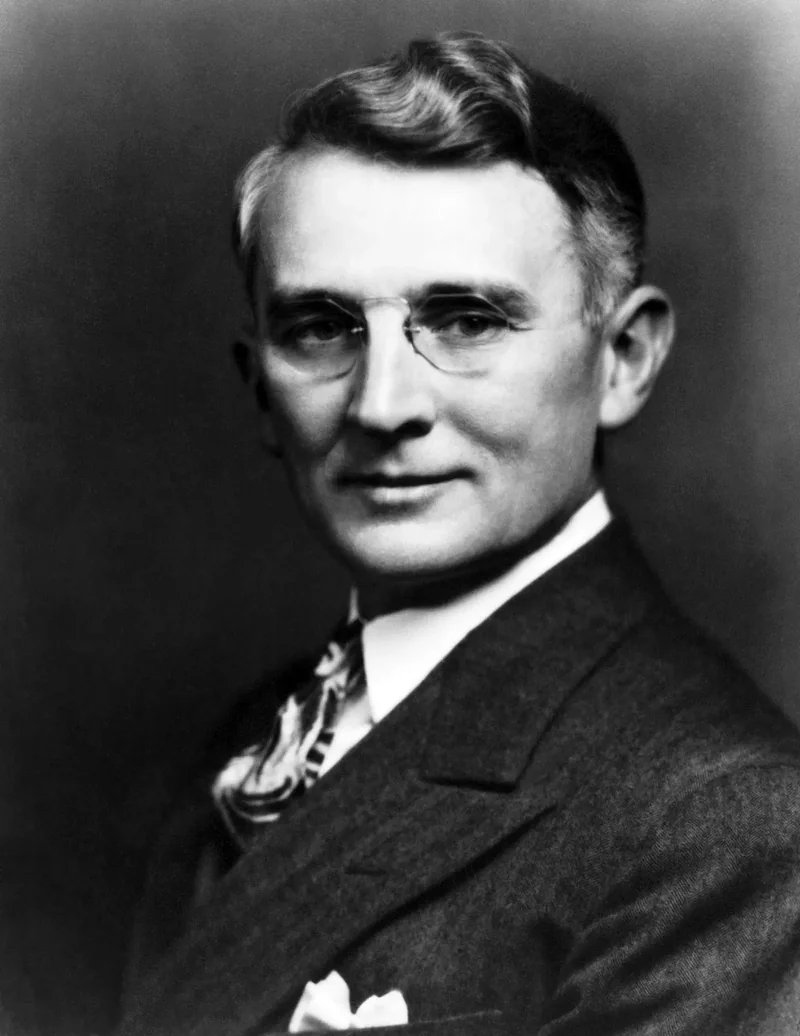
Attr: Britannica
| 47 Quotes | |
| Occup. | Writer |
| From | USA |
| Born | November 24, 1888 |
| Died | November 1, 1955 |
| Aged | 66 years |
| Cite | |
Citation Formats
APA Style (7th ed.)
Dale carnegie biography, facts and quotes. (2026, February 1). FixQuotes. https://fixquotes.com/authors/dale-carnegie/
Chicago Style
"Dale Carnegie biography, facts and quotes." FixQuotes. February 1, 2026. https://fixquotes.com/authors/dale-carnegie/.
MLA Style (9th ed.)
"Dale Carnegie biography, facts and quotes." FixQuotes, 1 Feb. 2026, https://fixquotes.com/authors/dale-carnegie/. Accessed 6 Mar. 2026.
Early Life and Education
Dale Carnegie was born in 1888 in rural Missouri and raised on farms near Warrensburg, where hard work and church gatherings shaped his early outlook. He became fascinated by oratory as a teenager, listening to traveling preachers and studying speeches. At the State Teachers College in Warrensburg, later the University of Central Missouri, he joined debating and literary societies and practiced the craft of clear, persuasive speaking. Those experiences gave him the conviction that effective communication was not an inborn gift reserved for a few but a set of skills that could be learned by many.From Salesman to Speaker
After college, Carnegie took a job as a traveling salesman for Armour and Company. On the road across the Midwest, he learned to adjust his message to different personalities, a lesson that would become central to his later teaching. He briefly tried the stage in New York, discovering both the allure and the precariousness of theatrical work. Acting did not provide a stable living, but it sharpened his sense of timing, voice, and audience engagement. Seeking steadier work, he approached the YMCA on 125th Street in Manhattan in 1912 and proposed a course to help ordinary people overcome stage fright and speak convincingly. The course drew immediate interest, and he began refining exercises, from impromptu talks to storytelling and personal testimony, that visibly improved participants week by week.Building a Teaching Method
Carnegie developed a practical, participatory method that favored short speeches, positive feedback, and real-life applications. He asked learners to speak from their own experience, to focus on the listener rather than the speaker, and to substitute sincere appreciation for flattery. He emphasized remembering names, encouraging others to talk about themselves, and admitting one's own mistakes swiftly. As his classes grew, he collaborated with Joseph Berg Esenwein to publish The Art of Public Speaking in 1915, giving a wider audience access to his techniques. Early in his career he sometimes used the spelling Carnagey; he later standardized his surname as Carnegie, a choice that inevitably evoked Andrew Carnegie even though there was no family connection.Breakthrough as an Author
By the 1930s, Carnegie's programs had reached thousands of businesspeople, sales representatives, and community leaders. In 1934, Leon Shimkin of Simon and Schuster attended the course and urged him to turn his notes on human relations into a book. The result, How to Win Friends and Influence People, appeared in 1936 under the imprint of Richard L. Simon and M. Lincoln Schuster. It became a publishing phenomenon, going through multiple printings rapidly. The book's case studies drew from Carnegie's classrooms and from public figures whose habits of listening, encouragement, and tactful persuasion seemed to unlock cooperation. Carnegie did not promise manipulation; he framed influence as the outcome of genuine interest in others, fairness, and clear purpose. He followed this work with Lincoln the Unknown in 1932, reflecting his admiration for Abraham Lincoln's patience and empathy, and later with How to Stop Worrying and Start Living in 1948, which combined anecdotes, common-sense psychology, and practical routines for reducing anxiety.Institutional Growth and Influence
As demand surged, Carnegie formalized instructor training and standardized course outlines, while leaving room for local examples and personal stories. The Dale Carnegie Course in Effective Speaking and Human Relations, as it became known, expanded through affiliated centers in major cities. In New York, editors, sales managers, and young professionals often mixed in the same classroom, testing Carnegie's claim that the principles of thoughtful listening, courtesy, and clear expression crossed occupational lines. Alumni included well-known executives and entrepreneurs; years later Warren Buffett would credit a Dale Carnegie course with strengthening his confidence in addressing people directly. The organization attracted devoted collaborators and teachers who carried his methods beyond the United States, translating the core ideas of respect, clarity, and encouragement into other languages and cultures.Personal Life
Carnegie's personal life intersected closely with his work. He married Lolita Baucaire early in his New York years; the union ended in divorce in 1931, a difficult period that coincided with the demands of travel and teaching during the Depression. In 1944 he married Dorothy Price Vanderpool, who became an essential partner in managing and promoting the expanding programs. Dorothy Carnegie later wrote about the principles in her own voice and helped guide the institution after his death. Their family life, which included Dorothy's daughter from a prior marriage and a daughter together, unfolded alongside the steady rhythm of evening classes, speaking engagements, and revising course materials.Themes and Methods
Carnegie's approach rested on a few recurring themes. He argued that criticism often hardens resistance, while sincere appreciation opens the way to cooperation. He taught that remembering names, smiling, and seeing matters from the other person's perspective were not superficial tricks but habits that conveyed respect. He urged speakers to replace abstraction with concrete stories and to use vivid, specific examples. In his classes he normalized fear of public speaking, asking students to practice repeatedly under supportive conditions until anxiety subsided. This blend of behavioral rehearsal, straightforward principles, and moral emphasis on goodwill distinguished his work from purely technical rhetoric manuals and from manipulative sales patter that he disdained.Later Years and Death
By the late 1940s and early 1950s, Carnegie was a national figure, balancing authorship, speaking, and oversight of an organization that was becoming a global franchise. He remained closely involved with curriculum standards and instructor certification. Even as health concerns arose, he continued to refine course content and revise his books. He died in New York in 1955, and Dorothy Carnegie, together with trusted associates from the teaching corps and publishing partners at Simon and Schuster, helped ensure that the courses and books remained available to new generations.Legacy
Dale Carnegie's legacy lies in the marriage of timeless courtesies to practical, repeatable techniques. He offered a vision of achievement built not on dominance but on cooperation, and he gave nervous speakers a pathway to confidence through practice. The people around him shaped that legacy: Joseph Berg Esenwein gave his early work editorial rigor; Leon Shimkin recognized a broader audience for his ideas; Richard L. Simon and M. Lincoln Schuster brought his books to market; Dorothy Carnegie safeguarded and extended the institution he founded. Long after his passing, the Dale Carnegie programs continue to adapt to new workplaces, while the central message he championed remains the same: respect others, express yourself clearly, and act with genuine interest in the people you hope to influence.Our collection contains 47 quotes written by Dale, under the main topics: Witty One-Liners - Motivational - Wisdom - Love - Writing.
Dale Carnegie Famous Works
- 1962 The Quick and Easy Way to Effective Speaking (Non-fiction)
- 1948 How to Stop Worrying and Start Living (Non-fiction)
- 1936 How to Win Friends and Influence People (Non-fiction)
- 1932 Lincoln the Unknown (Biography)