
Daniel J. Boorstin Biography Quotes 27 Report mistakes
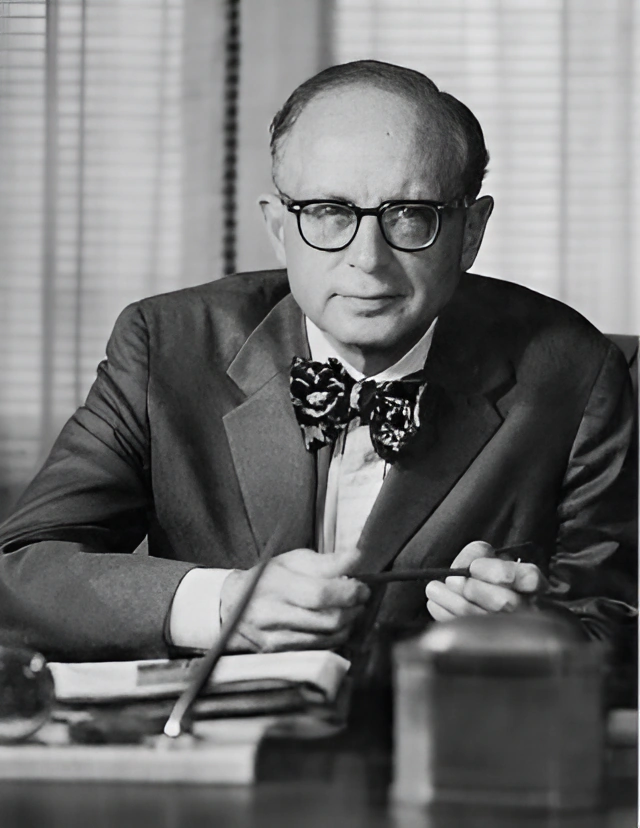
| 27 Quotes | |
| Occup. | Historian |
| From | USA |
| Born | October 1, 1914 |
| Died | February 28, 2004 |
| Aged | 89 years |
| Cite | |
Citation Formats
APA Style (7th ed.)
Daniel j. boorstin biography, facts and quotes. (2026, February 11). FixQuotes. https://fixquotes.com/authors/daniel-j-boorstin/
Chicago Style
"Daniel J. Boorstin biography, facts and quotes." FixQuotes. February 11, 2026. https://fixquotes.com/authors/daniel-j-boorstin/.
MLA Style (9th ed.)
"Daniel J. Boorstin biography, facts and quotes." FixQuotes, 11 Feb. 2026, https://fixquotes.com/authors/daniel-j-boorstin/. Accessed 5 Mar. 2026.
Early Life and Background
Daniel Joseph Boorstin was born on October 1, 1914, in Atlanta, Georgia, to Jewish parents whose world was shaped by both American opportunity and the pressures of early-20th-century politics. When he was still a child, the family moved to Tulsa, Oklahoma, where his father became a prominent lawyer. Tulsa in the 1920s was an oil-boom city trying to invent itself overnight, a place where boosterism, advertising, and civic mythmaking were as tangible as derricks and new brick streets - an environment that later helped Boorstin see how modern societies manufacture images of themselves.His adolescence unfolded against the Great Depression, when the promises of progress sounded hollow and public narratives collided with private anxiety. Boorstin developed an instinct for the difference between what a culture says it is and what it actually rewards. That tension - between lived experience and public representation - became the lifelong engine of his historical imagination, and it would later reappear in his famous critiques of modern "pseudo-events" and celebrity culture.
Education and Formative Influences
Boorstin attended Harvard, graduating in 1934, then went on as a Rhodes Scholar to Balliol College, Oxford, and returned to earn his LL.B. from Yale in 1937. The interwar Atlantic world he studied in - marked by ideological certainty, economic rupture, and the rising claims of mass persuasion - taught him to distrust grand systems and to favor history as the record of practical choices, institutions, and unintended consequences. He began as a legal academic, but his temperament was that of a storyteller-scholar: drawn to how people build communities, markets, and myths, and how those constructions eventually harden into what later generations mistake for inevitabilities.Career, Major Works, and Turning Points
After teaching law at the University of Chicago, Boorstin shifted decisively into history, writing with a sweep that appealed to general readers without abandoning archival discipline. His trilogy The Americans (The Colonial Experience, 1958; The National Experience, 1965; The Democratic Experience, 1973) reframed U.S. development less as an abstract ideological crusade than as a set of improvisations in religion, commerce, technology, and everyday life; the third volume won the Pulitzer Prize. With The Image (1961) he diagnosed a new age of manufactured reality, and with The Discoverers (1983), The Creators (1992), and The Seekers (1998) he broadened into a panoramic history of curiosity itself. His public stature culminated in service as Librarian of Congress (1975-1987), where he expanded access and championed the library as a civic instrument - a repository not only of knowledge but of the nation's memory about itself.Philosophy, Style, and Themes
Boorstin wrote as a diagnostician of modern confidence. He distrusted the lazy certainty that comes from having an explanation ready-made, insisting that societies often stop seeing precisely when they believe they already understand. “The greatest obstacle to discovery is not ignorance - it is the illusion of knowledge”. The line doubles as autobiography: a scholar trained in elite institutions who nonetheless treated expertise as a temptation, forever at risk of turning into a closed system. For him, history was a discipline of surprise - less a warehouse of facts than a method for puncturing the stories people tell to protect themselves from ambiguity.His prose was brisk, aphoristic, and crowded with concrete examples - inventions, travel habits, advertising, media rituals - because he believed modern life is governed by ordinary mechanisms that quietly remap desire. In The Image he argued that publicity does not merely reflect wants; it manufactures them, and in the same spirit he nailed the paradox of fame: “The celebrity is a person who is known for his well-knownness”. That is not just cultural criticism; it is psychological observation about a public hungry for symbols that demand no commitment. He saw similar passivity in modern travel and leisure, where experience becomes prepackaged and expectation replaces encounter; the result is a life haunted by substitutes. “We suffer primarily not from our vices or our weaknesses, but from our illusions. We are haunted, not by reality, but by those images we have put in their place”. In Boorstin's moral universe, the central struggle is not between good and evil, but between reality and the convenient picture of reality.
Legacy and Influence
Boorstin endures as one of the rare American historians who reshaped both scholarly conversation and popular self-understanding. His language - pseudo-events, manufactured images, celebrity as a cultural function - anticipated later debates about television politics, branding, and the attention economy, while The Americans remains a model for writing national history through institutions and daily practice rather than mere ideology. As Librarian of Congress he strengthened the infrastructure of public knowledge; as an author he gave readers a vocabulary for resisting the seductions of certainty and spectacle. His work continues to challenge modern audiences to recover curiosity, to notice what is real beneath what is advertised, and to treat the past not as a mirror for present slogans but as a record of human improvisation under pressure.Our collection contains 27 quotes written by Daniel, under the main topics: Witty One-Liners - Ethics & Morality - Wisdom - Truth - Writing.
Source / external links