
Daniel Libeskind Biography Quotes 26 Report mistakes
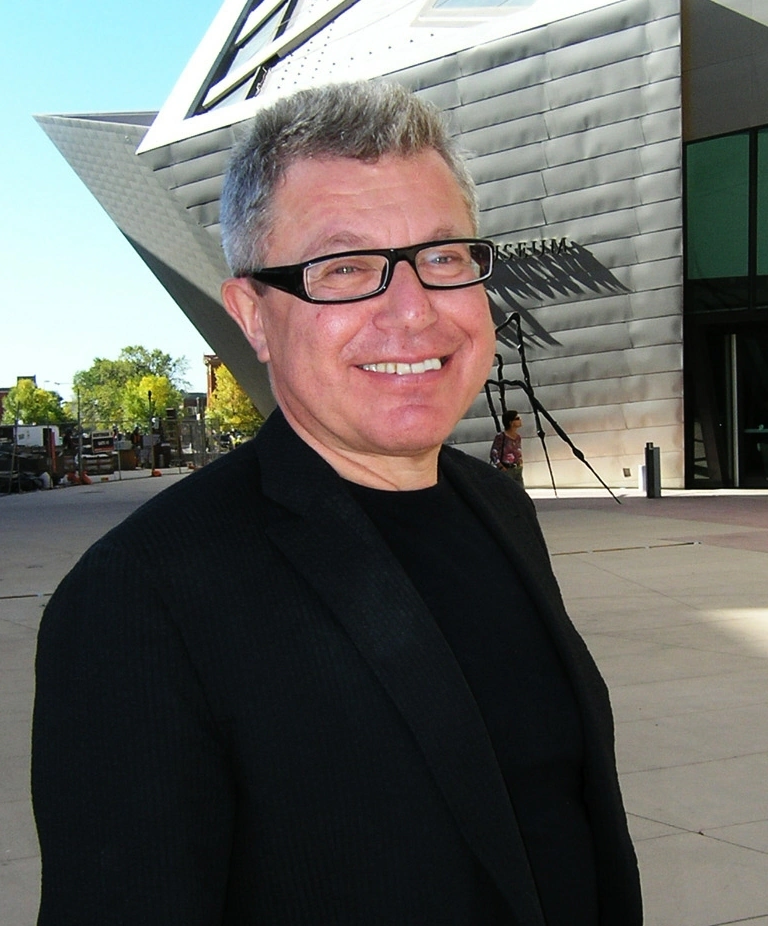
| 26 Quotes | |
| Occup. | Architect |
| From | Poland |
| Spouse | Nina Libeskind |
| Born | May 12, 1946 Łódź, Poland |
| Age | 79 years |
| Cite | |
Citation Formats
APA Style (7th ed.)
Daniel libeskind biography, facts and quotes. (2026, February 11). FixQuotes. https://fixquotes.com/authors/daniel-libeskind/
Chicago Style
"Daniel Libeskind biography, facts and quotes." FixQuotes. February 11, 2026. https://fixquotes.com/authors/daniel-libeskind/.
MLA Style (9th ed.)
"Daniel Libeskind biography, facts and quotes." FixQuotes, 11 Feb. 2026, https://fixquotes.com/authors/daniel-libeskind/. Accessed 27 Mar. 2026.
Early Life and Background
Daniel Libeskind was born on May 12, 1946, in Lodz, Poland, to Jewish parents who had survived the Holocaust. In the shadow of postwar ruin and the tightening grip of communist rule, his earliest world was marked by absence as much as by presence - a landscape where memory was political, and where the everyday carried the afterimage of catastrophe. That inherited history did not make him a nostalgic architect; it made him alert to what cities conceal, repress, and refuse to mourn.In 1957 his family left Poland for Israel, part of a broader postwar diaspora shaped by antisemitism, displacement, and new national projects. Tel Aviv and other Israeli cities offered a different register of modernity - urgent, improvisational, and contested - and the young Libeskind moved through them as someone learning how buildings can encode both refuge and unease. In 1965 the family emigrated again, this time to the United States, a move that placed him inside the promise and contradictions of American urban life while keeping him psychologically close to the condition of the outsider.
Education and Formative Influences
Libeskind initially trained not as an architect but as a musician, studying accordion and developing a disciplined sense of structure, rhythm, and counterpoint that would later surface in his spatial compositions. He studied architecture at The Cooper Union in New York (B.Arch., 1970) and pursued graduate work at the University of Essex in England. In those years, late modernism was being challenged by new theoretical languages - semiotics, deconstruction, and renewed attention to history - and Libeskind absorbed both the intellectual atmosphere and the disillusionment with technocratic planning that had hollowed out many postwar cities.Career, Major Works, and Turning Points
Before building major projects, Libeskind established himself through drawings, installations, and teaching, developing an architectural voice that treated line and fracture as arguments about history rather than style. His international breakthrough came with the Jewish Museum Berlin, won by competition in 1989 and opened in 2001, where voids, slashes of light, and disorienting routes made absence legible as space. The project repositioned him from paper architect to public figure, followed by works such as the Imperial War Museum North in Manchester (2002), the Denver Art Museum Hamilton Building (2006), the Michael Lee-Chin Crystal at the Royal Ontario Museum (2007), and master-planning roles including the World Trade Center site in New York after 2001, where politics, grief, and real estate collided in plain view.Philosophy, Style, and Themes
Libeskind is often grouped with deconstructivism, yet his best work is less about formal disruption than about ethical narration: architecture as a way to stage what a culture would prefer to smooth over. His buildings lean on sharp geometries, compressed passages, angled walls, and abrupt shifts in scale that make the body register instability - a physical analogue to historical fracture. He has argued that “To provide meaningful architecture is not to parody history but to articulate it”. That insistence distinguishes him from postmodern quotation: he does not decorate with the past, he interrogates it, often by designing routes where visitors must choose, hesitate, and feel the weight of what is missing.At the core of his inner life is a refusal to treat human beings as data points in a rational machine. “Life it is not just a series of calculations and a sum total of statistics, it's about experience, it's about participation, it is something more complex and more interesting than what is obvious”. This is why his memorial-inflected projects prioritize embodied encounter over detached viewing. In Berlin, he pushed the idea that a city can only move forward by facing its own void: “Only through acknowledgment of the erasure and void of Jewish life can the history of Berlin and Europe have a human future”. The line that runs through his work - from museum to master plan - is that modernity is not healed by erasing scars, but by giving them a civic, spatial language.
Legacy and Influence
Libeskind helped re-legitimize architecture as a medium of public memory at a time when globalization encouraged cities to market themselves through interchangeable icons. By translating trauma and migration into spatial experience, he widened the vocabulary of museums and memorial-adjacent civic buildings, influencing architects and curators grappling with contested histories. His career also illustrates the modern architect's predicament: celebrated for visionary form, yet forced to negotiate budgets, security, politics, and competing constituencies. If his work sometimes polarizes, that too is part of his impact - he made it harder to pretend that buildings are neutral, and easier to argue that the deepest structures a city must confront are psychological and historical as much as material.Our collection contains 26 quotes written by Daniel, under the main topics: Art - Meaning of Life - New Beginnings - Faith - Legacy & Remembrance.
Source / external links