
David Attenborough Biography Quotes 32 Report mistakes
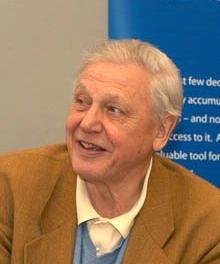
| 32 Quotes | |
| Occup. | Journalist |
| From | United Kingdom |
| Born | May 8, 1926 |
| Age | 99 years |
| Cite | |
Citation Formats
APA Style (7th ed.)
David attenborough biography, facts and quotes. (2026, February 11). FixQuotes. https://fixquotes.com/authors/david-attenborough/
Chicago Style
"David Attenborough biography, facts and quotes." FixQuotes. February 11, 2026. https://fixquotes.com/authors/david-attenborough/.
MLA Style (9th ed.)
"David Attenborough biography, facts and quotes." FixQuotes, 11 Feb. 2026, https://fixquotes.com/authors/david-attenborough/. Accessed 25 Mar. 2026.
Early Life and Background
David Frederick Attenborough was born on May 8, 1926, in Isleworth, Middlesex, and grew up in Leicester in a house where public service and curiosity were daily habits. His father, Frederick Attenborough, was principal of University College, Leicester, and his mother, Mary, sustained a busy, intellectual household that would include two brothers who also became prominent - Richard Attenborough in film and John Attenborough in business. From early childhood David collected fossils, stones, and specimens, ordering the natural world as if it were already a vocation.His boyhood was framed by the upheavals of the 1930s and World War II, and those pressures sharpened, rather than narrowed, his outward attention. Leicester took evacuees; the family helped host two Jewish girls who had fled Nazi Germany, bringing global politics into the domestic sphere. Attenborough did not retreat into private reverie so much as develop a calm, observant temperament: he learned to watch closely, record accurately, and treat living things as more than scenery - early roots of the moral seriousness that later distinguished his broadcasting.
Education and Formative Influences
After schooling at Wyggeston Grammar School for Boys, Attenborough served in the Royal Navy from 1945, an apprenticeship in discipline and logistics at the edge of empire. He then read Natural Sciences at Clare College, Cambridge, graduating in 1947, and deepened his zoological training with postgraduate work. Cambridge in the late 1940s was a crossroads of field biology and emerging media culture, and Attenborough absorbed both: the rigorous habits of classification and the conviction that knowledge could be made public without being cheapened.Career, Major Works, and Turning Points
Joining the BBC in 1952, he entered television when it was still experimental and intimate, learning to translate expertise into narrative. He became widely known through Zoo Quest (from 1954), in which travel, animals, and a quietly authoritative presenter made natural history a popular event, even as later decades would judge the era's collecting practices more critically. As controller of BBC Two (1965-1969) and then director of programmes for BBC Television (1969-1972), he helped shape modern broadcasting, commissioning ambitious work and backing innovations such as expanded color programming and landmark series. Returning to authorship on screen, he wrote and fronted the Life collection - Life on Earth (1979), The Living Planet (1984), The Trials of Life (1990) - followed by The Blue Planet (2001), Planet Earth (2006), and later climate-focused films and series including Blue Planet II (2017) and A Life on Our Planet (2020). The turning point was not fame but scale: he moved from showing nature as spectacle to showing it as a system under pressure, with human agency as the decisive force.Philosophy, Style, and Themes
Attenborough's style is built on patient looking, precise naming, and a narrator's restraint that trusts images and evidence. He speaks as a companion rather than a preacher, but the gentleness is strategic: it lowers defenses so the reality can land. Underneath is a temperament that prizes wonder as a gateway to responsibility - he returns again and again to the idea that emotional attachment is the precondition for protection. “People are not going to care about animal conservation unless they think that animals are worthwhile”. In psychological terms, he treats affection for the nonhuman world as something that can be cultivated, not assumed, and his films function as an education of attention.Over time, his work hardened into a civic argument without losing its lyrical core. He frames extinction not as an abstraction but as a theft from the future and an ethical breach committed in the present. “It's a moral question about whether we have the right to exterminate species”. He also resists apocalyptic performance, warning that alarmism can backfire: “Crying wolf is a real danger”. The tension between awe and urgency is central to his themes: he wants viewers to feel the world is miraculous enough to save, yet fragile enough to lose, and he positions human prosperity and wild biodiversity as intertwined rather than competing.
Legacy and Influence
Attenborough became the defining voice of natural history broadcasting, not simply by longevity but by setting a standard for how science, storytelling, and ethics can cohere on mass television. His influence runs through generations of filmmakers, biologists, and environmental communicators who borrow his method: start with beauty, proceed with evidence, end with agency. In an era when media often accelerates outrage, he modeled a slower authority - a public intellectual whose credibility came from field experience, institutional leadership at the BBC, and an evolving willingness to name the crisis. For many viewers in the United Kingdom and far beyond, his films did not merely show what exists; they shaped what seemed worth defending, making conservation part of popular moral imagination.Our collection contains 32 quotes written by David, under the main topics: Witty One-Liners - Ethics & Morality - Truth - Art - Nature.
David Attenborough Famous Works
- 2002 The Life of Mammals (Book)
- 2002 Life on Air (Book)
- 2001 The Blue Planet (Book)
- 1998 The Life of Birds (Book)
- 1963 Quest Under Capricorn (Book)
- 1961 Zoo Quest to Madagascar (Book)
- 1960 Quest in Paradise (Book)
- 1959 Zoo Quest in Paraguay (Book)
- 1957 Zoo Quest for a Dragon (Book)
- 1956 Zoo Quest to Guiana (Book)
Source / external links