
David Lloyd George Biography Quotes 15 Report mistakes
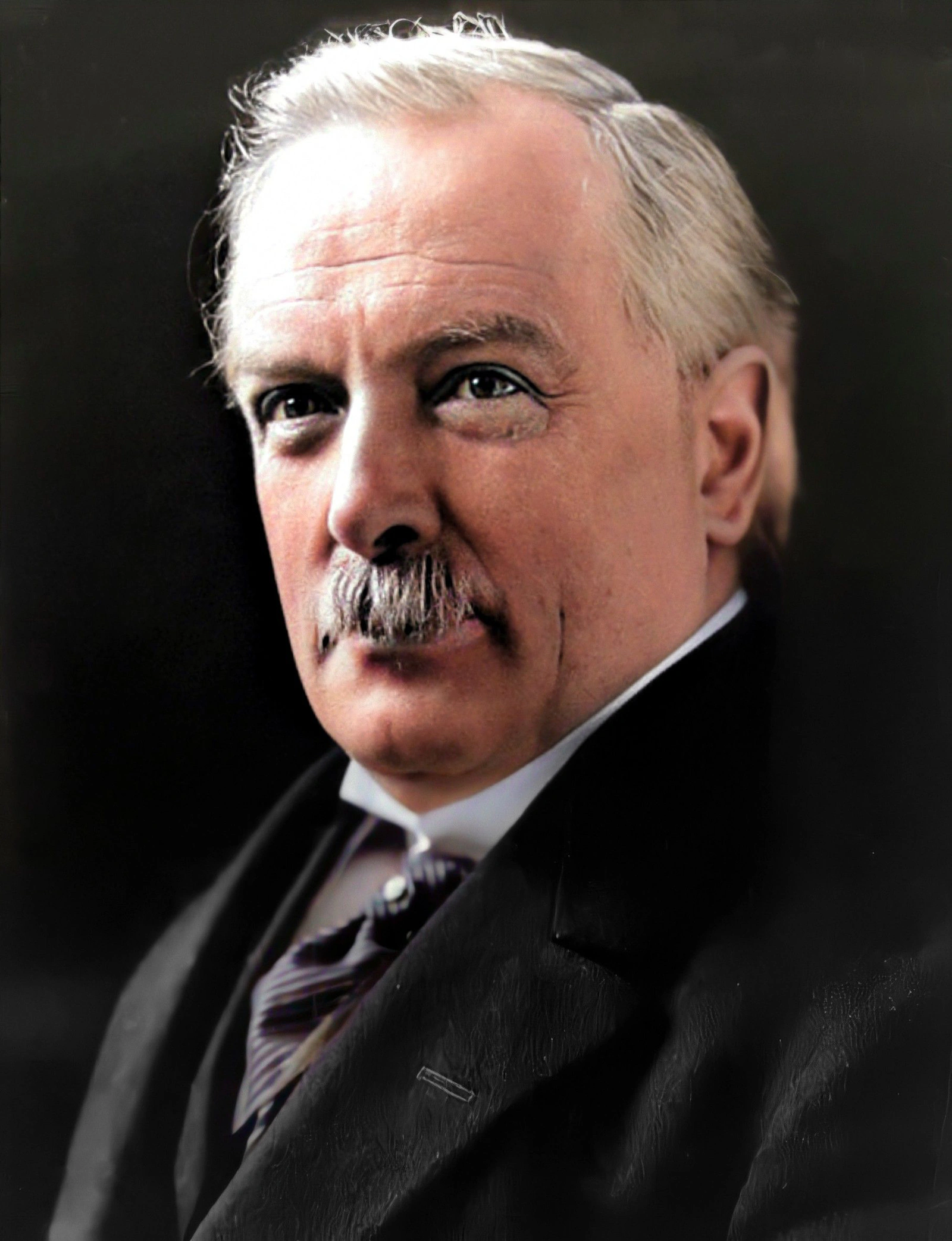
| 15 Quotes | |
| Occup. | Statesman |
| From | Welsh |
| Born | January 17, 1863 Manchester, England |
| Died | March 26, 1945 Tylorstown, Wales |
| Cause | Stroke |
| Aged | 82 years |
| Cite | |
Citation Formats
APA Style (7th ed.)
David lloyd george biography, facts and quotes. (2026, February 11). FixQuotes. https://fixquotes.com/authors/david-lloyd-george/
Chicago Style
"David Lloyd George biography, facts and quotes." FixQuotes. February 11, 2026. https://fixquotes.com/authors/david-lloyd-george/.
MLA Style (9th ed.)
"David Lloyd George biography, facts and quotes." FixQuotes, 11 Feb. 2026, https://fixquotes.com/authors/david-lloyd-george/. Accessed 26 Mar. 2026.
Early Life and Background
David Lloyd George was born on January 17, 1863, in Manchester, to Welsh parents, but his imagination and loyalties were formed in northwest Wales. After his schoolmaster father died when David was very young, his mother took him back to Llanystumdwy, Caernarfonshire, to the household of her brother, Richard Lloyd, a shoemaker and Baptist lay preacher. The boy grew up in a world where chapel, Welsh speech, and a deep suspicion of aristocratic power shaped daily life, and where political argument was a craft practiced at the hearth as much as in public halls.That upbringing mattered because Victorian Wales was a nation-in-waiting inside the United Kingdom: culturally cohesive, economically strained, and politically underrepresented. Lloyd George absorbed the grievances of tenant farmers, quarrymen, and Nonconformists against Anglican privilege and landlord dominance. He learned early that moral indignation could be organized into votes, and that eloquence in a small community could become a ladder into the imperial Parliament.
Education and Formative Influences
He had no university career; instead he educated himself through voracious reading, chapel debating, and a rigorous legal apprenticeship. He qualified as a solicitor in 1884, building a practice in Criccieth that brought him into fights over land, tithes, and local governance. The law taught him how power hid in procedure, and Nonconformity taught him that conscience could be a political weapon. Gladstonian Liberalism, Welsh nationalism, and the populist energies of the late Victorian public meeting fused in him into a style that was both prosecutorial and evangelical.Career, Major Works, and Turning Points
Elected Liberal MP for Caernarfon Boroughs in 1890, Lloyd George became a national figure as a radical backbencher, attacking the Boer War and the landed order with a ferocity that thrilled the chapels and alarmed London clubs. As President of the Board of Trade (1905) and then Chancellor of the Exchequer (1908-1915), he helped drive the "People's Budget" of 1909, a redistributive program that precipitated a constitutional crisis with the House of Lords and helped lead to the Parliament Act 1911. During World War I he moved from munitions (1915) to war secretary (1916) and then replaced H.H. Asquith as prime minister in December 1916, running a hard-driving coalition state to victory. At the Paris Peace Conference in 1919 he navigated between vengeance and stability, then dominated British politics until the Conservative withdrawal in 1922. His later years mixed prophecy and frustration: critic of postwar settlement, intermittent Liberal leader, marginal coalition-maker, and finally a peerage in 1945, weeks before his death on March 26, 1945, at Ty Newydd near Llanystumdwy.Philosophy, Style, and Themes
Lloyd George's inner life was an argument between tenderness and calculation, between chapel morality and the ruthless arithmetic of governing an empire at war. He believed politics existed to repair life, not merely to referee interests, and his social reforms came wrapped in a moral vocabulary of debt and duty. In the midst of total war, he could still articulate an almost pastoral standard for the state: “What is our task? To make Britain a fit country for heroes to live in”. The line is not only patriotic rhetoric; it reveals his instinct to translate abstract policy into a felt obligation toward ordinary families, an instinct that made old-age pensions, labor exchanges, and national insurance appear as instruments of national honor.His method was impatience disciplined into action. He distrusted slow, gentlemanly equilibrium and preferred concentrated executive energy, whether breaking the Lords, reorganizing munitions, or constructing a smaller "war cabinet". That temperament surfaces in his own maxim about risk and decision: “Don't be afraid to take a big step if one is indicated. You can't cross a chasm in two small jumps”. Yet the same urgency could shade into opportunism and improvisation, the habit of treating alliances as tools rather than loyalties. Even his skepticism about the rituals of statecraft was psychological self-portrait as much as epigram: “Diplomats were invented simply to waste time”. Behind the joke sits a leader who feared drift more than backlash, and who thought history punished hesitation.
Legacy and Influence
Lloyd George endures as the most consequential Welsh politician to govern Britain, a radical who proved that social reform could be fiscally engineered and electorally sustained, and a wartime premier who expanded the modern state while centralizing its power. His reforms helped lay groundwork for the later welfare settlement, even as his coalition tactics accelerated the Liberal Party's fragmentation and opened a clearer path for Labour. In memory he remains difficult by design: a moralist with a lawyer's pragmatism, a democrat who could relish manipulation, and a visionary who believed politics was justified only when it changed daily life.Our collection contains 15 quotes written by David, under the main topics: Witty One-Liners - Motivational - Leadership - Freedom - War.
Other people related to David: Arthur Henderson (Politician), Roy Hattersley (Statesman), John Grigg (Writer), John Edward Redmond (Politician), Augustine Birrell (Author), Henry Campbell-Bannerman (Politician), King Edward VIII (Royalty), Joseph Chamberlain (Politician), C. P. Scott (Journalist), Edward Marsh (Editor)