
David Ogilvy Biography Quotes 48 Report mistakes
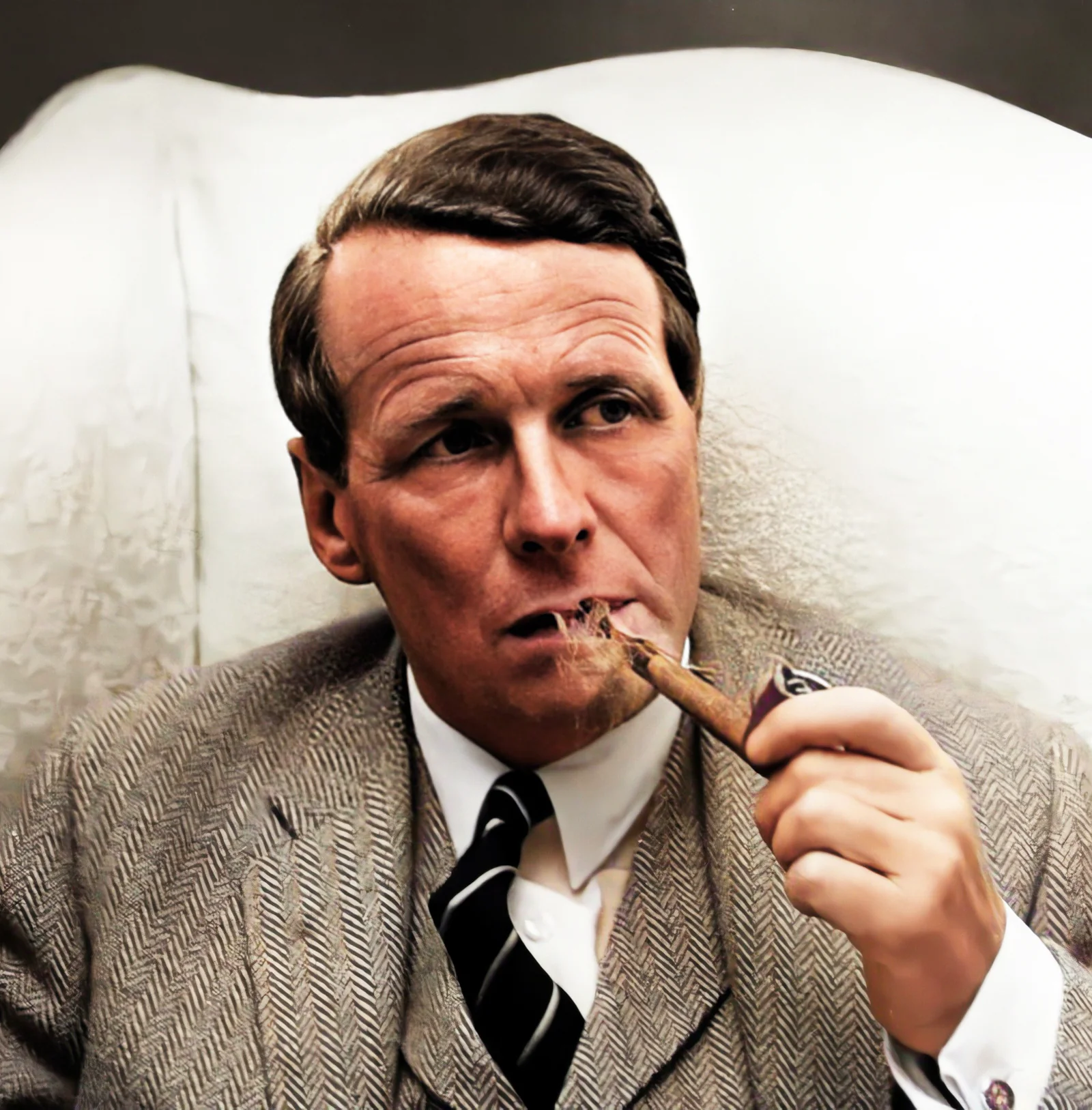
| 48 Quotes | |
| Born as | David Mackenzie Ogilvy |
| Occup. | Businessman |
| From | England |
| Born | June 23, 1911 West Horsley, Surrey in England |
| Died | July 21, 1999 |
| Aged | 88 years |
| Cite | |
Citation Formats
APA Style (7th ed.)
David ogilvy biography, facts and quotes. (2026, February 11). FixQuotes. https://fixquotes.com/authors/david-ogilvy/
Chicago Style
"David Ogilvy biography, facts and quotes." FixQuotes. February 11, 2026. https://fixquotes.com/authors/david-ogilvy/.
MLA Style (9th ed.)
"David Ogilvy biography, facts and quotes." FixQuotes, 11 Feb. 2026, https://fixquotes.com/authors/david-ogilvy/. Accessed 26 Mar. 2026.
Early Life and Background
David Mackenzie Ogilvy was born on 1911-06-23 in England, into the anxious afterglow of Edwardian confidence and the sharper realities that followed World War I. His father, Francis John Longley Ogilvy, worked in finance and later as an investment banker; his mother, Dorothy Blew Jones, was of Irish and English background and gave him an upbringing that mixed manners with pressure. The family shifted between comfort and constraint as money tightened, a pattern that left Ogilvy with a lifelong sensitivity to status, performance, and the fear of waste.That early tension shaped his inner life: a boy trained to sound confident while privately measuring himself against older institutions and richer peers. He learned to treat work as a kind of self-invention and to treat reputation as capital. This psychological drive - to compensate, to prove, to build an edifice sturdy enough to quiet insecurity - later became the engine of his leadership style and his insistence that advertising be accountable to results, not applause.
Education and Formative Influences
Ogilvy attended Fettes College in Edinburgh, then went to Christ Church, Oxford, without completing a degree, a rupture that mattered because it forced him into the modern world without the shield of credentials. He trained briefly as a chef at the Hotel Majestic in Paris, then sold Aga cookers door-to-door in Scotland, where he wrote his famous sales manual for the company - an early sign of his gift for turning practical experience into doctrine. In the 1930s he crossed the Atlantic, worked with George Gallup's Audience Research Institute, and absorbed the era's new faith in sampling, measurement, and mass persuasion - the empirical backbone he later fused with bravura copywriting.Career, Major Works, and Turning Points
During World War II he worked in intelligence and information roles tied to British and Allied propaganda, then tried an interlude as a farmer in Pennsylvania before returning to the arena that suited him: persuasion with consequences. In 1948 he co-founded the New York agency Hewitt, Ogilvy, Benson and Mather, which soon became Ogilvy & Mather, and he built it into a global network by selling not just ads but a philosophy of disciplined creativity. Landmark campaigns followed: Hathaway shirts with the eye patch, Schweppes (and its patrician spokesman Commander Edward Whitehead), Rolls-Royce ("At 60 miles an hour the loudest noise in this new Rolls-Royce comes from the electric clock"), and Dove, which he positioned around real skin benefits rather than fantasy. His books - Confessions of an Advertising Man (1963) and Ogilvy on Advertising (1983) - codified his methods and turned him into the closest thing the business had to a public intellectual, even as he later retreated to the Chateau de Touffou in France and watched the industry he helped professionalize become more fragmented.Philosophy, Style, and Themes
Ogilvy's central psychological preoccupation was legitimacy: he wanted advertising to be respected like engineering, not dismissed as hucksterism. That hunger for seriousness produced his signature blend of courtly tone and hard-nosed accountability. He argued that the consumer is not a fool but a spouse to be honored, and he framed ethics as strategy as much as conscience: “Never write an advertisement which you wouldn't want your family to read. You wouldn't tell lies to your own wife. Don't tell them to mine”. Beneath the gentlemanly phrasing is a revealing self-image - the ad man as host at the table, responsible for what he serves.His style prized clarity, information, and proof, a reaction against empty cleverness and a confession of what he feared most: irrelevance. “If it doesn't sell, it isn't creative”. That sentence compresses his worldview into a moral test: persuasion must cash out in behavior, not in awards, and the writer must submit ego to outcomes. Yet he was not anti-imagination; he was anti-frivolity, insisting that imagination be harnessed to product truth and testing. Leadership, too, became a form of self-protection - a way to ensure the institution outlasted the founder's moods - and he famously urged a kind of purposeful humility: “If each of us hires people who are smaller than we are, we shall become a company of dwarfs. But if each of us hires people who are bigger than we are, we shall become a company of giants”. It is both management advice and autobiography: a man haunted by insecurity building a system that defeats insecurity by recruiting excellence.
Legacy and Influence
Ogilvy died on 1999-07-21, leaving behind an agency network, a canon of copy, and a professional identity for advertising that still shapes how brands talk: research-informed positioning, long-copy clarity when warranted, the discipline of testing, and the belief that reputation follows rigor. He helped turn the mid-century "Madison Avenue" moment into an exportable craft, training generations of planners, account leaders, and writers to defend ideas with evidence and to treat the audience with adult respect. Even in an age of algorithms, his enduring influence is the same provocation he lived by: make persuasion measurable, make claims defensible, and let creativity be judged by what it changes in the world.Our collection contains 48 quotes written by David, under the main topics: Witty One-Liners - Motivational - Funny - Writing - Leadership.
Other people related to David: Rosser Reeves (Businessman), Fairfax Cone (Businessman)
David Ogilvy Famous Works
- 2017 Ogilvy on Advertising in the Digital Age (Book)
- 1983 Ogilvy on Advertising (Book)
- 1963 Confessions of an Advertising Man (Book)
Source / external links