
Democritus Biography Quotes 19 Report mistakes
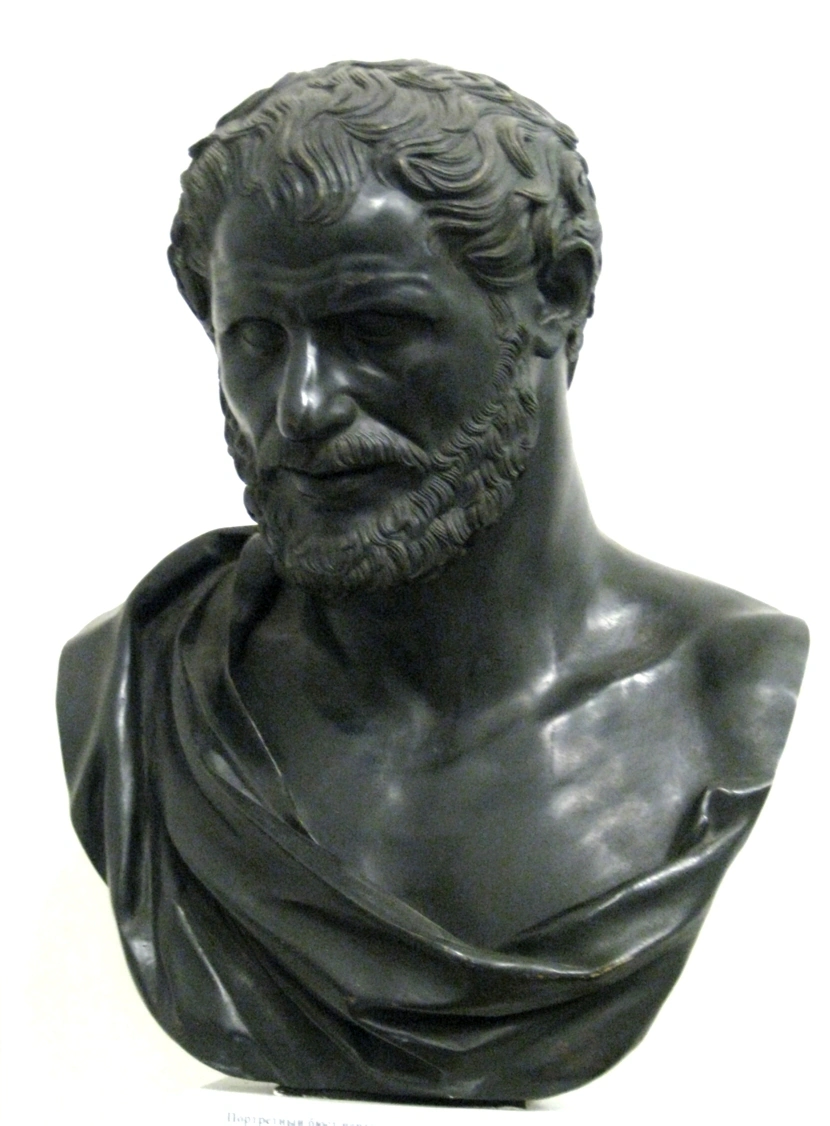
| 19 Quotes | |
| Occup. | Philosopher |
| From | Greece |
| Born | 460 BC Abdera, Greece |
| Died | 370 BC Abdera, Greece |
| Cite | |
Citation Formats
APA Style (7th ed.)
Democritus biography, facts and quotes. (2026, February 11). FixQuotes. https://fixquotes.com/authors/democritus/
Chicago Style
"Democritus biography, facts and quotes." FixQuotes. February 11, 2026. https://fixquotes.com/authors/democritus/.
MLA Style (9th ed.)
"Democritus biography, facts and quotes." FixQuotes, 11 Feb. 2026, https://fixquotes.com/authors/democritus/. Accessed 5 Mar. 2026.
Early Life and Background
Democritus was born around 460 BCE in Abdera, a Thracian coastal city in the Greek world that other Greeks caricatured as provincial. The stereotype mattered: it sharpened the contrast between Abdera's comic reputation and the intellectual audacity of the man later nicknamed the "laughing philosopher". He grew up during the long afterglow of the Persian Wars and the tightening rivalry between Athens and Sparta, when Greek cities were rich in argument, anxious about power, and increasingly confident that nature could be explained without appealing to myth.Ancient reports about his family are colored by legend, but they agree on two essentials: he had access to resources and he used them to buy time for thought. He is often said to have spent an inheritance on travel and study rather than public ambition, a choice that fits his later moral psychology - independence from status, suspicion of crowd opinion, and a preference for the quiet authority of reasons over the noisy authority of rank.
Education and Formative Influences
Democritus belongs to the Ionian line of natural philosophers, and the most reliable intellectual link is Leucippus, with whom he developed atomism. He absorbed the era's central tensions: the Eleatic challenge that change is illusory, the Pythagorean fascination with number and form, and the medical habit of explaining visible symptoms by invisible causes. Traditions place him traveling widely - to Egypt, perhaps to the Near East - but what is historically secure is the breadth of his curiosity and the way he treated "foreign" learning as data rather than revelation, folding it into a program to describe nature in general terms.Career, Major Works, and Turning Points
He wrote prolifically across physics, ethics, mathematics, and the arts, though nearly everything survives only in fragments and later testimony. His major achievement was the systematic articulation of atomism: reality consists of indivisible atoms moving in the void, differing in shape and arrangement, producing worlds through collisions and interlockings without divine design. In a century when teleological stories were common and the polis demanded civic certainty, his turning point was to make explanation impersonal and scalable - from sensation to cosmology - while also treating ethics as a science of steadiness. His fame traveled through adversaries as much as disciples: Plato reportedly disliked him, Aristotle argued with him constantly, and later Epicureans treated him as a foundational precursor.Philosophy, Style, and Themes
Democritus' inner life, as glimpsed through fragments, is a discipline of cheerfulness built on hard-eyed realism. He distrusted prestige and even conquest because they were poor currencies for truth: “I would rather discover one true cause than gain the kingdom of Persia”. That sentence is not merely a boast about intellect; it reveals a temperament that experienced explanation as liberation. In his physics, causes are mechanical and sufficient; in his ethics, the same hunger for clear causes becomes a demand to diagnose the mind's turbulence - envy, greed, fear - as patterns that can be changed.His moral vocabulary centers on euthymia, a durable good spirit grounded in measure and self-command. Happiness, for him, is not a prize society hands out but a stable condition one cultivates: “Happiness resides not in posessions and not in gold; the feeling of happiness dwells in the soul”. This interiorization is not withdrawal but strategy: if atoms and void explain nature, then the mind must learn to live with contingency. Hence his ethic of self-correction over rivalry - “It is better to destroy one's own errors than those of others”. - a line that reads like a psychological rule for an age of public disputation, turning the competitive impulse inward where it can become improvement rather than faction.
Legacy and Influence
Democritus became one of antiquity's decisive templates for naturalistic explanation: a world of lawlike processes, minimal metaphysical furniture, and courage before chance. Even filtered through opponents, his atomism shaped Epicurus and, through Epicureanism, later Roman thought (most famously Lucretius) and the early modern revival of corpuscular philosophy that helped nourish modern science. His ethical fragments endured as a counterweight to triumphal politics - insisting that the best life is built from understanding, moderation, and self-knowledge - while his image as the philosopher who laughed at human pretension kept reminding later ages that clarity can be both rigorous and humane.Our collection contains 19 quotes written by Democritus, under the main topics: Ethics & Morality - Wisdom - Truth - Parenting - Honesty & Integrity.
Other people related to Democritus: Parmedides (Philosopher)
Source / external links