
Dennis Rodman Biography Quotes 51 Report mistakes
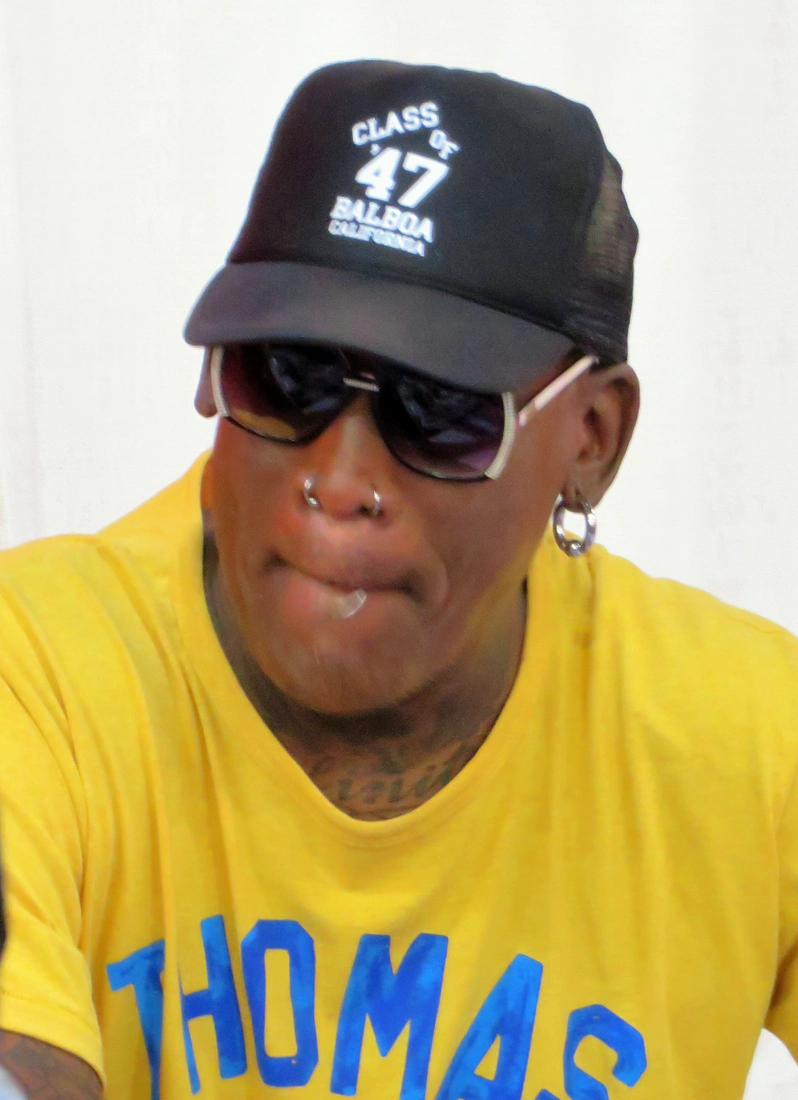
Attr: GabboT, CC BY-SA 2.0
| 51 Quotes | |
| Born as | Dennis Keith Rodman |
| Occup. | Athlete |
| From | USA |
| Born | May 13, 1961 Trenton, New Jersey, United States |
| Age | 64 years |
| Cite | |
Citation Formats
APA Style (7th ed.)
Dennis rodman biography, facts and quotes. (2026, February 14). FixQuotes. https://fixquotes.com/authors/dennis-rodman/
Chicago Style
"Dennis Rodman biography, facts and quotes." FixQuotes. February 14, 2026. https://fixquotes.com/authors/dennis-rodman/.
MLA Style (9th ed.)
"Dennis Rodman biography, facts and quotes." FixQuotes, 14 Feb. 2026, https://fixquotes.com/authors/dennis-rodman/. Accessed 6 Mar. 2026.
Early Life and Background
Dennis Keith Rodman was born on May 13, 1961, in Trenton, New Jersey, and grew up largely in Dallas, Texas, in a household defined by absence and strain. His father, Philander Rodman, drifted out of the family and later lived for stretches abroad; Rodman has described the lingering impact as equal parts anger and hunger for recognition. Raised primarily by his mother, Shirley, he experienced the grinding insecurity of working-class life and the social volatility of American cities in the 1970s, when masculinity, race, and status were policed daily in schools, neighborhoods, and locker rooms.
As a teenager, Rodman was not a prodigy and not even, by conventional measures, an athlete to watch. Friends and teachers remembered him more for a restless personality than a dominant jump shot; he worked odd jobs after high school, including at Dallas-Fort Worth International Airport, and carried a sense of being overlooked that would later harden into a public persona. The emotional throughline of his early years was simple: he learned to survive by becoming unforgettable.
Education and Formative Influences
Rodman took an unconventional route through higher education, first at Cooke County College in Gainesville, Texas, and then at Southeastern Oklahoma State University, where he developed late and rapidly as a rebounder and defender. In a small-school ecosystem far from national spotlight, he discovered that effort could be a skill and that chaos could be organized into advantage - sprinting for loose balls, studying angles off the rim, and turning conditioning into a kind of private religion. The 1980s college scene, increasingly televised and commercial, also taught him how attention works: stars score, but winners need someone willing to do the unglamorous math.
Career, Major Works, and Turning Points
Drafted by the Detroit Pistons in 1986, Rodman became a defining figure of the late-1980s NBA: physical, antagonistic, and tactically brilliant within the "Bad Boys" culture under Chuck Daly. He won NBA championships with Detroit (1989, 1990) and later remade himself with the San Antonio Spurs and then the Chicago Bulls, where alongside Michael Jordan and Scottie Pippen he helped anchor a second three-peat (1996-1998). A two-time Defensive Player of the Year and seven-time rebounding champion, he was less a traditional "star" than a specialist who bent games to his will by controlling possessions. Turning points were rarely purely athletic: conflicts with coaches, fines, suspensions, and tabloid spectacle - from neon hair to public relationships and a brief foray into pro wrestling - turned his career into a running argument about freedom, self-destruction, and performance.
Philosophy, Style, and Themes
Rodman's on-court style was an ethic: sacrifice disguised as disruption. He treated defense and rebounding as crafts, building an identity on being willing to absorb what others avoided, and he narrated that willingness with startling candor: “I go out there and get my eyes gouged, my nose busted, my body slammed. I love the pain of the game”. Read psychologically, this is not mere bravado but a coping strategy - converting vulnerability into control by choosing the terms of suffering. Rebounding, especially, became his language of belonging: if he could not always be the most celebrated, he would be the most necessary.
Off the court, Rodman made himself a billboard for contradiction, challenging the era's rigid scripts about masculinity, sexuality, and authenticity in sports entertainment. “I'll be the judge of my own manliness”. functions like a manifesto - a refusal to let media, opponents, or even teammates define him, and a clue to why he oscillated between defiance and neediness. He also framed the sports world as a moral theater with selective rules: “There is so much hypocrisy in sports”. That skepticism fit the 1990s, when the NBA globalized, celebrity culture intensified, and athletes were increasingly expected to be both corporate ambassadors and raw competitors; Rodman responded by leaning into the rawness and daring institutions to punish him for being exactly what they profited from.
Legacy and Influence
Rodman endures as a prototype for the modern specialist-celebrity: a player whose value was measurable in possessions and psychological pressure, yet whose cultural impact spilled far beyond the box score. He helped legitimize defense, rebounding, and positional versatility as championship engines, influencing how teams scout role players and how stars appreciate connective labor. At the same time, his public self-fashioning - flamboyant, volatile, sometimes self-sabotaging - foreshadowed a media age in which athletes narrate their own identities in real time. Rodman is remembered not simply as a Hall of Fame rebounder, but as a reminder that greatness can be built from refusal: refusal to conform, refusal to disappear, and refusal to let anyone else write the story.
Our collection contains 51 quotes written by Dennis, under the main topics: Witty One-Liners - Funny - Music - Mortality - Sarcastic.
Other people related to Dennis: Isaiah Thomas (Athlete), Carmen Electra (Actress), Bill Laimbeer (Coach)