
Desiderius Erasmus Biography Quotes 44 Report mistakes
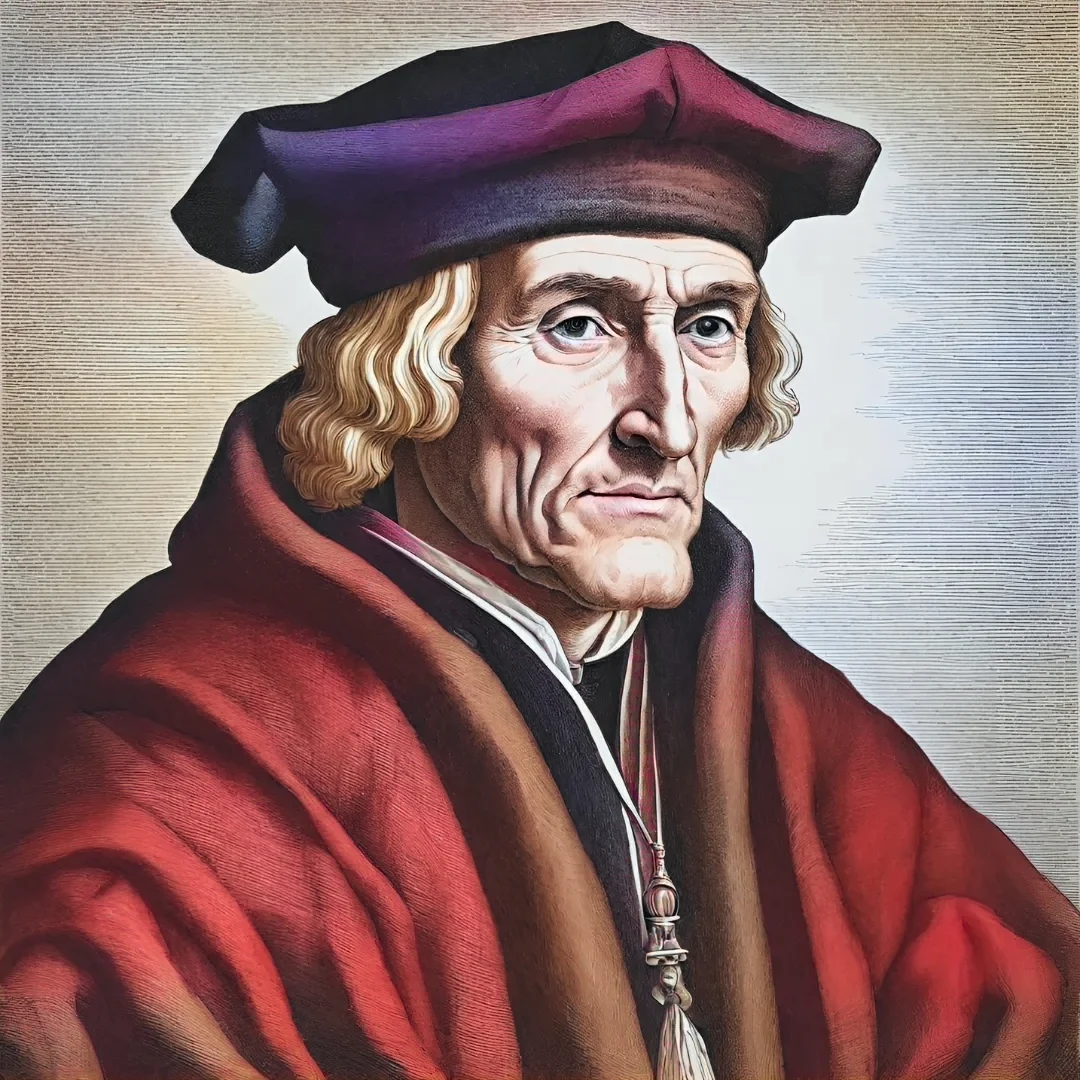
| 44 Quotes | |
| Born as | Erasmus of Rotterdam |
| Occup. | Philosopher |
| From | Netherland |
| Born | October 26, 1466 Rotterdam, County of Holland, Duchy of Burgundy |
| Died | July 12, 1536 Basel, Old Swiss Confederacy |
| Aged | 69 years |
| Cite | |
Citation Formats
APA Style (7th ed.)
Desiderius erasmus biography, facts and quotes. (2026, February 2). FixQuotes. https://fixquotes.com/authors/desiderius-erasmus/
Chicago Style
"Desiderius Erasmus biography, facts and quotes." FixQuotes. February 2, 2026. https://fixquotes.com/authors/desiderius-erasmus/.
MLA Style (9th ed.)
"Desiderius Erasmus biography, facts and quotes." FixQuotes, 2 Feb. 2026, https://fixquotes.com/authors/desiderius-erasmus/. Accessed 27 Mar. 2026.
Early Life and Background
Desiderius Erasmus was born in Rotterdam in the Burgundian Netherlands on October 26, 1466, the illegitimate son of a priest, Gerard, and a physician's daughter, Margaretha Rogerius. The stigma of his birth and the precariousness of late-medieval urban life shaped his early psychology: he learned to mistrust fixed statuses and to prize mobility, reputation, and the portable wealth of learning. Rotterdam was no capital of letters, yet it sat within a mercantile, multilingual corridor where Latin could be a passport and satire a weapon.Orphaned while still young, Erasmus absorbed loss as a discipline. Guardians steered him toward clerical life, less out of vocation than necessity, and he experienced the institutional church first as shelter and then as constraint. The era was thick with reformist murmurs, new print culture, and devotio moderna piety that emphasized inward faith over ritual display. In that atmosphere Erasmus developed a characteristic tension - sincerely religious, impatient with cant - and a lifelong desire to remain free of binding patronage, local faction, or monastic routine.
Education and Formative Influences
He attended the school of the Brethren of the Common Life at Deventer, where disciplined Latin, moral seriousness, and a bookish spirituality trained him to see education as ethical formation. Pressured into the Augustinian canons at Steyn near Gouda, he was ordained in 1492, but the monastery mainly sharpened his hunger for the wider republic of letters. Released to serve as secretary to the Bishop of Cambrai, he moved through Paris, England, the Low Countries, Italy, and Basel, forming friendships with John Colet, Thomas More, and leading printers. Classical humanism, Italian philology, and the practical reformism of northern piety fused into a program: restore Christian life by restoring texts.Career, Major Works, and Turning Points
Erasmus became Europe's best-known Christian humanist by using print as both pulpit and laboratory. Early successes such as the Adagia (from 1500) made him a curator of classical wisdom; the Enchiridion militis Christiani (1503) urged an interior, moral Christianity; and In Praise of Folly (1511), dedicated to More, turned irony against clerical vanity and scholastic hair-splitting. His most consequential act was scholarly: the 1516 Novum Instrumentum, a Greek New Testament with a fresh Latin translation and annotations, which redirected biblical study toward philology and sources and unsettled inherited authority. When Luther's revolt broke in 1517, Erasmus was claimed by reformers and feared by traditionalists; he chose a middle path and, in 1524-1525, argued against Luther in De libero arbitrio and Hyperaspistes, defending a moderated view of free will. In later years he lived largely in Basel and Freiburg, working with Johann Froben's press, revising editions, and trying to keep intellectual space open amid confessional hardening, until he died in Basel on July 12, 1536.Philosophy, Style, and Themes
Erasmus' philosophy was less a system than a moral method: return to sources (ad fontes), use eloquence to clarify conscience, and treat learning as a form of spiritual hygiene. He distrusted coercion and preferred reform by education, persuasion, and example. His confidence in pedagogy appears in the maxim “Give light, and the darkness will disappear of itself”. It is not naive optimism so much as a strategy for surviving an age in which power punished dissent - by making critique look like instruction, and instruction look like piety. Yet beneath the calm surface lay a nerve for danger: he knew how easily language becomes a tool of domination, and how survival can tempt a scholar into tact and omission.His style - urbane, epigrammatic, and relentlessly readable - is inseparable from his inner life: a man who sought peace but could not stop dissecting folly. He loved the scalpel of the proverb, using repetition and variation to train habits of mind. The line “A nail is driven out by another nail. Habit is overcome by habit”. captures his practical psychology: vice is not exorcised by rage but displaced by disciplined routines, better reading, better speech. At times his candor about rhetoric turns almost bleak: “A good portion of speaking will consist in knowing how to lie”. In Erasmus this is less a celebration of deceit than a diagnosis of public life - courts, pulpits, universities - where half-truth and diplomatic phrasing can be the price of keeping a reforming project alive.
Legacy and Influence
Erasmus left an enduring template for the modern intellectual: cosmopolitan, text-centered, skeptical of fanaticism, and committed to critique without schism. His editions of Church Fathers, his Greek New Testament, and his insistence that moral renewal begins with education helped define northern Renaissance humanism and provided tools used by both Catholic reformers and Protestant theologians. Later generations have argued over his caution during the Reformation, but his deeper legacy is the idea that scholarship can be a form of conscience - that philology, satire, and ethical pedagogy can challenge power while refusing the intoxication of violence. In that sense Erasmus remains a patron saint of the uneasy middle: rigorous, devout, ironic, and stubbornly committed to light over heat.Our collection contains 44 quotes written by Desiderius, under the main topics: Witty One-Liners - Motivational - Ethics & Morality - Truth - Wisdom.
Other people related to Desiderius: John Skelton (Poet)
Frequently Asked Questions
- Desiderius Erasmus fun Facts: Erasmus never wished to break away from the Catholic Church, despite his criticisms. His reluctance to choose a side in the Protestant Reformation earned him friends and enemies on both sides.
- Desiderius Erasmus beliefs: Erasmus believed in the power of education, religious tolerance, and returning to the original texts of Scripture to understand Christian doctrine better.
- Desiderius Erasmus significance: His ideas on religious tolerance and reform were foundational to the development of modern humanism and education.
- Desiderius Erasmus famous for: Erasmus is famous for his works on Christian humanism and criticism of church practices which influenced the Protestant Reformation.
- What did Desiderius Erasmus do: Erasmus was a philosopher and theologian known for his scholarly writings and critical approaches to both religious and educational reform.
- Desiderius Erasmus Accomplishments: Erasmus was a leading scholar of the Northern Renaissance, significantly contributed to humanism, and developed a critical Greek edition of the New Testament.
- Desiderius Erasmus famous works: In Praise of Folly, Adagia, and Education of a Christian Prince.
- How old was Desiderius Erasmus? He became 69 years old
Desiderius Erasmus Famous Works
- 1530 On Civility in Children (Book)
- 1524 On Free Will (Book)
- 1516 The Education of a Christian Prince (Book)
- 1511 The Praise of Folly (Book)
- 1503 Handbook of a Christian Knight (Book)
- 1500 Adagia (Book)
Source / external links