
Desmond Morris Biography Quotes 8 Report mistakes
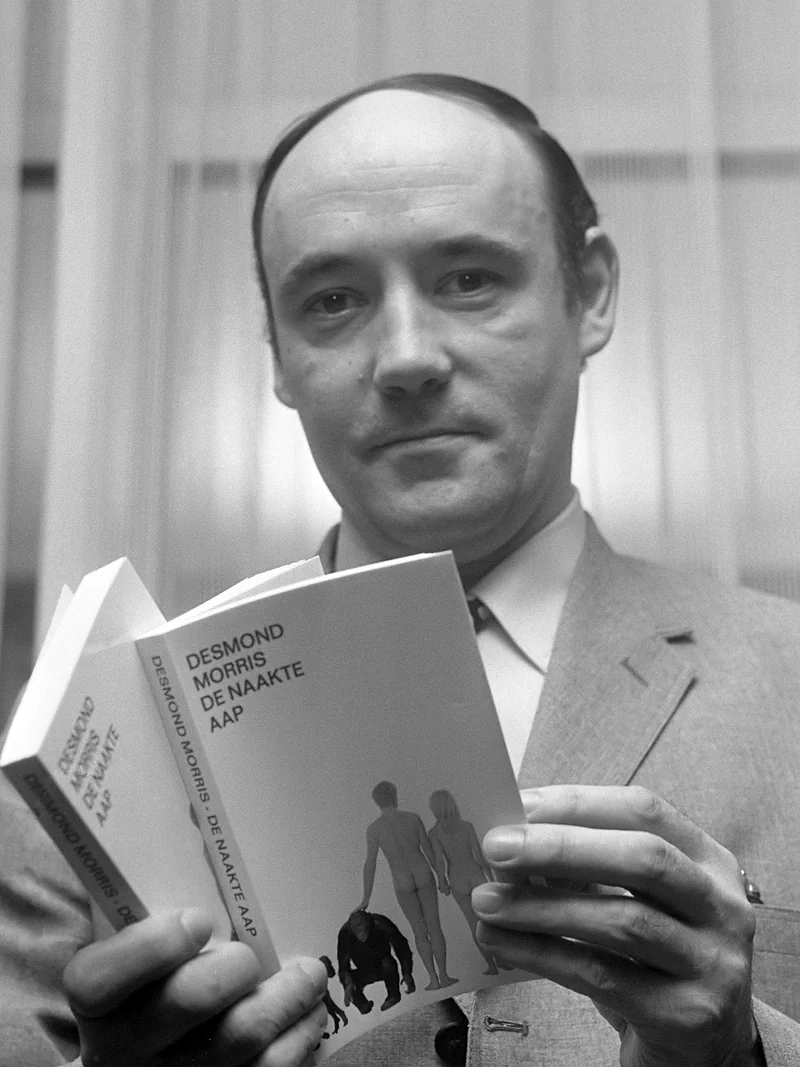
| 8 Quotes | |
| Occup. | Scientist |
| From | England |
| Born | January 24, 1928 |
| Age | 98 years |
| Cite | |
Citation Formats
APA Style (7th ed.)
Desmond morris biography, facts and quotes. (2026, February 11). FixQuotes. https://fixquotes.com/authors/desmond-morris/
Chicago Style
"Desmond Morris biography, facts and quotes." FixQuotes. February 11, 2026. https://fixquotes.com/authors/desmond-morris/.
MLA Style (9th ed.)
"Desmond Morris biography, facts and quotes." FixQuotes, 11 Feb. 2026, https://fixquotes.com/authors/desmond-morris/. Accessed 22 Mar. 2026.
Early Life and Background
Desmond John Morris was born on January 24, 1928, in Purton, Wiltshire, England, into a country still shadowed by the First World War and soon to be reshaped by the second. His boyhood unfolded amid rationing, blackouts, and the cultural leveling of wartime Britain, experiences that sharpened his attention to how environment scripts behavior. The rural edge of Wiltshire offered him a living field site: birds, insects, and mammals were not abstractions but daily presences, and the young Morris learned to watch first and explain later.That habit of patient observation became his private discipline. Even before he had a public voice, he displayed a double allegiance that would define his life - to art as a way of seeing and to biology as a way of testing what is seen. In an England rebuilding itself through science, industry, and new mass media, Morris developed an instinct for translation: turning specialist knowledge into images and stories that ordinary people could grasp without feeling talked down to.
Education and Formative Influences
Morris studied zoology at the University of Birmingham, where postwar British biology was being energized by ethology and evolutionary thinking, and he trained his eye on animal behavior with the rigor of a laboratory scientist. He later completed a PhD at Oxford, working in an academic culture that prized careful description of behavior and comparative method - how one species illuminates another. Alongside formal training he pursued painting seriously, and that parallel education mattered: it honed his sense of gesture, posture, and the expressive meaning of bodies in space, skills that would later let him read human social life with an anatomist's precision and an artist's sensitivity.Career, Major Works, and Turning Points
Morris built his early career in animal behavior and public communication, directing the mammal house at London Zoo in the 1950s and 1960s and becoming a familiar media presence through television, notably on programs such as Zoo Time. His decisive turning point came in 1967 with The Naked Ape, a provocative, best-selling synthesis that recast modern humans as one primate species among others and brought ethological thinking into popular debate about sex, aggression, status, and culture. He followed with The Human Zoo (1969), arguing that many urban stresses reflect a mismatch between ancient social instincts and dense modern living, and later expanded his catalog with works on body language, intimacy, and observation, including Manwatching (1977) and Bodywatching (1985). Across decades he occupied a rare role: a scientist who wrote for mass audiences without surrendering the comparative framework of biology, even as critics challenged him for occasional overreach, gender generalizations, and the risks of extrapolating from evolutionary narratives to contemporary society.Philosophy, Style, and Themes
Morris's governing idea was that human beings are best understood neither as purely cultural inventions nor as fallen creatures needing metaphysical rescue, but as animals whose symbolic lives are built on older behavioral foundations. He framed this in a deliberately bracing formulation: “I viewed my fellow man not as a fallen angel, but as a risen ape”. Psychologically, the line functions as self-positioning - a refusal of romantic exceptionalism and a pledge to look at people with the same cool attention he gave zoo specimens, including himself. His prose style mirrors that stance: brisk, comparative, rich in examples, and tilted toward visual detail, as though every argument must be something you can picture.That same realism drives his most quoted urban metaphor: “The city is not a concrete jungle, it is a human zoo”. He used it not as a sneer at city life but as a diagnosis of enclosure - the idea that crowding, anonymity, and constant social comparison can distort primate needs for stable groups, territory, and ritualized contact. Underneath is a skeptical view of self-knowledge: “This unusual and highly successful species spends a great deal of time examining his higher motives and an equal amount of time ignoring his fundamental ones”. The sentence captures Morris at his most characteristic - amused, unsparing, and intent on dragging the unconscious into daylight. It also reveals the inner engine of his work: a compulsion to puncture comforting stories with biological first principles, while still treating curiosity, play, and social performance as the very forces that made the "risen ape" capable of art, science, and compassion.
Legacy and Influence
Morris helped set the template for modern popular ethology and evolutionary anthropology writing: confident, image-driven, and willing to connect everyday behavior to deep time. The Naked Ape and The Human Zoo became cultural reference points in late-20th-century debates about nature and nurture, influencing broadcasters, science writers, and later generations of evolutionary psychologists and behavioral ecologists, even when they argued against his conclusions. His lasting impact lies less in any single hypothesis than in a method and a mood: watch closely, compare across species, distrust flattering myths, and treat human behavior as a legible record of both ancient instincts and contemporary constraints.Our collection contains 8 quotes written by Desmond, under the main topics: Witty One-Liners - Wisdom - Mortality - Deep - Family.
Desmond Morris Famous Works
- 1994 The Human Animal (Book)
- 1977 Manwatching: A Field Guide to Human Behaviour (Non-fiction)
- 1969 The Human Zoo (Non-fiction)
- 1967 The Naked Ape (Non-fiction)