
Dick Cheney Biography Quotes 45 Report mistakes
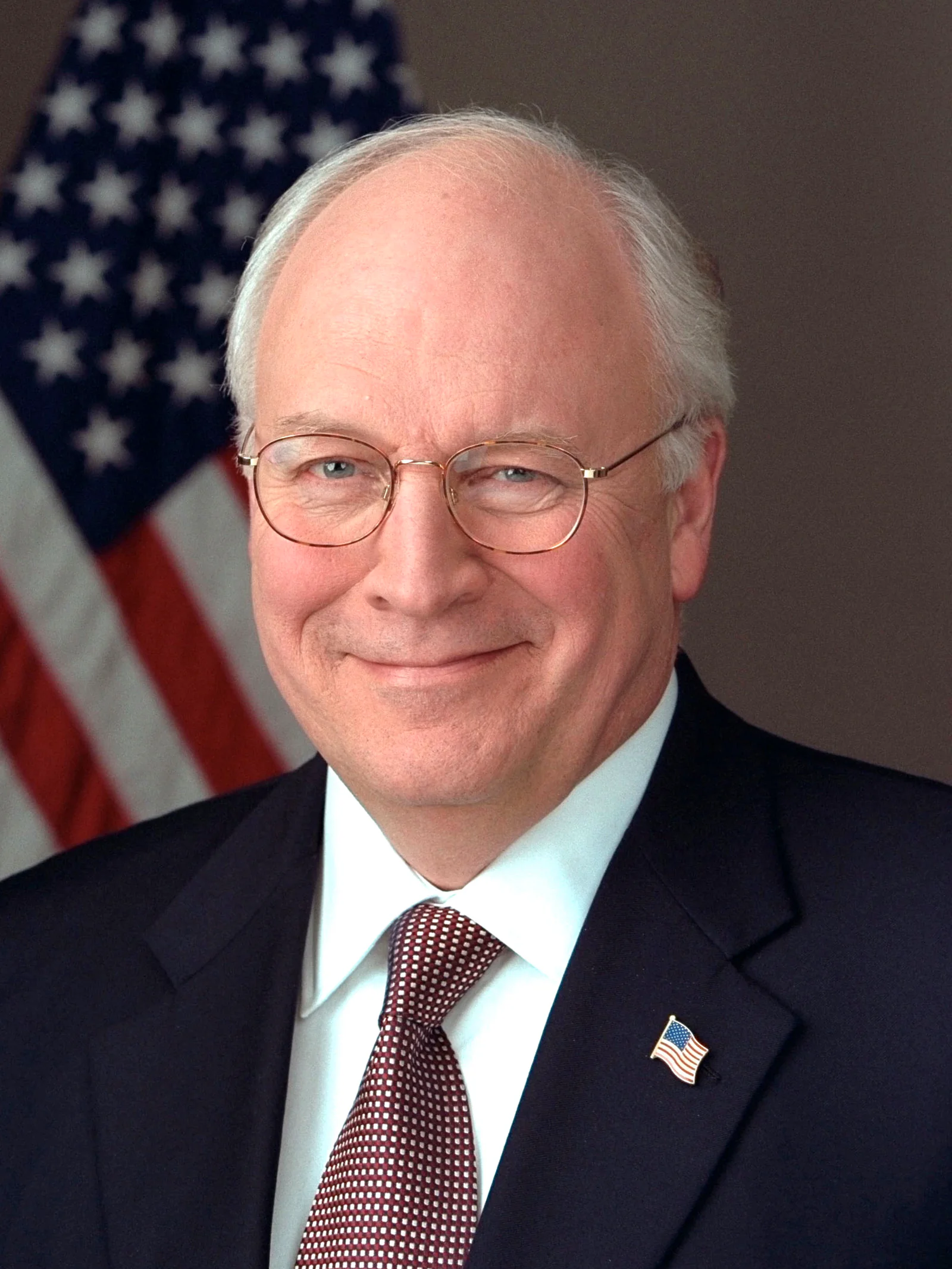
Attr: U.S. Air Force
| 45 Quotes | |
| Born as | Richard Bruce Cheney |
| Known as | Richard B. Cheney |
| Occup. | Vice President |
| From | USA |
| Spouse | Lynne Vincent (1964) |
| Born | January 30, 1941 Lincoln, Nebraska, United States |
| Died | November 3, 2025 Northern Virginia, USA |
| Aged | 84 years |
| Cite | |
Citation Formats
APA Style (7th ed.)
Dick cheney biography, facts and quotes. (2026, February 11). FixQuotes. https://fixquotes.com/authors/dick-cheney/
Chicago Style
"Dick Cheney biography, facts and quotes." FixQuotes. February 11, 2026. https://fixquotes.com/authors/dick-cheney/.
MLA Style (9th ed.)
"Dick Cheney biography, facts and quotes." FixQuotes, 11 Feb. 2026, https://fixquotes.com/authors/dick-cheney/. Accessed 5 Mar. 2026.
Early Life and Background
Richard Bruce Cheney was born on January 30, 1941, in Lincoln, Nebraska, into a country mobilized by World War II and soon defined by the Cold War. His family moved west to Casper, Wyoming, the sparse, energy-linked landscape that later supplied Cheney with a durable political identity: small-state pragmatism paired with national-security hawkishness. The son of Marjorie and Richard Cheney, he grew up in a culture that prized self-reliance, order, and civic obligation - values he would later channel into a career spent close to institutional power rather than retail politics.Cheney's early adulthood was marked by restlessness and a consequential pivot. He had brushes with the law for drunken driving, episodes he later described as a wake-up call. His marriage to Lynne Vincent in 1964 proved stabilizing and intellectually catalytic; she became a lifelong partner in ambition and discipline. In a generation that watched the Vietnam War fracture trust in government, Cheney moved in the opposite direction, gravitating toward the machinery of governance and the protective logic of state power.
Education and Formative Influences
Cheney attended Yale but left, later earning a BA and MA from the University of Wyoming. His decisive apprenticeship began in Washington during the Nixon and Ford years under Donald Rumsfeld, where Cheney learned that proximity to decision-making mattered more than public charisma. The era's shocks - Vietnam, Watergate, stagflation - nurtured his suspicion of bureaucratic drift and his preference for tight chains of command, executive flexibility, and contingency planning under pressure.Career, Major Works, and Turning Points
Elected to the US House from Wyoming in 1978, Cheney built a reputation as a conservative institutionalist and rose to House Republican leadership. Under President George H.W. Bush he served as secretary of defense (1989-1993), managing the endgame of the Cold War and the 1991 Gulf War while supporting a force posture designed for rapid deployment and technological dominance. After leaving government he became CEO of Halliburton (1995-2000), deepening ties to the energy sector and the post-Cold War globalization of extraction and contracting. As vice president under George W. Bush (2001-2009), he became an unusually influential operator - shaping staffing, legal theory, and national-security priorities after September 11, 2001 - and a central figure in the run-up to the Iraq War, the expansion of surveillance, and the approval of harsh interrogation policies. In later years he defended those choices publicly while managing chronic heart disease that culminated in a 2012 heart transplant; he died on November 3, 2025.Philosophy, Style, and Themes
Cheney's governing philosophy fused executive-branch assertiveness with an engineer's attention to systems: who holds authority, how information moves, and what latitude leaders keep in crisis. He viewed the presidency as an office of unrelenting contingency - “I've worked for four presidents and watched two others up close, and I know that there's no such thing as a routine day in the Oval Office”. That sensibility encouraged anticipatory governance: planning for worst cases, tightening decision loops, and privileging speed over broad consensus. It also helps explain why he prized personnel control and institutional loyalty, arguing, “You got to have people at the top who respond to and are selected by presidents”. In Cheney's psychology, competence and discipline were moral categories; dissent was tolerable, but fragmentation in a crisis looked like weakness.The signature theme of his public career was the post-9/11 conviction that traditional restraints were inadequate. He framed terrorism as borderless and existential, and he repeatedly defended exceptional responses: “I'm absolutely convinced that the threat we face now, the idea of a terrorist in the middle of one of our cities with a nuclear weapon, is very real and that we have to use extraordinary measures to deal with it”.
Our collection contains 45 quotes written by Dick, under the main topics: Witty One-Liners - Dark Humor - Leadership - Freedom - Learning.
Other people related to Dick: Sam Nunn (Politician), Adam Clymer (Journalist), Jane Mayer (Journalist), Marc Racicot (Politician), Bradley A. Blakeman (Businessman), Ahmed Chalabi (Statesman), Alberto Gonzales (Public Servant), Lynne Cheney (Author), Dennis Kucinich (Politician), Douglas Feith (Public Servant)
Frequently Asked Questions
- Dick Cheney hunting accident: In 2006 he accidentally shot Harry Whittington during a quail hunt in Texas; Whittington survived.
- Dick Cheney young: Born in Nebraska and raised in Wyoming; entered politics after attending Yale and graduating from the University of Wyoming.
- What is Dick Cheney known for: Serving as U.S. Vice President (2001–2009) and influencing post-9/11 national security policy; previously Secretary of Defense.
- Dick Cheney movie: He is the subject of the 2018 film "Vice" (played by Christian Bale).
- What is Dick Cheney net worth? Estimates vary; many sources place it in the tens of millions of dollars.
- How old was Dick Cheney? He became 84 years old
Source / external links