
Donald Knuth Biography Quotes 15 Report mistakes
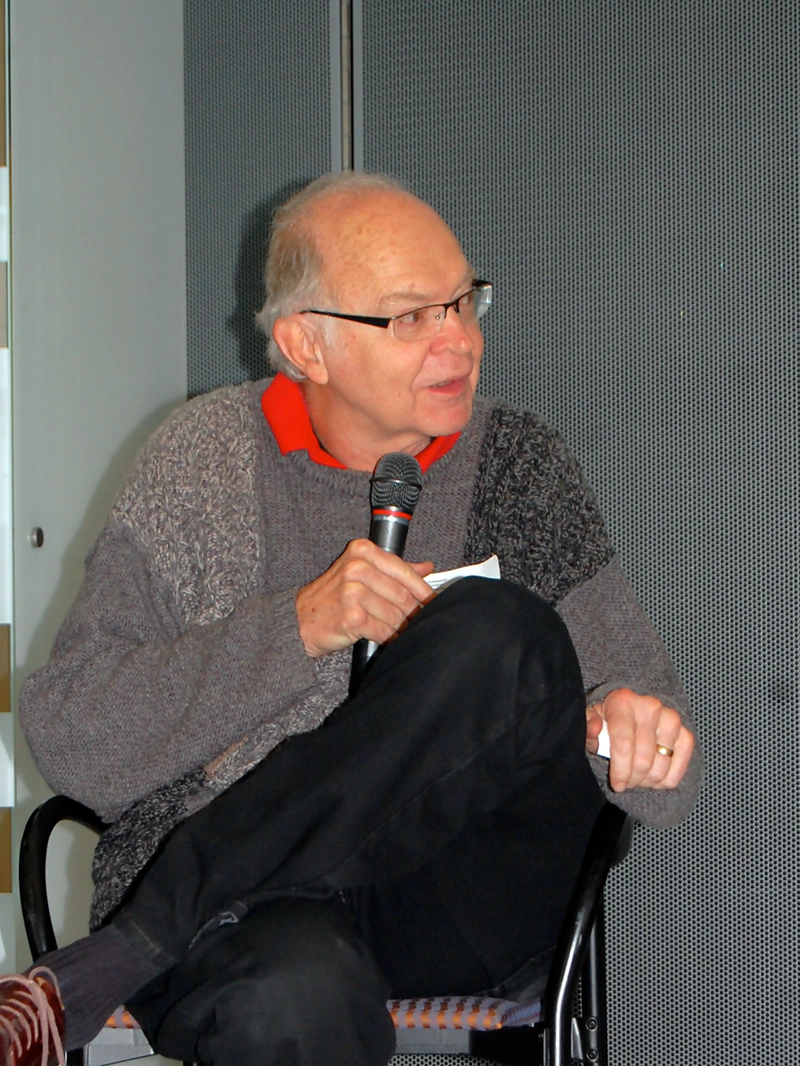
| 15 Quotes | |
| Born as | Donald Ervin Knuth |
| Known as | D. E. Knuth; Don Knuth |
| Occup. | Scientist |
| From | USA |
| Born | January 10, 1938 Milwaukee, Wisconsin, United States |
| Age | 88 years |
| Cite | |
Citation Formats
APA Style (7th ed.)
Donald knuth biography, facts and quotes. (2026, February 11). FixQuotes. https://fixquotes.com/authors/donald-knuth/
Chicago Style
"Donald Knuth biography, facts and quotes." FixQuotes. February 11, 2026. https://fixquotes.com/authors/donald-knuth/.
MLA Style (9th ed.)
"Donald Knuth biography, facts and quotes." FixQuotes, 11 Feb. 2026, https://fixquotes.com/authors/donald-knuth/. Accessed 5 Mar. 2026.
Early Life and Background
Donald Ervin Knuth was born on January 10, 1938, in Milwaukee, Wisconsin, into a middle-class, German-American household shaped by music, craft, and the practical ethic of Midwestern schooling. His father, Ervin Henry Knuth, taught printing and played organ; the household rhythm mixed disciplined technique with a love of pattern and performance, an atmosphere that later made it natural for Knuth to treat symbols, notation, and typography as moral as well as technical choices. The United States of his childhood was entering a postwar boom in industry and education, while the earliest digital machines were still rare institutional artifacts - distant from daily life but close enough in cultural aura to make "computation" feel like a new frontier.As a teenager, Knuth displayed the peculiar blend that would define him: competitive problem-solving married to meticulous aesthetic standards. At Milwaukee Lutheran High School he excelled in mathematics and found himself drawn to puzzles and systematic thinking. Even before he encountered academic computer science as a field, he was already living in the mindset of one: reduce a messy situation to its essential structure, then insist that the structure be made explicit, checkable, and beautiful.
Education and Formative Influences
Knuth attended the Case Institute of Technology in Cleveland (now part of Case Western Reserve University), earning a B.S. in 1960 and an M.S. in 1961; he then completed a Ph.D. in mathematics at the California Institute of Technology in 1963. Case exposed him to early computing in a hands-on way, including the IBM 650 era of constrained memory and expensive machine time - conditions that rewarded clarity, economy, and proofs of correctness. At Caltech he absorbed a mathematician's respect for rigorous argument while working on topics related to compilers and algorithms, and he began to see that programming was not merely "applied math" but a new kind of literate craft with its own standards, history, and pedagogy.Career, Major Works, and Turning Points
After teaching at Caltech, Knuth joined Stanford University in 1968, where he became a central architect of theoretical computer science as it professionalized in the United States. His defining project began as a textbook but grew into a lifelong enterprise: The Art of Computer Programming (vol. 1 in 1968; subsequent volumes over decades), a synthesis of algorithms, analysis, and disciplined exposition that set a gold standard for technical writing. Turning points followed from his intolerance for sloppiness: frustration with poor typesetting in the second edition drove him to create TeX (late 1970s) and later METAFONT, transforming scientific publishing by giving authors precise control over mathematical typography. He also helped formalize algorithmic analysis, popularized literate programming (notably in the 1980s), and modeled an unusual relationship with his audience through famously detailed "bug reports" and reward checks, treating scholarship as a conversation conducted in public and under strict standards.Philosophy, Style, and Themes
Knuth's inner life as a scientist is marked by a continuous tension between proof and experience, between what can be shown and what must be tested in the stubborn world of machines. His dry humor often hides a serious epistemology: “Beware of bugs in the above code; I have only proved it correct, not tried it”. The sentence is not just a joke about programmers; it reveals a mind that treats computation as an encounter between formal logic and fallible reality, where certainty must be earned twice - once in the symbolic realm, and again in execution. That dual demand shaped his style: definitions are explicit, assumptions are named, and examples are not decorative but diagnostic, designed to expose where an argument might break.At the same time, Knuth resisted the anxious temperament of the engineer who cannot stop tuning. “If you optimize everything, you will always be unhappy”. The remark reads like self-discipline as much as advice: an insistence that human attention is the scarce resource, and that elegance includes knowing what not to perfect. His aesthetic is ultimately integrative, refusing to separate technical mastery from expressive form: “Science is what we understand well enough to explain to a computer. Art is everything else we do”. In Knuth's work, that boundary is a creative engine - algorithms must be precise enough for automation, yet the act of communicating them (through notation, typography, and narrative structure) remains an art that demands taste, patience, and moral seriousness about clarity.
Legacy and Influence
Knuth's enduring influence lies less in any single theorem than in the culture of exactness he helped install: that algorithms are a literature to be read closely, analyzed, and taught with historical memory; that programs deserve explanation as much as execution; and that tools like TeX can elevate the entire ecosystem of knowledge by making precision easy to publish. The Art of Computer Programming remains a canonical reference for generations of researchers, while TeX became an invisible infrastructure of modern science, from preprints to textbooks. In an era that increasingly prizes speed, Knuth stands as a counterexample - a scientist who made slowness, verification, and beautiful exposition into a form of progress, and whose standards continue to shape how computer science defines rigor, taste, and intellectual honesty.Our collection contains 15 quotes written by Donald, under the main topics: Witty One-Liners - Work Ethic - Science - God - Teamwork.
Other people related to Donald: Martin Gardner (Mathematician)
Donald Knuth Famous Works
- 2023 The Art of Computer Programming, Volume 4B: Combinatorial Algorithms, Part 2 (Book)
- 2013 3:16 Bible Texts Illuminated (Non-fiction)
- 2011 The Art of Computer Programming, Volume 4A: Combinatorial Algorithms, Part 1 (Book)
- 2005 Selected Papers on Fun and Games (Collection)
- 2000 Selected Papers on Analysis of Algorithms (Collection)
- 1999 Digital Typography (Collection)
- 1996 Selected Papers on Computer Science (Collection)
- 1992 Literate Programming (Book)
- 1989 Concrete Mathematics: A Foundation for Computer Science (Book)
- 1986 METAFONT: The Program (Book)
- 1986 The METAFONTbook (Book)
- 1986 TeX: The Program (Book)
- 1984 The TeXbook (Book)
- 1974 Surreal Numbers: How Two Ex-Students Turned on to Pure Mathematics and Found Total Happiness (Book)
- 1973 The Art of Computer Programming, Volume 3: Sorting and Searching (Book)
- 1969 The Art of Computer Programming, Volume 2: Seminumerical Algorithms (Book)
- 1968 The Art of Computer Programming, Volume 1: Fundamental Algorithms (Book)