
Donald Rumsfeld Biography Quotes 59 Report mistakes
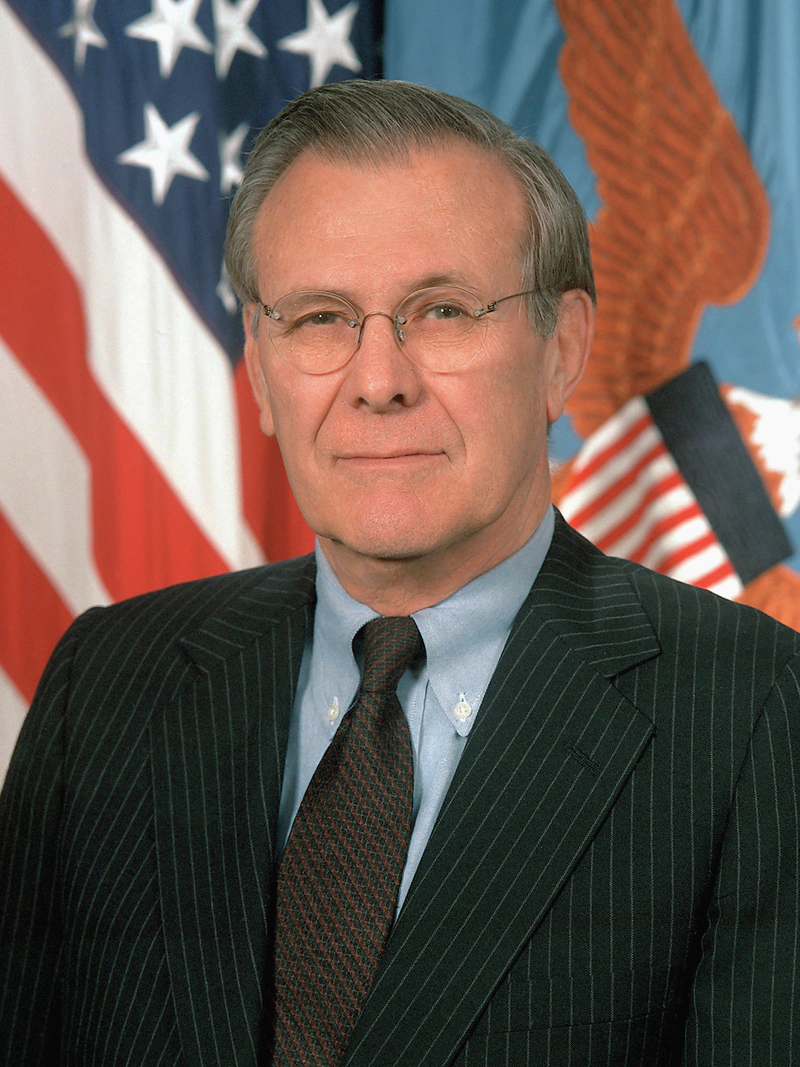
| 59 Quotes | |
| Born as | Donald Henry Rumsfeld |
| Occup. | Politician |
| From | USA |
| Born | July 9, 1932 Chicago, Illinois, USA |
| Died | June 29, 2021 Taos, New Mexico, USA |
| Aged | 88 years |
| Cite | |
Citation Formats
APA Style (7th ed.)
Donald rumsfeld biography, facts and quotes. (2026, February 11). FixQuotes. https://fixquotes.com/authors/donald-rumsfeld/
Chicago Style
"Donald Rumsfeld biography, facts and quotes." FixQuotes. February 11, 2026. https://fixquotes.com/authors/donald-rumsfeld/.
MLA Style (9th ed.)
"Donald Rumsfeld biography, facts and quotes." FixQuotes, 11 Feb. 2026, https://fixquotes.com/authors/donald-rumsfeld/. Accessed 5 Mar. 2026.
Early Life and Background
Donald Henry Rumsfeld was born on July 9, 1932, in Evanston, Illinois, into a middle-class Midwestern milieu shaped by the Depression and then by wartime mobilization. He grew up in Winnetka, a North Shore suburb where civic obligation and competitive striving were social currencies. The early United States that formed him prized managerial competence, anti-communist vigilance, and the belief that institutions could be mastered by disciplined men. Rumsfeld absorbed that ethic early: the confidence that problems yield to organization, and that leadership is a craft learned in teams.That confidence always carried an undertow of impatience. Friends and colleagues later described a person who moved quickly, tested loyalties, and treated ambiguity as something to be boxed and labeled. It was not that he ignored uncertainty; it was that he wanted to dominate it through method, routines, and constant evaluation. The habits of his youth - sports, community expectations, the ordered life of suburbia - helped create a temperament that equated decisiveness with responsibility, and delay with drift.
Education and Formative Influences
Rumsfeld attended Princeton University, graduating in 1954, and joined the U.S. Navy as a naval aviator, flying and serving in anti-submarine warfare roles during the early Cold War. Princeton sharpened his taste for argument and hierarchy; the Navy added the practical language of chains of command, readiness, and after-action critique. Those experiences formed his lifelong preference for concise briefings, measurable performance, and a suspicion of bureaucracies that, in his view, could turn caution into paralysis.Career, Major Works, and Turning Points
After entering politics in Illinois, Rumsfeld won a seat in the U.S. House of Representatives in the 1960s, then moved into national executive power under Presidents Richard Nixon and Gerald Ford, serving in senior White House roles and as U.S. ambassador to NATO. Ford made him one of the youngest Secretaries of Defense (1975-1977), where he confronted post-Vietnam retrenchment and the search for a sustainable deterrent posture against the Soviet Union. After a period in the private sector - notably at G.D. Searle and other corporate leadership posts - he returned as Secretary of Defense under President George W. Bush (2001-2006), becoming the central civilian architect and public face of the Pentagon after September 11. The Afghanistan campaign and especially the 2003 invasion of Iraq became the defining turning points of his legacy: swift conventional victory followed by a grinding insurgency, controversy over intelligence on weapons of mass destruction, and fierce debates over detainee policy and military force structure. He resigned in 2006, then reframed his record in memoir and public commentary while the wars he helped launch continued to shape U.S. politics and civil-military relations.Philosophy, Style, and Themes
Rumsfelds inner life revolved around control - not as domination for its own sake, but as an attempt to reduce strategic chaos to actionable categories. His famous taxonomy of uncertainty, delivered with a managers cadence, was less a joke than a worldview: “There are known knowns. These are things we know that we know. There are known unknowns. That is to say, there are things that we know we don't know. But there are also unknown unknowns. There are things we don't know we don't know”. Psychologically, it reveals a mind that could tolerate ambiguity only by naming it, then treating naming as the first step toward mastery. This habit made him rhetorically agile and intellectually bracing, but it also risked turning deep uncertainty into a checklist, inviting overconfidence when the labels felt complete.His leadership ethic was relentlessly procedural and performance-driven. “Be precise. A lack of precision is dangerous when the margin of error is small”. That line captures both his strength and his vulnerability: precision can discipline institutions, yet it can also narrow attention to what can be counted and briefed, even when reality refuses the frame. He believed government should be staffed like an elite unit, arguing, “Your performance depends on your people. Select the best, train them and back them. When errors occur, give sharper guidance. If errors persist or if the fit feels wrong, help them move on. The country cannot afford amateur hour in the White House”. In practice, this produced a hard-edged culture of loyalty, speed, and accountability - admired by some as a corrective to drift, condemned by others as fostering insularity and punishing dissent at moments when dissent might have clarified costs.
Legacy and Influence
Rumsfeld died on June 29, 2021, leaving a legacy inseparable from the post-9/11 transformation of U.S. national security: emphasis on rapid, networked operations; aggressive counterterrorism; and a management style that treated government like a high-pressure executive suite. Admirers credit him with pushing military modernization and forcing institutions to adapt; critics argue he underestimated occupation dynamics, empowered a culture that blurred lines on detention and interrogation, and helped normalize a politics of permanent emergency. Either way, his enduring influence is real: in the vocabulary leaders use to discuss uncertainty, in the expectation that defense secretaries must be strategists and reformers, and in the cautionary lessons policymakers still draw from Iraq about the limits of precision, speed, and managerial certainty in the face of human, political war.Our collection contains 59 quotes written by Donald, under the main topics: Witty One-Liners - Motivational - Ethics & Morality - Wisdom - Leadership.
Other people related to Donald: Dick Cheney (Vice President), Errol Morris (Director), Douglas Feith (Public Servant), Ahmed Chalabi (Statesman), Phil Crane (Politician), John Yoo (Educator), Steve Carell (Actor), Tommy Franks (Soldier), Jim Saxton (Politician), Seymour Hersh (Journalist)