
Dorie Miller Biography Quotes 1 Report mistakes
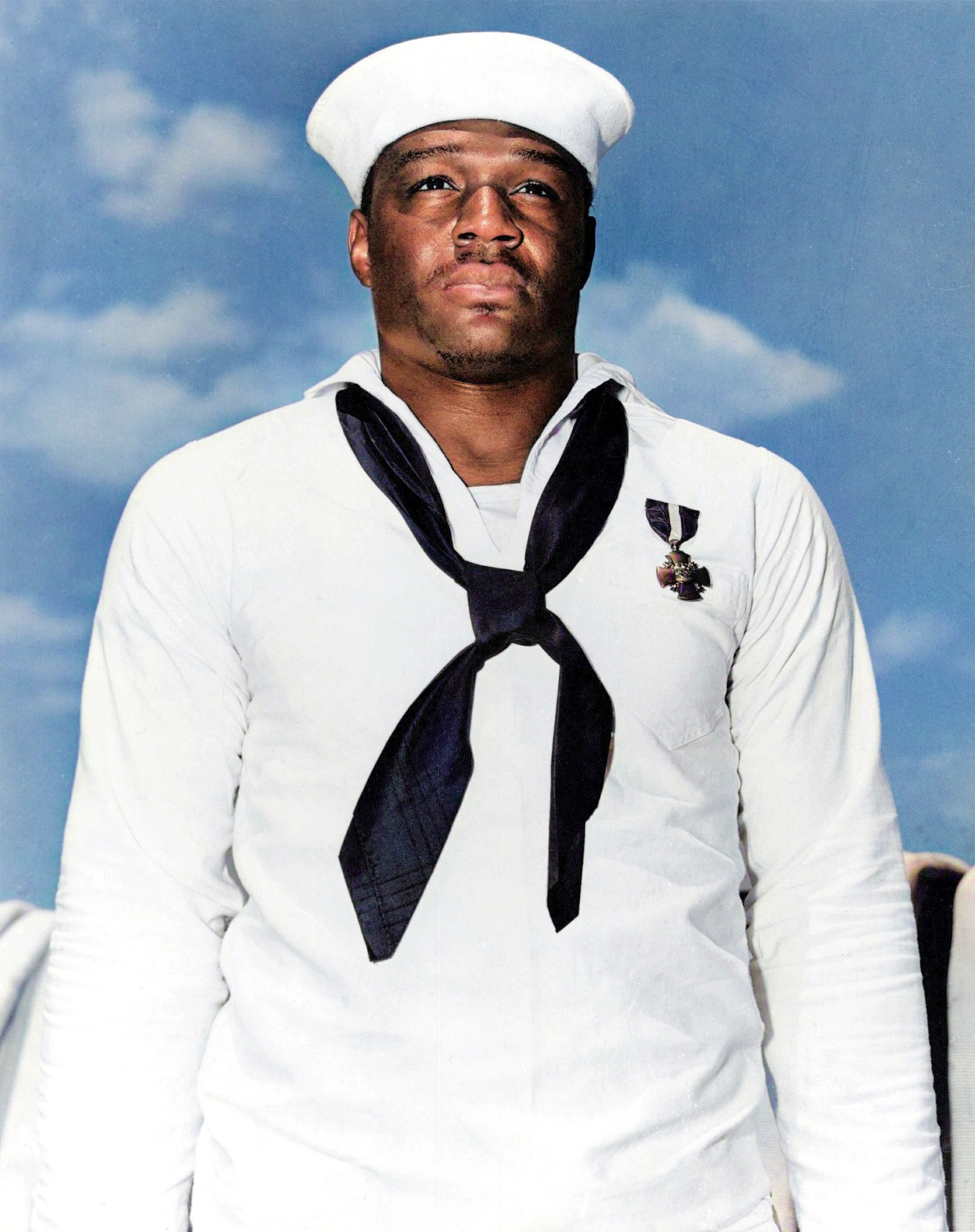
| 1 Quotes | |
| Occup. | Celebrity |
| From | USA |
| Born | October 12, 1919 Waco, Texas, USA |
| Died | November 24, 1943 USS Liscome Bay, off Makin Atoll, Gilbert and Ellice Islands |
| Aged | 24 years |
| Cite | |
Citation Formats
APA Style (7th ed.)
Dorie miller biography, facts and quotes. (2026, February 11). FixQuotes. https://fixquotes.com/authors/dorie-miller/
Chicago Style
"Dorie Miller biography, facts and quotes." FixQuotes. February 11, 2026. https://fixquotes.com/authors/dorie-miller/.
MLA Style (9th ed.)
"Dorie Miller biography, facts and quotes." FixQuotes, 11 Feb. 2026, https://fixquotes.com/authors/dorie-miller/. Accessed 28 Mar. 2026.
Early Life and Background
Doris "Dorie" Miller was born on October 12, 1919, in Waco, Texas, the third of four sons in a Black working-class family shaped by Jim Crow segregation and the limited horizons it imposed. The Waco of Miller's childhood offered steady labor but little public dignity; Black Texans were expected to keep their place, to defer, and to be grateful for scraps of opportunity. In that atmosphere, his physical strength and quiet pride stood out early, and he learned the double discipline common to many Southern Black households: endurance in public, self-respect in private.He grew into a powerful athlete at Waco's A.J. Moore High School, where football and boxing gave him a controlled arena for competitiveness and grit. Friends and family later remembered him as reserved rather than theatrical - a man more comfortable doing than speaking. That temperament, forged in a society that punished Black assertiveness, would later make his sudden emergence on the national stage both startling and symbolically potent.
Education and Formative Influences
Miller's formal education ended after high school, and his formative influences were less literary than social and institutional: the Black church and family obligation in Texas, and then the U.S. Navy's rigid hierarchy, which offered a paycheck and travel while confining most Black sailors to mess attendant duties. Enlisting in 1939, he entered an integrated military still structured by segregation, where competence did not guarantee advancement and the daily lesson was to excel without being seen.Career, Major Works, and Turning Points
Assigned as a Mess Attendant Third Class, Miller served aboard the battleship USS West Virginia at Pearl Harbor. On December 7, 1941, after helping move the wounded - including his captain, Mervyn S. Bennion - he reached an antiaircraft station and fired on attacking Japanese aircraft despite having no formal gunnery training. The ship was hit by multiple torpedoes and sank to the harbor bottom; Miller survived, but his actions traveled far beyond the wreckage. In spring 1942 the Navy awarded him the Navy Cross, making him the first Black American to receive that decoration in World War II and briefly turning a soft-spoken sailor into a national emblem in the fight against fascism and for dignity at home. Reassigned to the escort carrier USS Liscome Bay, he was killed on November 24, 1943, when a Japanese submarine torpedoed the ship near the Gilbert Islands during the Makin operation; many aboard were lost in the ensuing explosion and fires, and his body was never recovered.Philosophy, Style, and Themes
Miller left few personal writings, so his inner life must be read through the texture of his choices: he did not seek a stage, but he did not step away from one when it arrived. In an era that cast Black servicemen as support labor, his defining "style" was competence under constraint, a kind of moral minimalism that asked for no special permission to do what needed doing. The Navy's public-relations apparatus tried to script him as a war-bond symbol, yet his reticence resisted easy packaging; he appeared in uniform, accepted the honor, and returned to duty, as if fame were just another assignment.What his story offers is not a slogan but a psychology of composure amid catastrophe. Accounts of Pearl Harbor linger on sensory overload and disorientation - “The sky seemed filled with diving planes and the black bursts of exploding antiaircraft shells”. Miller's response, by contrast, reads as focused refusal: refusal to accept the role assigned to him by race, refusal to let shock dictate his movements, refusal to treat heroism as a separate category from work. His example is therefore less about sudden transformation than about latent capability finally given a violent opening - a reminder that systems can suppress recognition, not ability.
Legacy and Influence
Miller's legacy sits at the intersection of civil rights history and military memory: his Navy Cross challenged assumptions about Black valor at a time when the armed forces remained segregated, and his fame helped pressure the Navy toward broader opportunities that culminated, after the war, in desegregation. Ships, schools, and memorials later bore his name, most notably the Knox-class frigate USS Miller (FF-1091), signaling an institutional acknowledgment that arrived too late for the man himself. Enduring influence comes from the tension his life embodies - a citizen denied full equality who nonetheless defended his country with extraordinary initiative - making him a touchstone for discussions of patriotism, recognition, and the long fight to align American ideals with American practice.Our collection contains 1 quotes written by Dorie, under the main topics: War.
Source / external links