
Douglas MacArthur Biography Quotes 33 Report mistakes
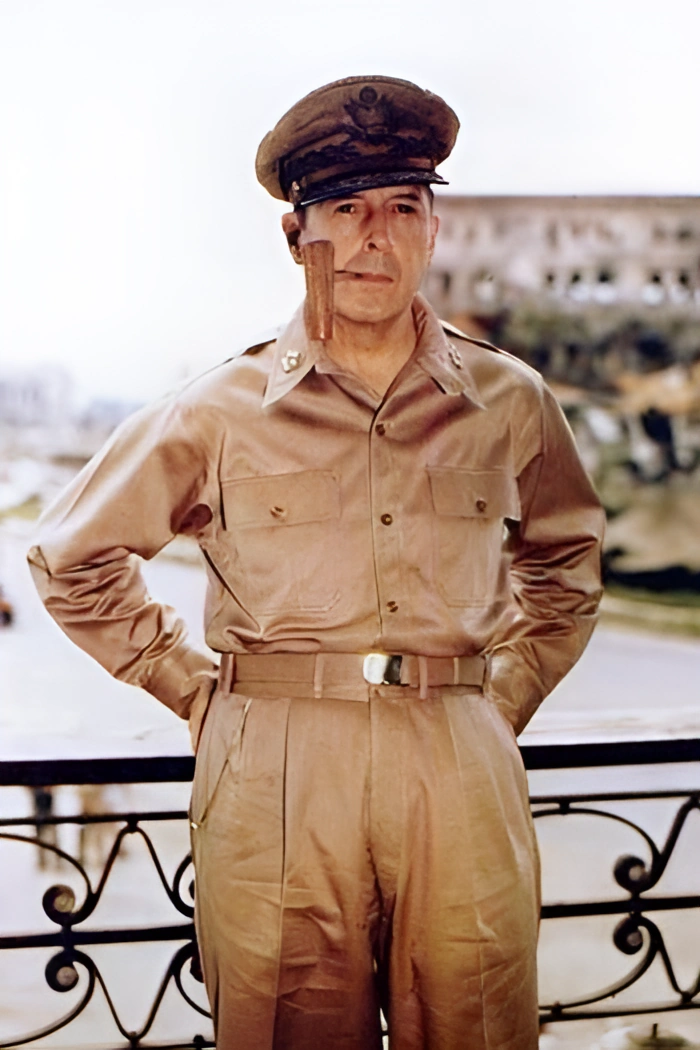
| 33 Quotes | |
| Known as | Gaijin Shogun |
| Occup. | Soldier |
| From | USA |
| Born | January 26, 1880 Little Rock, Arkansas |
| Died | April 5, 1964 Washington, DC, U.S. |
| Aged | 84 years |
| Cite | |
Citation Formats
APA Style (7th ed.)
Douglas macarthur biography, facts and quotes. (2026, February 11). FixQuotes. https://fixquotes.com/authors/douglas-macarthur/
Chicago Style
"Douglas MacArthur biography, facts and quotes." FixQuotes. February 11, 2026. https://fixquotes.com/authors/douglas-macarthur/.
MLA Style (9th ed.)
"Douglas MacArthur biography, facts and quotes." FixQuotes, 11 Feb. 2026, https://fixquotes.com/authors/douglas-macarthur/. Accessed 11 Feb. 2026.
Early Life and Background
Douglas MacArthur was born on January 26, 1880, at Little Rock Barracks, Arkansas, into a family where soldiering was both profession and inheritance. His father, Arthur MacArthur Jr., was a decorated Union officer in the Civil War and later a general; his mother, Mary Pinkney Hardy MacArthur, brought ambition, social polish, and fierce protectiveness that shaped her son into a performer of duty as much as a practitioner of it. The peripatetic life of Army posts in the West and South gave him an early sense that the nation was best understood from its frontiers and garrisons, where authority had to be visible, confident, and personal.That household also supplied the psychological template of his adulthood: pride fused to vulnerability, and a need to demonstrate mastery to earn love. The young MacArthur learned to read rank and ritual the way others read rooms, and he internalized both his fathers legend and his mothers expectations. From the start he was, in his own mind, less an individual than a standard-bearer, destined to reenact and surpass an ancestral story of national service.
Education and Formative Influences
After schooling at West Texas Military Academy, he entered the U.S. Military Academy at West Point, graduating first in the class of 1903 amid a haze of hazing scandals and institutional self-scrutiny that taught him to treat systems as both stage and obstacle. Early engineering duty in the Philippines and on the Panama Canal, followed by service as his fathers aide and an official military observer in the Russo-Japanese War, broadened his strategic imagination: modern war was becoming logistical, political, and psychological. He absorbed the Progressive Eras faith in institutions while also learning how easily institutions could become timid - a tension that later hardened into his lifelong impatience with half-measures.Career, Major Works, and Turning Points
MacArthurs meteoric rise came in World War I, where he led the 42nd "Rainbow" Division in France with conspicuous personal bravery, accumulating decorations and a reputation for theatrical courage that masked an acute grasp of morale and publicity. Between wars he served as superintendent of West Point, Army chief of staff during the Great Depression - including the disastrous Bonus Army episode in 1932 - and field marshal of the Philippine Commonwealth, charged with building a force that could not match Japans timetable. In World War II he escaped to Australia after the fall of the Philippines, then executed the long, grinding Southwest Pacific campaign of island-hopping and combined arms, returning triumphantly to Leyte in 1944 and presiding over Japans surrender in 1945. As Supreme Commander for the Allied Powers he oversaw occupation reforms that rewrote Japans political economy, then commanded UN forces in Korea, achieving the Inchon landing before clashing with President Harry S. Truman over strategy and civil-military authority; his 1951 removal, followed by his farewell address to Congress, sealed his transformation from commander to symbol.Philosophy, Style, and Themes
MacArthurs inner life was built around a sacralized ideal of service, expressed in a rhetoric that treated military virtue as civic religion. "Duty, Honor, Country. Those three hallowed words reverently dictate what you ought to be, what you can be, what you will be". That creed was not mere ceremony; it functioned as a self-binding vow against doubt, and as a way to convert private longing for approval into public obligation. Yet it also encouraged a paternal, almost priestly conception of command in which dissent could look like heresy, and politics like contamination. His best work - the patient orchestration of coalition warfare and the disciplined imagination behind Inchon - came when this moral certainty was paired with technical rigor and careful subordinates.His style fused audacity with narrative control: he wanted operations to be not only effective but legible, decisive, and remembered. He demanded orders that could be carried out, because failure threatened his sense of an ordered world: "Never give an order that can't be obeyed". In crisis he reframed reversals as forward motion, protecting morale and his own myth of inevitability: "We are not retreating - we are advancing in another direction". That ability to transmute setbacks into purpose helped sustain battered forces in 1942, but in Korea it also fed an escalatory imagination that outran political limits, exposing the fault line between battlefield logic and national policy. Beneath the grandeur was a man who feared irrelevance, who understood that authority depends on belief, and who therefore fought to control the story as fiercely as the terrain.
Legacy and Influence
MacArthur died on April 5, 1964, in Washington, D.C., leaving behind a legacy both commanding and contested: architect of victory narratives in the Pacific, chief executive of one of historys most consequential occupations, and cautionary example of civil-military tension in a nuclear age. His insistence on clear objectives and the "will to win" shaped generations of American officers, while his Japan settlement influenced Cold War statecraft across Asia. At the same time, his grandiosity, media mastery, and willingness to test constitutional boundaries became a permanent case study in how charisma can both elevate and endanger democratic control of the armed forces. His final public persona - the fading warrior-statesman - endures because it spoke to a nation that wanted virtue without ambiguity, even as history kept supplying both.Our collection contains 33 quotes written by Douglas, under the main topics: Motivational - Never Give Up - Mortality - Leadership - Freedom.
Other people related to Douglas: Shigeru Yoshida (Politician), Dean Rusk (Diplomat), Chester W. Nimitz (Soldier), Billy Mitchell (Soldier), Smedley Butler (Soldier), Samuel Ullman (Poet), Emperor Hirohito (Royalty)
Source / external links