
Duane G. Carey Biography Quotes 30 Report mistakes
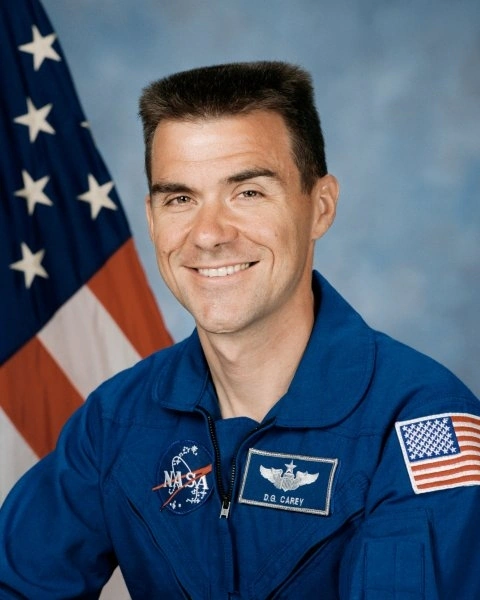
| 30 Quotes | |
| Occup. | Astronaut |
| From | USA |
| Born | April 30, 1957 |
| Age | 68 years |
| Cite | |
Citation Formats
APA Style (7th ed.)
Duane g. carey biography, facts and quotes. (2026, February 11). FixQuotes. https://fixquotes.com/authors/duane-g-carey/
Chicago Style
"Duane G. Carey biography, facts and quotes." FixQuotes. February 11, 2026. https://fixquotes.com/authors/duane-g-carey/.
MLA Style (9th ed.)
"Duane G. Carey biography, facts and quotes." FixQuotes, 11 Feb. 2026, https://fixquotes.com/authors/duane-g-carey/. Accessed 6 Mar. 2026.
Early Life and Background
Duane Gene Carey was born on April 30, 1957, in the United States, arriving in adulthood at the hinge point between the Apollo afterglow and the pragmatic, systems-heavy era of the Space Shuttle. By the time he was a teenager, human spaceflight had shifted from heroic first steps to repeatable operations, and that change mattered: his generation would be asked not simply to go, but to build routines that made going sustainable.Carey grew up in a culture that still treated aviation as both craft and calling, yet also in an America learning that high technology required teamwork, procedures, and patience. The astronaut he became would be marked less by the lone-test-pilot myth than by the quiet confidence of someone comfortable inside complex machines and complex organizations - the kind of temperament the Shuttle program demanded, especially as it matured from spectacle into infrastructure.
Education and Formative Influences
Carey pursued engineering as a way to translate fascination into competence, earning a Bachelor of Science in Aerospace Engineering from Texas A&M University and later a Master of Science in Aerospace Engineering from the University of Houston. Those choices placed him near NASA and its contractor ecosystem, where design reviews, failure modes, and incremental improvements were the daily language. He also followed the classic operational path into the U.S. Navy as a pilot and test pilot, learning to respect checklists not as bureaucracy but as the distilled memory of past mistakes - a formative discipline that would later echo in his cockpit calm.Career, Major Works, and Turning Points
Selected by NASA as an astronaut in 1996, Carey entered the Astronaut Office when the Shuttle was tasked with heavy-lift assembly, telescope servicing, and international partnership. His defining flight came as pilot of STS-109 (March 1-12, 2002), the fourth servicing mission to the Hubble Space Telescope aboard Space Shuttle Columbia. The mission combined intricate rendezvous, robotic handling, and multiple spacewalks by crewmates to install new hardware and restore scientific capability - a concentrated demonstration of the Shuttle era at its best: precision operations that extended the life of an iconic instrument. In Carey's career arc, STS-109 served as both peak and pivot; it was among the last major successes before Columbia's 2003 loss ended the fleet's assumption of routine and hardened NASA's institutional insistence on visible, provable safety margins.Philosophy, Style, and Themes
Carey's public remarks reveal a psychology oriented toward exploration but grounded in the workmanlike reality of piloting and procedures. He framed his motivation not as a childhood destiny but as an adult alignment of values and vocation: “So, I decided that whatever I was, wanted to do with my life, it would have to do, it would have to have something to do with the exploration and doing new things”. That sentence is less romantic than it sounds - it emphasizes decision, not fate, and it pairs exploration with novelty as an ethical requirement, a way of guarding against complacency in a program where complacency could be lethal.At the same time, Carey communicated the Shuttle cockpit as a human space where humor, humility, and adrenaline management coexisted. “So, we have to get up and get pumped up for each day”. The line is psychologically telling: it treats motivation as something deliberately generated, not automatically present, and it implies the emotional labor behind excellence. His jokes about handing the orbiter to mission commander Scott "Scooter" Altman - “So, whenever Scooter was the Pilot, he never had a chance to fly the orbiter. So, the joke is: I'm going to have a chance to fly it first and hand it over to him”. - show an aviator using levity to domesticate high stakes, reinforcing crew cohesion while acknowledging hierarchy and responsibility. The humor also points to a deeper theme of the Shuttle era: flight as shared custody of a machine too complex for any single ego.
Legacy and Influence
Carey's legacy is inseparable from STS-109 and the broader Hubble program, which helped anchor public trust that human spaceflight could deliver concrete scientific returns. As a Navy test pilot turned NASA operator, he embodied the transition from frontier myth to operational mastery - the astronaut as systems integrator, not just adventurer. His voice, practical and lightly self-deprecating, offers a durable model for how astronauts can speak about risk without bravado and about ambition without self-importance, reminding later crews that exploration is sustained not only by vision, but by daily discipline, shared humor, and the willingness to do new things carefully.Our collection contains 30 quotes written by Duane, under the main topics: Motivational - Funny - Work Ethic - Science - Goal Setting.
Source / external links