
Duke Kahanamoku Biography Quotes 6 Report mistakes
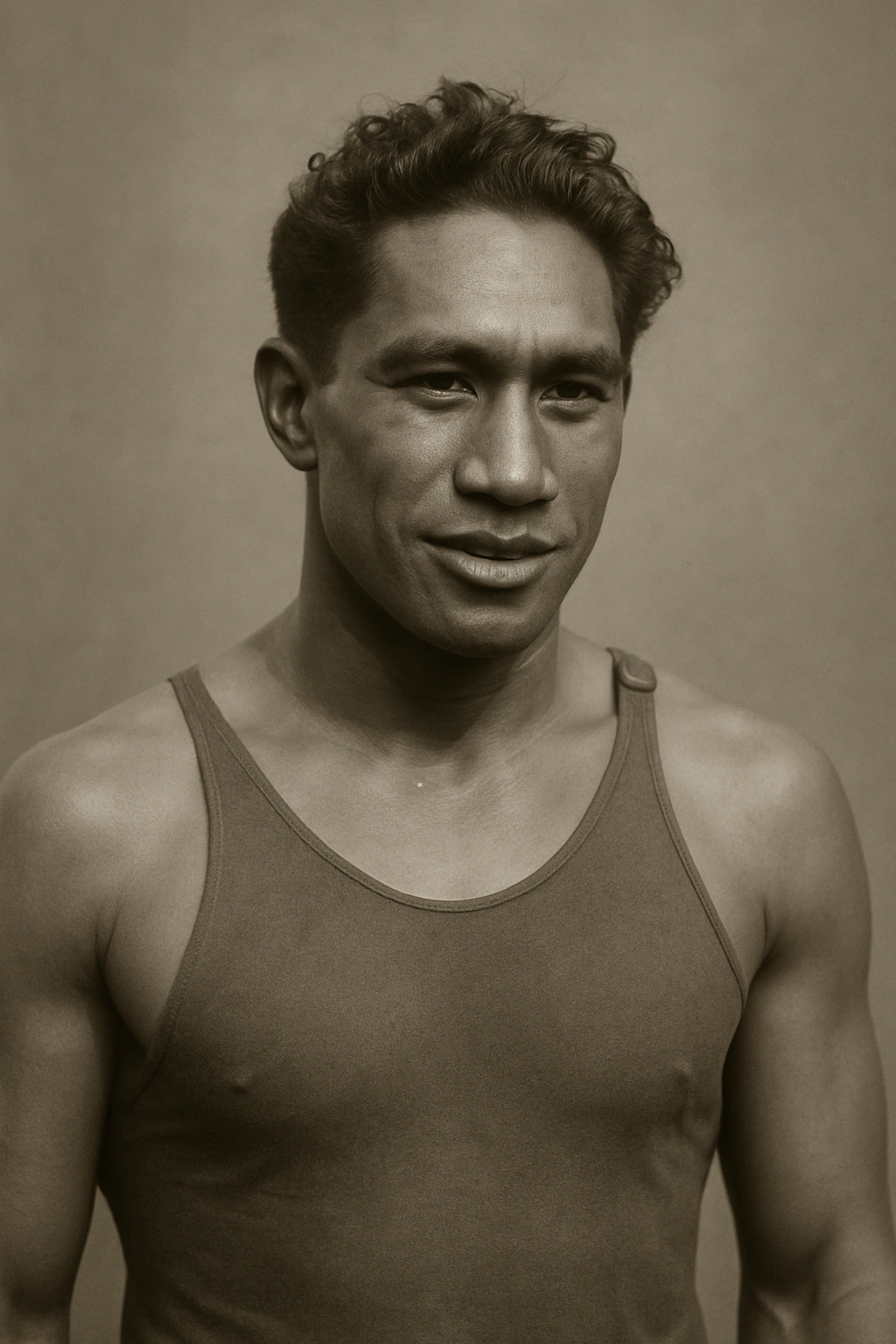
| 6 Quotes | |
| Born as | Duke Paoa Kahinu Mokoe Hulikohola Kahanamoku |
| Occup. | Athlete |
| From | USA |
| Born | August 24, 1890 Honolulu, Hawaii, United States |
| Died | January 22, 1968 Honolulu, Hawaii, United States |
| Cause | Heart attack (myocardial infarction) |
| Aged | 77 years |
| Cite | |
Citation Formats
APA Style (7th ed.)
Duke kahanamoku biography, facts and quotes. (2026, February 11). FixQuotes. https://fixquotes.com/authors/duke-kahanamoku/
Chicago Style
"Duke Kahanamoku biography, facts and quotes." FixQuotes. February 11, 2026. https://fixquotes.com/authors/duke-kahanamoku/.
MLA Style (9th ed.)
"Duke Kahanamoku biography, facts and quotes." FixQuotes, 11 Feb. 2026, https://fixquotes.com/authors/duke-kahanamoku/. Accessed 12 Feb. 2026.
Early Life and Background
Duke Paoa Kahinu Mokoe Hulikohola Kahanamoku was born on August 24, 1890, in Honolulu on the island of Oahu, in the last generation of Native Hawaiians to come of age under the shadow of an overthrown monarchy. The Kingdom of Hawaii had been toppled in 1893; annexation by the United States followed in 1898, and the Territory of Hawaii was created in 1900. In that fast-changing Honolulu - where English-language schools, tourism, and American business expanded beside longstanding Hawaiian kin networks - Kahanamoku grew up with the ocean as both playground and inheritance, in a culture where swimming, paddling, and wave-riding were not novelty sports but lived knowledge.He was raised in Waikiki when it was still a shoreline community of fishponds and canoe landings rather than a corridor of hotels. His family was of Hawaiian descent and he carried his identity openly in an era when many islanders were pressed to assimilate. The sea formed his earliest sense of competence and calm: he learned to move through water as naturally as others moved down streets, and he absorbed the social ethic of aloha - generosity, humility, and steadiness - that later shaped how he handled fame. By the time organized sport began to notice him, he was already a product of place: strong-shouldered from paddling and surfing, disciplined by tides, and socially attuned to the communal life of beaches and boats.
Education and Formative Influences
Kahanamoku attended local schools in Honolulu and worked various jobs, including positions connected to the waterfront, before elite competition pulled him outward. The decisive influence was not a single coach or academy but Waikiki itself - an informal training ground where Hawaiian watermen compared strokes, read currents, and built boards. Competitive swimming was then being standardized by mainland institutions, yet his speed was forged in open water rather than in controlled pools. That background gave him an uncommon feel for pacing and rhythm, and it prepared him to translate Indigenous ocean skill into the language of international sport without losing the spirit that produced it.Career, Major Works, and Turning Points
Kahanamoku burst onto the global stage at the 1912 Stockholm Olympics, winning gold in the 100-meter freestyle and silver in the 4x200 relay, then returned to claim gold again in the 100-meter freestyle at the 1920 Antwerp Games, with a silver in the relay as well; his Olympic medals made him one of the first truly international athletic stars from Hawaii. He set multiple world records in freestyle and became a leading figure in early 20th-century swimming technique, with an efficient flutter kick that helped push the sport forward as it moved away from older scissor-style actions. His fame carried him across the United States and beyond on exhibitions that were part athletic tour, part cultural diplomacy, and he used those trips to demonstrate surfing to new audiences - a turning point not only for him but for the sport itself. In 1925, while in Southern California, he took part in the legendary rescue at Corona del Mar, using a surfboard to save multiple people from a capsized fishing boat, an episode that accelerated the acceptance of boards as lifesaving tools. He also appeared in Hollywood films during the silent and early sound eras, often typecast, yet he leveraged the visibility to keep Hawaiian ocean culture in the public eye. Back home, he served for decades as Sheriff of the City and County of Honolulu, becoming a civic fixture whose authority rested as much on personal trust as on office.Philosophy, Style, and Themes
Kahanamoku's inner life reads as a disciplined refusal to separate identity from element. His public persona - relaxed, courteous, almost shy in confrontation - was not performance but method: he conserved energy, listened more than he spoke, and let results arrive on their own schedule. The ocean provided both his metaphors and his ethics. "Out of the water, I am nothing". The sentence is not false modesty; it is a psychological anchor, a way of locating selfhood in relationship rather than ego. Even as Olympic celebrity turned him into an emblem for tourists and promoters, he kept returning to the sea as the only place where attention dissolved into practice.His style, in both swimming and surfing, emphasized timing over force and patience over panic. "Just take your time - wave comes. Let the other guys go, catch another one". That advice doubles as a worldview shaped by tides: the belief that opportunities recur, that rushing costs more than it gains, and that mastery is the ability to wait without anxiety. He also articulated a kind of sunlit realism about Hawaii's climate and his own rootedness in it, remarking, "I have never seen snow and do not know what winter means". Beneath the humor lies an affirmation of place against a mainland narrative that often treated Hawaii as exotic backdrop; he insisted, gently, that his normal was ocean-warm and wave-timed, and that this normal could produce excellence on the world's hardest stages.
Legacy and Influence
Kahanamoku died on January 22, 1968, in Honolulu, but his influence continued to travel like swell: steady, long, and far-reaching. He is widely remembered as the "father of modern surfing" not because he invented wave-riding, but because he carried a Native Hawaiian practice into global modernity and made it legible without draining it of grace. In swimming, his Olympic triumphs helped normalize the idea that champions could come from outside the mainland centers of training, and his technique contributed to the evolution of freestyle racing. In public life, his long service and personal decency made him a model of civic steadiness during Hawaii's transition from territory to statehood in 1959. Statues, halls of fame, and the continuing reverence of watermen and swimmers mark his reputation, but the deeper legacy is cultural: an enduring association between Hawaiian identity and ocean mastery, framed not as spectacle, but as a way of being in the world.Our collection contains 6 quotes written by Duke, under the main topics: Motivational - Love - Ocean & Sea - Winter.
Frequently Asked Questions
- Duke Kahanamoku movies: Appeared in films like The Pony Express (1925), Lord Jim (1925), Old Ironsides (1926), and Girl of the Port (1930).
- Duke Kahanamoku education: Attended schools in Honolulu, including Kamehameha School for Boys; no college degree.
- Duke Kahanamoku Beach: A beach at the west end of Waikiki (by Hilton Hawaiian Village and the Duke Kahanamoku Lagoon), named in his honor.
- Duke Kahanamoku children: None.
- What is Duke Kahanamoku net worth? Not publicly documented.
- Duke Kahanamoku wife: Nadine Alexander (m. 1940–1968).
- Duke Kahanamoku height: About 6 ft 1 in (1.85 m).
- Duke Kahanamoku death: January 22, 1968; heart attack in Honolulu, Hawaii.
- How old was Duke Kahanamoku? He became 77 years old
Source / external links