
E. O. Wilson Biography Quotes 30 Report mistakes
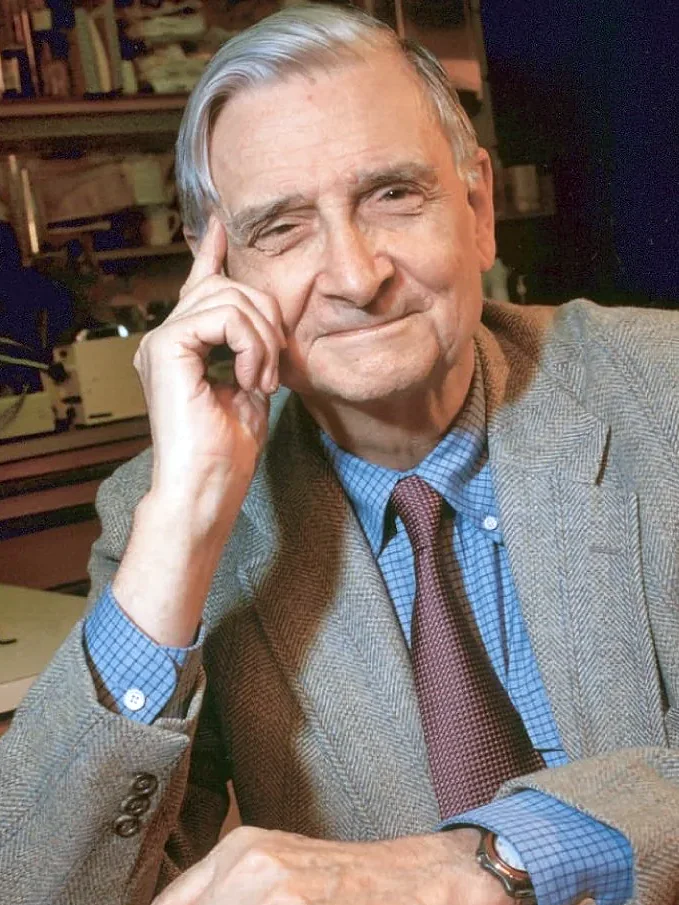
| 30 Quotes | |
| Born as | Edward Osborne Wilson |
| Occup. | Scientist |
| From | USA |
| Born | June 10, 1929 Birmingham, Alabama, USA |
| Died | December 26, 2021 |
| Aged | 92 years |
| Cite | |
Citation Formats
APA Style (7th ed.)
E. o. wilson biography, facts and quotes. (2026, February 11). FixQuotes. https://fixquotes.com/authors/e-o-wilson/
Chicago Style
"E. O. Wilson biography, facts and quotes." FixQuotes. February 11, 2026. https://fixquotes.com/authors/e-o-wilson/.
MLA Style (9th ed.)
"E. O. Wilson biography, facts and quotes." FixQuotes, 11 Feb. 2026, https://fixquotes.com/authors/e-o-wilson/. Accessed 25 Mar. 2026.
Early Life and Background
Edward Osborne Wilson was born June 10, 1929, in Birmingham, Alabama, into the long shadows of the Great Depression and the still-segregated American South. His childhood was marked by family instability and frequent moves between Alabama and Florida, a pattern that taught him to read landscapes as much as households. In later life he described himself as an essentially solitary boy - not from misanthropy, but from the quiet self-reliance of someone who learned early that attention could be paid to what stayed constant: shorelines, insects, and the logic of living systems.A formative accident left him partially blind in one eye and weakened his depth perception, closing off some boyhood paths while opening another. Where other children hunted with rifles, Wilson learned to hunt with observation, training a naturalist's patience on small creatures he could track at close range. That shift toward the minute - ants, beetles, the hidden commerce of the ground - became both his scientific niche and a psychological refuge: a world governed by discoverable rules rather than adult unpredictability.
Education and Formative Influences
Wilson entered the University of Alabama and then moved into biology at Harvard, where he would spend nearly his entire professional life, eventually becoming one of the university's most public scientists. He was shaped by mid-20th-century evolutionary synthesis thinking and by the comparative methods of systematics and ecology, but also by the moral atmosphere of the postwar scientific ascendancy - a time when American research universities expanded rapidly and when biology was being remade by genetics, computation, and field ecology. Early fieldwork in the American South and later in the tropics honed his belief that biodiversity was not a decorative extra but the infrastructure of life.Career, Major Works, and Turning Points
At Harvard, Wilson became the preeminent authority on ants and social insects, producing foundational work in myrmecology and coauthoring The Ants (1990) with Bert Holldobler, a landmark synthesis that helped make insect societies legible to a general audience. His earlier The Insect Societies (1971) and Sociobiology: The New Synthesis (1975) pushed a larger claim: that behavior, including aspects of human social life, could be studied as an evolutionary phenomenon. The resulting controversy - especially over sociobiology's implications for human nature - scarred and energized him, turning him into a public intellectual and a careful strategist of explanation. He later broadened his reach through Biophilia (1984), Consilience (1998), and The Creation (2006), arguing that scientific and humanistic ways of knowing could be braided into a single moral project centered on the living world.Philosophy, Style, and Themes
Wilson's inner life fused two temperaments that often distrust each other: the empiricist who insists on evidence and mechanism, and the naturalist-poet who treats nature as a source of meaning. His prose carried the crisp, taxonomic precision of a field biologist, yet it aimed at conversion - not to a creed, but to attention. “Nature holds the key to our aesthetic, intellectual, cognitive and even spiritual satisfaction”. For Wilson, that was not sentimentalism; it was an argument about evolved minds, about why the human animal is calmed and enlarged by complexity it did not create. His idea of biophilia framed love of living things as both biological inheritance and ethical lever.The same logic drove his conservation stance, sharpened by a scientist's sense of irreversibility and by a storyteller's intolerance for waste. "The one process now going on that will take millions of years to correct is the loss of genetic and species diversity by the destruction of natural habitats. This is the folly our descendants
Our collection contains 30 quotes written by O. Wilson, under the main topics: Ethics & Morality - Truth - Wisdom - Nature - Deep.
Other people related to O. Wilson: Ruth Hubbard (Scientist)
E. O. Wilson Famous Works
- 2013 Letters to a Young Scientist (Book)
- 2012 The Social Conquest of Earth (Book)
- 2002 The Future of Life (Book)
- 1998 Consilience: The Unity of Knowledge (Book)
- 1992 The Diversity of Life (Book)
- 1984 Biophilia (Book)
- 1978 On Human Nature (Book)
- 1975 Sociobiology: The New Synthesis (Book)
- 1971 The Insect Societies (Book)
- 1967 The Theory of Island Biogeography (Book)
Source / external links