
Edgar Allan Poe Biography Quotes 38 Report mistakes
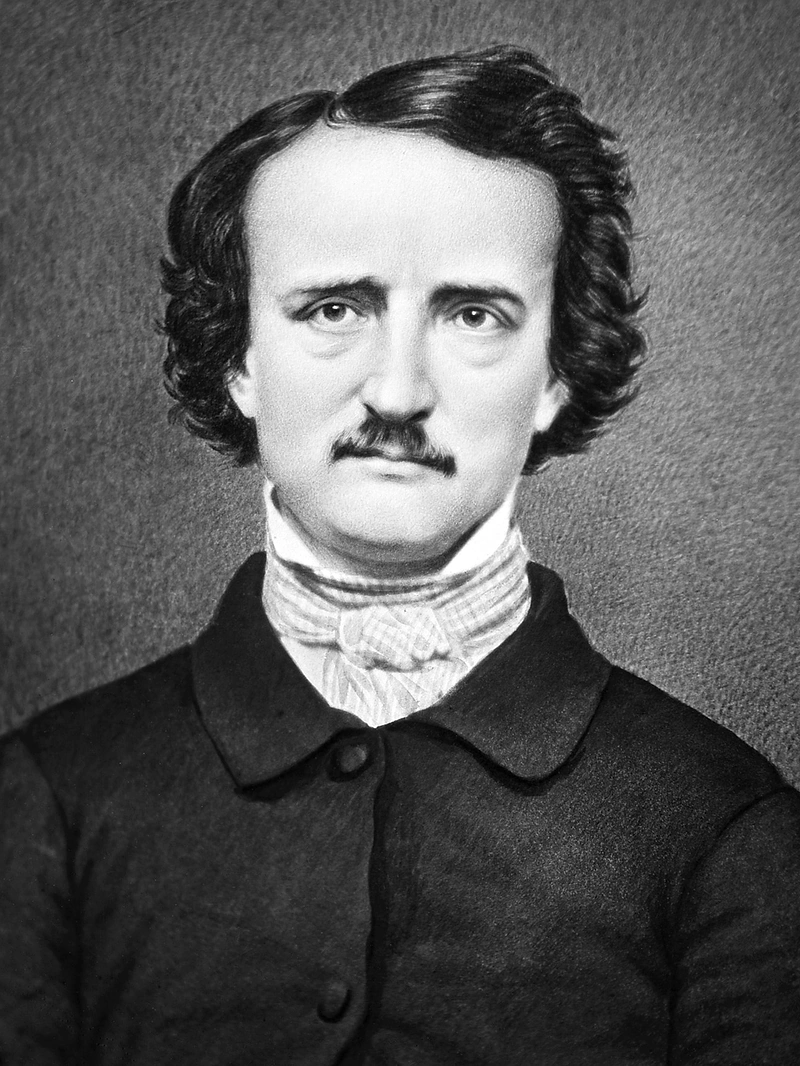
| 38 Quotes | |
| Occup. | Poet |
| From | USA |
| Born | January 19, 1809 Boston, Massachusetts, United States |
| Died | October 7, 1849 Baltimore, Maryland, United States |
| Aged | 40 years |
| Cite | |
Citation Formats
APA Style (7th ed.)
Edgar allan poe biography, facts and quotes. (2026, February 11). FixQuotes. https://fixquotes.com/authors/edgar-allan-poe/
Chicago Style
"Edgar Allan Poe biography, facts and quotes." FixQuotes. February 11, 2026. https://fixquotes.com/authors/edgar-allan-poe/.
MLA Style (9th ed.)
"Edgar Allan Poe biography, facts and quotes." FixQuotes, 11 Feb. 2026, https://fixquotes.com/authors/edgar-allan-poe/. Accessed 24 Mar. 2026.
Early Life and Background
Edgar Allan Poe was born on January 19, 1809, in Boston, Massachusetts, to itinerant actors David Poe Jr. and Elizabeth Arnold Hopkins Poe. The early republic offered little safety net for a theater family, and calamity came quickly: his father disappeared from the family's life, and his mother died of tuberculosis in Richmond, Virginia, in 1811. Orphaned before he could form stable memories, Poe absorbed early the brutal lesson that intimacy could vanish without warning - a private wound that later reemerged as art's obsession with separation, bereavement, and the fear that loss is the only constant.He was taken in, not legally adopted, by the Richmond merchant John Allan and his wife Frances, a household of comfort and strict expectations. The boy grew up between gratitude and resentment: Allan's prosperity provided books, schooling, and travel, while Allan's emotional distance and emphasis on commercial respectability made Poe feel simultaneously sponsored and stifled. That conflict - dependence on patrons and editors coupled with fierce pride - became a recurring pattern, sharpening his sensitivity to humiliation and driving him toward literary distinction as a form of self-sovereignty.
Education and Formative Influences
Poe's adolescence was marked by transatlantic impressions and a hunger for intellectual rigor. He lived with the Allans in Britain from 1815 to 1820, attending schools in Scotland and England before returning to Richmond. In 1826 he entered the University of Virginia, where he excelled in languages yet quickly fell into debt through gambling, deepening his rift with John Allan. After leaving the university, he drifted through Boston and enlisted in the U.S. Army in 1827, later entering West Point in 1830; he deliberately engineered his dismissal in 1831 when Allan's support collapsed. These years - classical study, military discipline, and repeated rupture with authority - trained both his technical precision and his sense of being cornered by circumstance.Career, Major Works, and Turning Points
Poe remade himself in print, shifting from obscure poetry to a professional life in magazines as editor, reviewer, and story writer - a precarious occupation in the rapidly expanding, fiercely competitive American press. After early volumes like "Tamerlane and Other Poems" (1827) and "Al Aaraaf" (1829), his breakthrough came with "MS. Found in a Bottle" (1833), followed by editorial work at the Southern Literary Messenger in Richmond, where his sharp reviews built notoriety as well as enemies. In 1836 he married his young cousin Virginia Clemm; their household in Philadelphia and later New York was sustained by relentless production: tales such as "The Fall of the House of Usher" (1839), "The Murders in the Rue Morgue" (1841), and "The Tell-Tale Heart" (1843), plus the poem that made him famous, "The Raven" (1845). Virginia's long illness and death from tuberculosis in 1847 intensified his volatility and grief. He struggled with bouts of drinking and instability, pursued an often-frustrated dream of founding his own magazine, and died in Baltimore on October 7, 1849, after being found delirious days earlier - a death still shadowed by uncertainty.Philosophy, Style, and Themes
Poe's art begins in sensation but aims at metaphysics: he wanted literature to act on the nerves with scientific exactitude, producing a single, overwhelming effect. He argued for craftsmanship over sprawl - the controlled length of the tale, the calculated cadence of verse, the moral neutrality of aesthetic impact. Yet the coldness of his method masks an inner life charged with dread and desire, as if form were a barricade against panic. When he writes, “Deep into that darkness peering, long I stood there, wondering, fearing, doubting, dreaming dreams no mortal ever dared to dream before”. , the line is less romantic scenery than a self-portrait: a mind compelled to stare into uncertainty until uncertainty stares back, turning introspection into a theatrical abyss.His most persistent subjects are the fragility of identity, the porous border between consciousness and breakdown, and the erotic pull of mourning. “The boundaries which divide Life from Death are at best shadowy and vague. Who shall say where the one ends, and where the other begins?” expresses more than gothic atmosphere - it names the psychological terrain Poe inhabited after repeated bereavements, where love and loss coexist so tightly that death feels like an extension of intimacy. In critical essays and in practice, he elevated Beauty as an effect achieved through rhythm, sound, and symbolic condensation, insisting that the imagination must transfigure experience rather than merely record it: “I would define, in brief, the poetry of words as the rhythmical creation of Beauty”. That definition helps explain his musical refrains and claustrophobic settings - not realism, but a deliberate dream-logic designed to make emotion audible.
Legacy and Influence
Poe's influence is unusually structural: he did not only write memorable works, he helped design genres. "The Murders in the Rue Morgue" helped establish modern detective fiction; his tales of ratiocination shaped Arthur Conan Doyle and later crime literature, while his speculative pieces anticipated elements of science fiction. In France, Charles Baudelaire's translations canonized him as a patron saint of modernity, feeding Symbolism and Decadence; in the United States, his harsh, principled criticism and insistence on technical unity pushed literary standards in an age often tolerant of genial sprawl. His life - orphaned beginnings, volatile ambition, public success paired with private collapse - hardened into myth, but the enduring fact is the work: a body of poetry and fiction that treats fear, beauty, and mortality as interlocking instruments, still capable of making readers feel that the mind's most secret rooms have been entered and precisely described.Our collection contains 38 quotes written by Edgar, under the main topics: Witty One-Liners - Truth - Wisdom - Art - Puns & Wordplay.
Other people related to Edgar: Ray Bradbury (Writer), Neil Gaiman (Author), Tom Robbins (Author), Julio Cortazar (Writer), Junichiro Tanizaki (Author), Stephane Mallarme (Poet), Arthur Ransome (Author), Ernest Hello (Critic), Roger Corman (Producer), George Edward Woodberry (Critic)
Edgar Allan Poe Famous Works
- 1849 Hop-Frog (Short Story)
- 1849 The Bells (Poetry)
- 1849 Annabel Lee (Poetry)
- 1848 Eureka: A Prose Poem (Essay)
- 1846 The Cask of Amontillado (Short Story)
- 1845 The Purloined Letter (Short Story)
- 1845 The Raven and Other Poems (Collection)
- 1845 The Facts in the Case of M. Valdemar (Short Story)
- 1845 The Raven (Poetry)
- 1844 The Premature Burial (Short Story)
- 1843 The Gold-Bug (Short Story)
- 1843 The Black Cat (Short Story)
- 1843 The Tell-Tale Heart (Short Story)
- 1842 The Pit and the Pendulum (Short Story)
- 1842 The Masque of the Red Death (Short Story)
- 1841 The Murders in the Rue Morgue (Short Story)
- 1840 Tales of the Grotesque and Arabesque (Collection)
- 1839 The Fall of the House of Usher (Short Story)
- 1838 Ligeia (Short Story)
- 1827 Tamerlane and Other Poems (Collection)