
Edsger Dijkstra Biography Quotes 26 Report mistakes
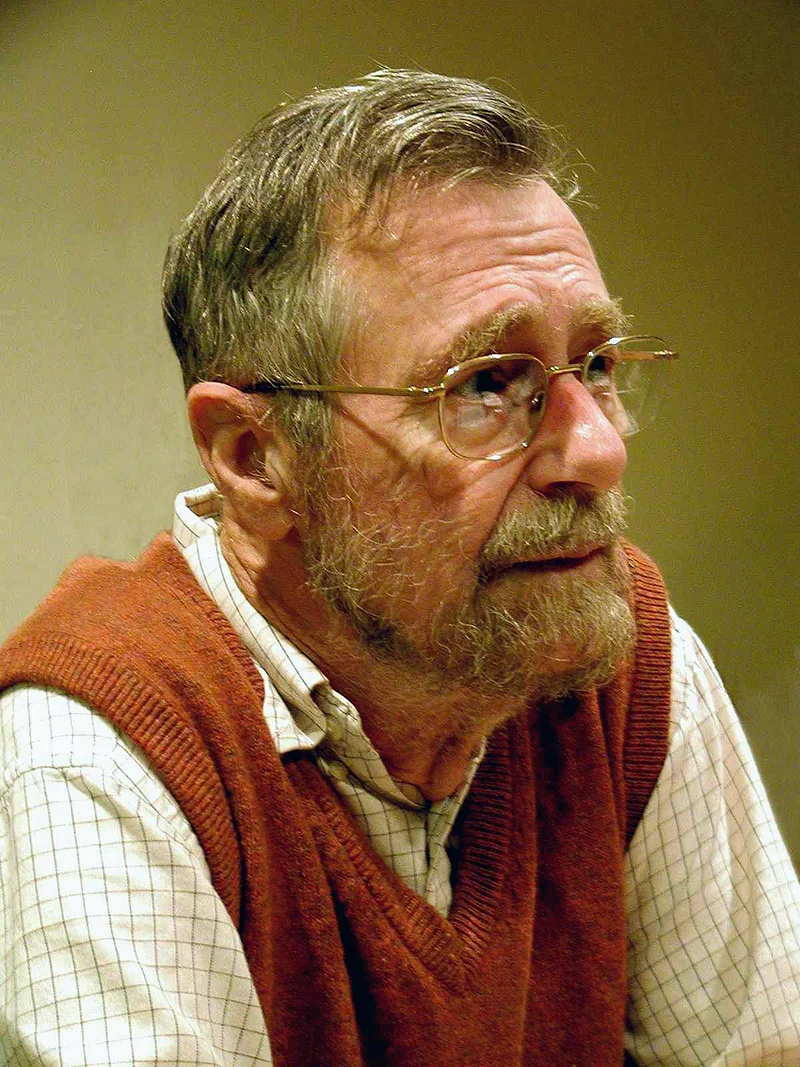
| 26 Quotes | |
| Born as | Edsger Wybe Dijkstra |
| Known as | Edsger W. Dijkstra |
| Occup. | Scientist |
| From | Netherland |
| Spouse | Maria (Ria) C. Debets |
| Born | May 11, 1930 Rotterdam, Netherlands |
| Died | August 6, 2002 Nuenen, Netherlands |
| Cause | Cancer |
| Aged | 72 years |
| Cite | |
Citation Formats
APA Style (7th ed.)
Edsger dijkstra biography, facts and quotes. (2026, February 2). FixQuotes. https://fixquotes.com/authors/edsger-dijkstra/
Chicago Style
"Edsger Dijkstra biography, facts and quotes." FixQuotes. February 2, 2026. https://fixquotes.com/authors/edsger-dijkstra/.
MLA Style (9th ed.)
"Edsger Dijkstra biography, facts and quotes." FixQuotes, 2 Feb. 2026, https://fixquotes.com/authors/edsger-dijkstra/. Accessed 27 Mar. 2026.
Early Life and Background
Edsger Wybe Dijkstra was born on 1930-05-11 in Rotterdam, Netherlands, into a Dutch professional milieu that valued discipline, clarity, and public service. His father, a chemist, and his mother, trained in mathematics and employed as a schoolteacher, gave him early contact with both scientific method and the pedagogical urge to explain. Growing up during the German occupation of the Netherlands in World War II, he absorbed - as many of his generation did - a lifelong sensitivity to how fragile civilized order can be, and how much depends on careful reasoning and personal responsibility.In the postwar years, Rotterdam rebuilt itself with a stark modernism that mirrored Dijkstra's later taste for clean structure and intolerance of ornament. Friends and colleagues would later describe him as courteous but unyielding: a man who did not merely prefer rigor, but required it as a moral posture. That temperament, formed early, would make him both a foundational figure in computer science and an unusually polarizing critic of its fashions.
Education and Formative Influences
Dijkstra studied at Leiden University, initially oriented toward theoretical physics and mathematics, and entered computing almost by accident through part-time work at the Mathematisch Centrum (later CWI) in Amsterdam in the early 1950s. There he encountered computation not as clerical machinery but as a new field where mathematical proof and human fallibility collided. Under the influence of Dutch mathematical culture and the emerging European school of programming-as-discipline, he began to treat programming languages, algorithms, and proofs as aspects of a single intellectual craft: to control complexity by design rather than by after-the-fact repair.Career, Major Works, and Turning Points
At the Mathematisch Centrum, Dijkstra helped implement early languages (notably ALGOL 60) and produced work that quickly became canonical: the 1959 shortest-path method now called Dijkstra's algorithm; early contributions to compiler construction; and, in 1965, the mutual exclusion problem, which led to the semaphore concept and a new vocabulary for concurrency. A decisive turning point came with his 1968 letter "Go To Statement Considered Harmful", which catalyzed structured programming and made him an international conscience for software correctness. He developed these ideas in "Notes on Structured Programming" (1970) and, with colleagues, in "The Discipline of Programming" (1976), arguing that programs should be derived with invariants and proofs, not patched into submission. After holding a professorship at Eindhoven University of Technology (from 1962), he moved in 1984 to the University of Texas at Austin as the Schlumberger Centennial Chair, where his "EWD" memos - handwritten, meticulously reasoned notes circulated worldwide - shaped generations until his death on 2002-08-06.Philosophy, Style, and Themes
Dijkstra's inner life was defined by an almost ascetic insistence that intellectual work should be simple enough to be trusted. For him, elegance was not decorative; it was ethical. “Simplicity is prerequisite for reliability”. That sentence functions as autobiography: he saw the programmer's real enemy not the machine, but the programmer's own capacity for self-deception in the face of complexity. His advocacy of weakest preconditions, invariants, and calculational proof was less about formalism for its own sake than about building a mental environment where lies - including accidental lies - are hard to tell.This psychology also explains his sharp, sometimes barbed public judgments about tools and trends. He distrusted languages and teaching practices that trained students to accept muddle as normal, because he believed early habits become permanent cognitive scars. His famous warning that “Program testing can be used to show the presence of bugs, but never to show their absence!” was not anti-testing rhetoric so much as a demand for epistemic honesty: testing gives evidence, not certainty, and engineers must know which kind of knowledge they possess. Even his broader view of the field resisted reduction to hardware fascination: “Computer science is no more about computers than astronomy is about telescopes”. He wrote in a distinctive style - short, numbered steps; carefully chosen words; arguments built like proofs - as if every paragraph were an executable artifact that must terminate without ambiguity.
Legacy and Influence
Dijkstra endures as a founder of modern algorithmic thinking, concurrent programming, and the culture of correctness: his shortest-path algorithm is taught worldwide; his semaphore and critical-section framing underlie operating systems; and his structured programming critique permanently altered language design and pedagogy. Yet his deeper legacy is a stance - that software is a branch of applied mathematics governed by limits of human reasoning, and that moral seriousness belongs in engineering. In an era that often celebrates speed, novelty, and scale, Dijkstra remains the patron of the harder virtues: restraint, proof, and the courage to be unfashionable.Our collection contains 26 quotes written by Edsger, under the main topics: Witty One-Liners - Wisdom - Writing - Learning - Reason & Logic.
Edsger Dijkstra Famous Works
- 1989 On the Cruelty of Really Teaching Computing Science (Essay)
- 1982 Selected Writings on Computing: A Personal Perspective (Collection)
- 1976 A Discipline of Programming (Book)
- 1975 Guarded Commands, Nondeterminacy and Formal Derivation of Programs (Essay)
- 1974 Self-stabilizing Systems in Spite of Distributed Control (Essay)
- 1972 The Humble Programmer (Essay)
- 1970 Notes on Structured Programming (Essay)
- 1968 The Structure of the 'THE' Multiprogramming System (Essay)
- 1968 Go To Statement Considered Harmful (Essay)
- 1965 Solution of a Problem in Concurrent Programming Control (Essay)
- 1959 A Note on Two Problems in Connexion with Graphs (Essay)
Source / external links