
Eduardo Galeano Biography Quotes 4 Report mistakes
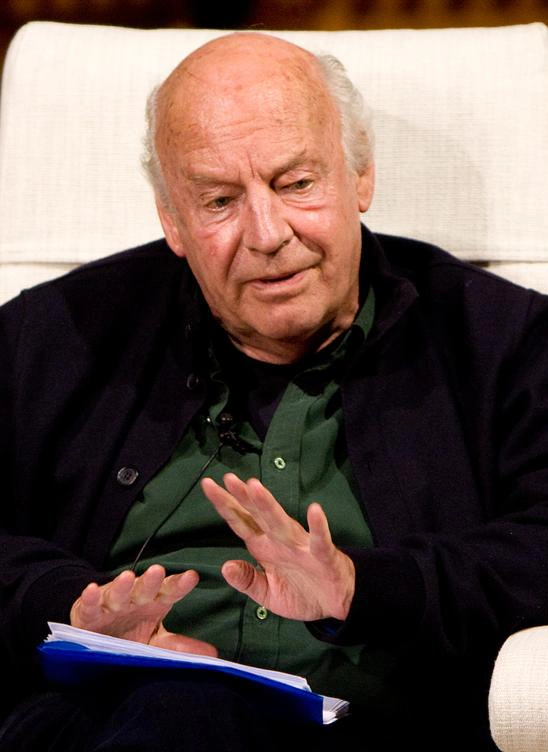
Attr: Donostia Kultura, CC BY-SA 2.0
| 4 Quotes | |
| Occup. | Journalist |
| From | Uruguay |
| Born | September 3, 1940 Montevideo, Uruguay |
| Died | April 13, 2015 Montevideo, Uruguay |
| Aged | 74 years |
| Cite | |
Citation Formats
APA Style (7th ed.)
Eduardo galeano biography, facts and quotes. (2026, February 14). FixQuotes. https://fixquotes.com/authors/eduardo-galeano/
Chicago Style
"Eduardo Galeano biography, facts and quotes." FixQuotes. February 14, 2026. https://fixquotes.com/authors/eduardo-galeano/.
MLA Style (9th ed.)
"Eduardo Galeano biography, facts and quotes." FixQuotes, 14 Feb. 2026, https://fixquotes.com/authors/eduardo-galeano/. Accessed 26 Mar. 2026.
Early Life and Background
Eduardo Germain Maria Hughes Galeano was born on September 3, 1940, in Montevideo, Uruguay, into a middle-class family whose very surname carried the layered migrations of the Rio de la Plata: Spanish and Welsh threads folded into a country that imagined itself European while living Latin American history. Montevideo in the 1940s and 1950s was a port capital of cafes, unions, and newspapers - outwardly stable, inwardly anxious as the postwar boom thinned and political polarization grew. From early on he gravitated toward print culture: sports pages, political cartoons, and the street-level talk that would later become his raw material.
He left formal schooling young and worked a string of jobs - messenger, factory hand, bank clerk - while drawing and writing. The youthful Galeano published cartoons and began to write journalism in an era when Uruguay still called itself the "Switzerland of America", even as inequality and state violence were beginning to sharpen. That tension between civic self-myth and social reality became his lifelong subject: how nations narrate themselves, and what those narratives conceal.
Education and Formative Influences
Galeano was largely self-educated, shaped less by universities than by newsrooms, libraries, and political argument. He read Latin American history as a contested archive - conquest, slavery, caudillos, foreign debt, U.S. interventions - and absorbed the region's literary experimentation from modernismo to the Boom while keeping his allegiance with reporters, workers, and exiles rather than with academic prestige. The Cuban Revolution, the rise of guerrilla movements, and the Cold War battlefield of the Southern Cone formed the background music of his apprenticeship: a time when language could be both witness and weapon.
Career, Major Works, and Turning Points
He became a journalist and editor in Montevideo, working at Marcha - the influential weekly that gathered a generation of left intellectuals - and later at the daily Epoca; he also directed the University of the Republic's publishing department. His international breakthrough came with "Las venas abiertas de America Latina" (1971), a sweeping indictment of colonial extraction and modern dependency, written with the urgency of reportage and the moral cadence of an indictment. After the 1973 coup in Uruguay and the spread of Southern Cone dictatorships, he was detained and forced into exile, first in Argentina, where he co-founded the cultural journal Crisis, and then in Spain after the 1976 Argentine coup. Exile reorganized his art: the later "Memoria del fuego" trilogy (1982-1986) rebuilt the Americas as a mosaic of brief scenes, voices, and documents, and in "El libro de los abrazos" (1989) and subsequent works he fused anecdote, parable, and political memory into a signature form. He returned to Uruguay after the dictatorship ended, remaining a public intellectual until his death in Montevideo on April 13, 2015.
Philosophy, Style, and Themes
Galeano's inner life was marked by a reporter's vigilance and an exile's homesickness: he distrusted official versions of reality, but he also distrusted purely programmatic writing. He wanted history to be felt in the body. “This work is a torture on the rump but a joy to the heart”. The line is funny, but it is also a confession of method - long hours at the desk as a kind of penance, repaid by the emotional electricity of giving language back to the silenced. In his best pages, the "heart" is not sentimentality; it is the moral sensor that tells him when a statistic hides a human face.
His style condensed journalism, lyric fragment, and oral storytelling, as if each paragraph were a small act of restitution. He treated streets, graffiti, and rumor as legitimate archives because the powerful had already monopolized the official record. “The walls are the publishers of the poor”. That conviction explains his preference for short, luminous vignettes and for unnamed speakers - dockworkers, indigenous rebels, disappeared people recalled by their mothers - arranged to produce a counter-history. Even when he wrote directly about geopolitics, he returned to the sensory life that politics invades: love, drink, fear, and the sudden grace that makes survival possible. “We are all mortal until the first kiss and the second glass of wine”. Underneath the aphorism is Galeano's recurring claim that dignity is not abstract: it lives in ordinary pleasures that systems of domination try to ration.
Legacy and Influence
Galeano endures as one of Latin America's defining chroniclers of power and memory, a writer who taught generations to read economics as a story of bodies and borders, not merely numbers. "Open Veins" became a touchstone for anti-imperialist critique and a lightning rod for debate, while "Memory of Fire" expanded the possibilities of historical narration in Spanish, influencing journalists, essayists, and hybrid-genre writers across the hemisphere. His greatest legacy may be ethical rather than doctrinal: an insistence that the past is not past, that official histories are provisional, and that language can return presence to those erased by conquest, capital, and dictatorship.
Our collection contains 4 quotes written by Eduardo, under the main topics: Knowledge - Equality - Work - Romantic.
Eduardo Galeano Famous Works
- 2008 Mirrors: Stories of Almost Everyone (Book)
- 1995 Football in Sun and Shadow (Book)
- 1989 The Book of Embraces (Book)
- 1982 Memory of Fire (Book)
- 1978 Days and Nights of Love and War (Book)
- 1971 Open Veins of Latin America (Book)
Source / external links