
Edward Abbey Biography Quotes 29 Report mistakes
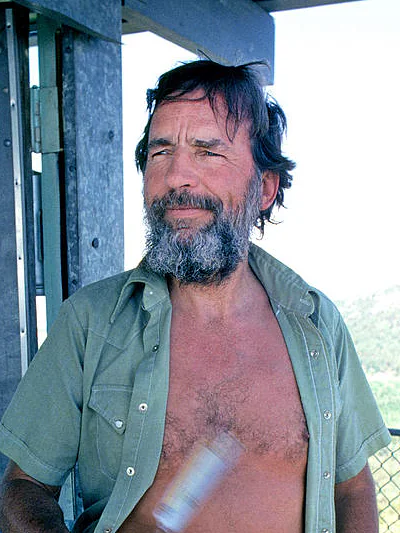
| 29 Quotes | |
| Occup. | Author |
| From | USA |
| Born | January 29, 1927 Indiana, Pennsylvania, USA |
| Died | March 14, 1989 Tucson, Arizona, USA |
| Aged | 62 years |
| Cite | |
Citation Formats
APA Style (7th ed.)
Edward abbey biography, facts and quotes. (2026, February 3). FixQuotes. https://fixquotes.com/authors/edward-abbey/
Chicago Style
"Edward Abbey biography, facts and quotes." FixQuotes. February 3, 2026. https://fixquotes.com/authors/edward-abbey/.
MLA Style (9th ed.)
"Edward Abbey biography, facts and quotes." FixQuotes, 3 Feb. 2026, https://fixquotes.com/authors/edward-abbey/. Accessed 5 Mar. 2026.
Early Life and Background
Edward Paul Abbey was born January 29, 1927, in the Appalachian coal-and-timber country around Home, Pennsylvania, a landscape of ridges, hard winters, and working-class self-reliance that helped form his lifelong suspicion of authority and his affection for rough-edged, nonconforming people. He grew up during the Great Depression and came of age as the United States mobilized for World War II, absorbing both the rhetoric of national purpose and the daily reality of scarcity, which later sharpened his contempt for waste, boosterism, and what he saw as the spiritual emptiness of mass consumption.In 1944, still a teenager, he left Pennsylvania by thumb, riding freight and hitchhiking across the country to the American West. The deserts and canyonlands he encountered were not simply scenic to him - they were a counter-civilization, a place where scale, silence, and risk stripped away what he considered the soft lies of modern life. That early westward flight became a private origin myth he would revisit in fiction and memoir: the young man reinventing himself against the horizon, convinced that true allegiance was owed not to institutions but to land, weather, and a few trusted friends.
Education and Formative Influences
After service in the U.S. Army (late 1940s) and the restlessness of postwar America, Abbey pursued formal study with the same contrarian intensity that drove his travels. He studied at the University of New Mexico in Albuquerque, where he earned degrees culminating in an M.A. and later a Ph.D. in philosophy, training that gave his work its argumentative backbone: a taste for first principles, a talent for aphorism, and a moral vocabulary drawn from skepticism, individual liberty, and an old Western strain of stoic realism. The mid-century Southwest - with its Cold War militarization, boomtown growth, and rising tourism economy - became his laboratory, letting him watch modernity spread across arid country like a new kind of weather.Career, Major Works, and Turning Points
Abbey worked seasonally as a park ranger and fire lookout, most famously at Arches National Monument in Utah, experiences he transmuted into his breakthrough nonfiction, Desert Solitaire (1968), a book that fused field observation, polemic, comedy, and elegy into a new kind of environmental writing - intimate with place yet openly enraged at the forces reshaping it. His satirical novel The Monkey Wrench Gang (1975) popularized the idea of ecological sabotage, turning wilderness defense into a rambunctious caper and helping catalyze a more militant environmental imagination, even as Abbey insisted on the difference between art, provocation, and literal instruction. Over the next decade he published essays, novels, and collections that deepened his persona as the desert anarchist-moralist, admired for candor and attacked for the same reason, while illness (including complications from surgery) increasingly shadowed his final years; he died on March 14, 1989, and was buried in the desert he had spent a lifetime describing and defending.Philosophy, Style, and Themes
Abbey wrote as if politeness were a form of surrender. The core of his philosophy was a fiercely local loyalty - to watersheds, canyons, dirt roads, and the small freedoms of living outside the glare of bureaucracy. He treated industrial progress as a quasi-religion, impatient with its promises and allergic to its metrics, and he condensed that critique into sentences built to stick like burrs: “Growth for the sake of growth is the ideology of the cancer cell”. For Abbey, the problem was not change but the unexamined premise that more is always better - more roads, more visitors, more extraction, more speed - and his environmentalism was inseparable from a political temperament that distrusted centralized solutions as much as centralized power.His style married lyrical description to barroom sarcasm, often pivoting from awe to insult in a single paragraph. He could be tender toward ravens, rocks, and the ordinary heroics of desert survival, then abruptly savage toward developers, tourists, and administrators, using humor as both shield and weapon. Beneath the performance was a psychological pattern: a man who feared domestication, who equated comfort with complicity, and who saw authority as a constant moral test. “Power is always dangerous. Power attracts the worst and corrupts the best”. That belief helped explain his recurring cast of rebels and misfits - not saints, but people trying to stay unowned. Even his regional jokes carried a worldview: “There is science, logic, reason; there is thought verified by experience. And then there is California”. The line is comic, but it also betrays his anxiety about the West being remade into a consumer playground, its harshness edited out, its contradictions marketed away.
Legacy and Influence
Abbey endures as one of the most consequential - and contested - voices in late 20th-century American environmental letters: a writer who made the desert intimate for millions while refusing to make it safe. Desert Solitaire remains a touchstone for place-based nonfiction, and The Monkey Wrench Gang left an undeniable imprint on activist culture, from Earth First! rhetoric to the broader debate over radical tactics and the ethics of resistance. His legacy is double-edged by design: he expanded the emotional and moral vocabulary of wilderness defense, yet he also forced readers to confront how anger, masculinity, and freedom myths can animate politics as much as policy does. In an era still torn between development and limits, Abbeys fiercest gift is his insistence that love of place is not a lifestyle - it is a form of allegiance that demands judgment, refusal, and, sometimes, solitude.Our collection contains 29 quotes written by Edward, under the main topics: Witty One-Liners - Ethics & Morality - Wisdom - Justice - Love.
Edward Abbey Famous Works
- 1990 Hayduke Lives! (Novel)
- 1988 One Life at a Time, Please (Collection)
- 1988 The Fool's Progress (Novel)
- 1980 Good News (Novel)
- 1975 The Monkey Wrench Gang (Novel)
- 1971 Black Sun (Novel)
- 1968 Desert Solitaire: A Season in the Wilderness (Non-fiction)
- 1962 Fire on the Mountain (Novel)
- 1956 The Brave Cowboy (Novel)
- 1954 Jonathan Troy (Novel)