
Edward Gibbon Biography Quotes 31 Report mistakes
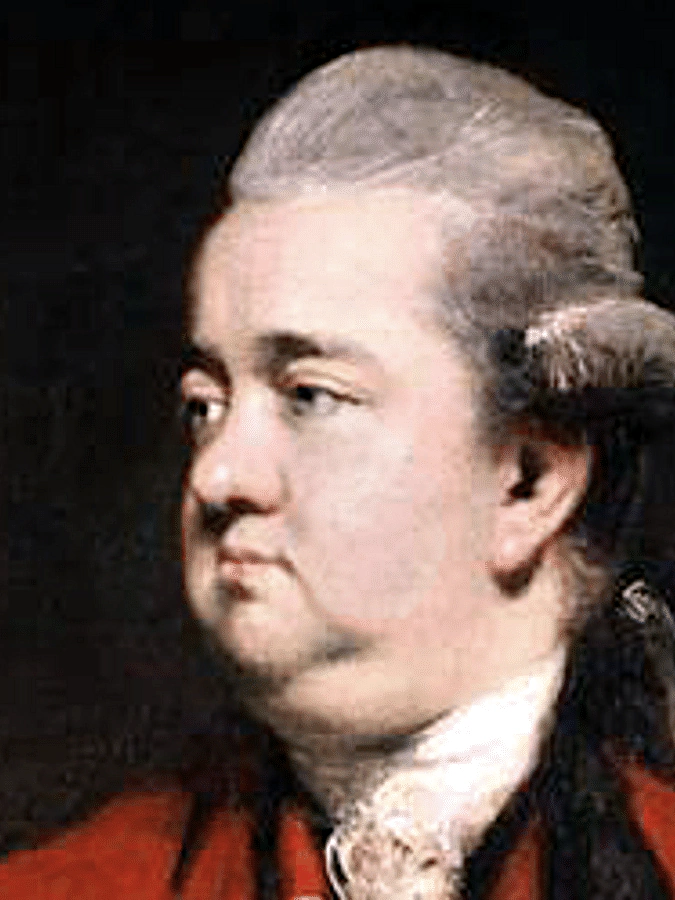
| 31 Quotes | |
| Occup. | Historian |
| From | England |
| Born | April 27, 1737 Putney, Surrey, England |
| Died | January 16, 1794 London, England |
| Aged | 56 years |
| Cite | |
Citation Formats
APA Style (7th ed.)
Edward gibbon biography, facts and quotes. (2026, February 11). FixQuotes. https://fixquotes.com/authors/edward-gibbon/
Chicago Style
"Edward Gibbon biography, facts and quotes." FixQuotes. February 11, 2026. https://fixquotes.com/authors/edward-gibbon/.
MLA Style (9th ed.)
"Edward Gibbon biography, facts and quotes." FixQuotes, 11 Feb. 2026, https://fixquotes.com/authors/edward-gibbon/. Accessed 5 Mar. 2026.
Early Life and Background
Edward Gibbon was born on April 27, 1737, at Putney, then a riverside village outside London, into a prosperous mercantile family. Sickly in childhood and often confined indoors, he grew up amid the uneasy afterglow of the Glorious Revolution and the early Hanoverian settlement, a Britain learning to prize commerce, party politics, and polite letters while also fearing religious division and continental war. That mixture of security and anxiety shaped him: he trusted institutions, suspected enthusiasm, and watched human motives with a cool, amused patience.His mother died when he was ten, and the emotional vacancy was partly filled by books and by a careful circle of guardians and relations, most importantly his aunt Catherine Porten, whose steadiness made his later self-discipline possible. The boy who would become the historian of civilizational decline absorbed, early, the rhythm of convalescence - long days, irregular schooling, and the sense that inner life could be both refuge and engine. He learned to treat the self as a project: fragile, improvable, and, with enough method, sovereign.
Education and Formative Influences
Gibbon entered Magdalen College, Oxford, in 1752, where he found the curriculum sleepy and the spiritual atmosphere porous; his reading was voracious and undirected, moving from classical historians to modern theology and controversy. In 1753 he converted to Roman Catholicism, less from devotion than from a young scholar's fascination with argument and authority, an act that alarmed his father and led to his removal from Oxford and dispatch to Lausanne under the Calvinist pastor Daniel Pavillard. The exile proved decisive: in French-speaking Switzerland he regained Protestantism (1754), mastered French, internalized continental standards of clarity, and - through systematic self-study - acquired the habit of turning private curiosity into public prose.Career, Major Works, and Turning Points
Returning to England in 1758, Gibbon published an early French essay, Essai sur l'etude de la litterature (1761), then served briefly as a militia officer during the Seven Years' War era, an experience that sharpened his sense of organization and the logistics beneath "great events". A grand tour carried him to Rome; on October 15, 1764, amid the ruins and the chanting of friars at the Capitol, he later claimed to have conceived the project that became The History of the Decline and Fall of the Roman Empire (1776-1788). Settled in London, he moved through the clubs and salons of the Enlightenment, entered Parliament for Liskeard (1774-1780), and cultivated a style as exacting as his research. Volumes I and II made him famous and controversial, especially for chapters on early Christianity; the remaining volumes confirmed his command of sources from Tacitus to Byzantine chroniclers. After financial strain and the loss of his patron Lord Sheffield's seat, he spent productive years again at Lausanne, then returned to England, dying in London on January 16, 1794.Philosophy, Style, and Themes
Gibbon's history is a psychology of power written with the tools of the Enlightenment: skepticism toward sacred claims, respect for institutions, and a mordant sense that human vanity outlives every constitution. His famous bleakness was not misanthropy but an analytic stance: “History is indeed little more than the register of the crimes, follies, and misfortunes of mankind”. The sentence is often quoted as despair; in context it is method, a refusal to sentimentalize empire or church, and a way of keeping moral outrage from distorting evidence. His compassion appears precisely where his irony tightens, as when he notes the limits of moral imagination in large societies: “Our sympathy is cold to the relation of distant misery”. That observation is also autobiographical - a man trained to look at suffering through archives and distances, struggling to keep humane feeling alive beneath apparatus.His prose married classical balance to modern insinuation: long periodic sentences, controlled antithesis, and footnotes that could become a parallel theater of wit, doubt, and disclosure. He understood learning as self-construction, not mere credential, and his discipline was a response to early fragility and to the temptations of fashionable London. “Conversation enriches the understanding, but solitude is the school of genius”. The line captures his inner economy: sociable enough for Parliament and clubs, yet dependent on withdrawal to convert reading, notes, and reflection into the grand architecture of narrative. Across Decline and Fall, the great theme is not simple "decay" but the trade-offs of civilization - how order is purchased, how belief mobilizes crowds, how prosperity softens virtue, and how contingency - plague, succession, frontier pressure - can redirect centuries.
Legacy and Influence
Gibbon became the template for modern narrative history: critical with sources, secular in explanation, and literary without surrendering to romance. Later historians contested his judgments on Christianity, the "barbarians", and Byzantium, yet they inherited his insistence on evidence and his conviction that institutions and ideas must be explained through human motives and material conditions. His irony influenced writers from Macaulay to Churchill; his footnote voice anticipated the modern scholar-essayist; and his central question - how complex societies unravel - continues to haunt debates about empire, religion, and the fragility of civic order.Our collection contains 31 quotes written by Edward, under the main topics: Witty One-Liners - Motivational - Ethics & Morality - Wisdom - Truth.