
Edward R. Murrow Biography Quotes 22 Report mistakes
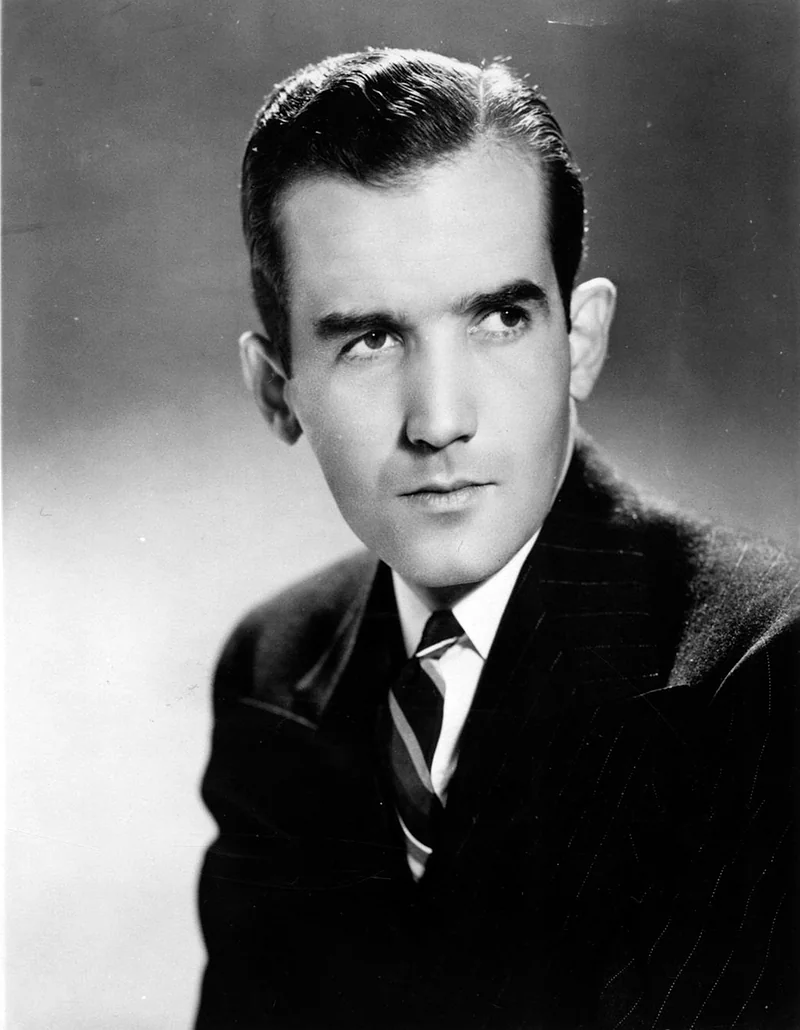
| 22 Quotes | |
| Born as | Egbert Roscoe Murrow |
| Occup. | Journalist |
| From | USA |
| Born | April 25, 1908 Guilford County, North Carolina |
| Died | April 27, 1965 Pawling, New York |
| Cause | lung cancer |
| Aged | 57 years |
| Cite | |
Citation Formats
APA Style (7th ed.)
Edward r. murrow biography, facts and quotes. (2026, February 11). FixQuotes. https://fixquotes.com/authors/edward-r-murrow/
Chicago Style
"Edward R. Murrow biography, facts and quotes." FixQuotes. February 11, 2026. https://fixquotes.com/authors/edward-r-murrow/.
MLA Style (9th ed.)
"Edward R. Murrow biography, facts and quotes." FixQuotes, 11 Feb. 2026, https://fixquotes.com/authors/edward-r-murrow/. Accessed 25 Mar. 2026.
Early Life and Background
Edward R. Murrow was born Egbert Roscoe Murrow on April 25, 1908, in Guilford County, North Carolina, and grew up largely in the timber towns and small farms of Washington State after his family moved west when he was a child. That relocation mattered: the distance from the old South, the hard physicality of logging country, and the rhythms of small-town civic life gave him an instinct for plain speech and a suspicion of inherited authority. He carried those early impressions into adulthood as a kind of moral ballast - a belief that public life should be accountable to ordinary people, not insulated from them.The United States of Murrow's youth was learning modern mass communication at the same time it was learning modern mass anxiety: radio was becoming intimate and immediate, while the nation lurched from post-World War I disillusion to the Great Depression. Murrow came of age watching confidence erode in institutions and leaders, and he absorbed the lesson that the public would not grant trust indefinitely. His later on-air persona - calm, clipped, deliberate - was not a mask so much as an answer to the volatility of his era: if the world was unstable, the voice describing it had to be steady.
Education and Formative Influences
Murrow attended Washington State College in Pullman, graduating in 1930, and became deeply involved in student leadership and debate, learning how argument can clarify a crisis without inflaming it. In the early 1930s he worked in educational and public-affairs roles, including the National Student Federation of America, which took him across the country and into contact with policymakers, labor organizers, and educators at a moment when democracy was being tested by economic collapse and ideological extremism. Those years taught him logistics, coalition-building, and the value of disciplined preparation - skills that later made him unusually effective at organizing news coverage as well as delivering it.Career, Major Works, and Turning Points
Murrow joined CBS in 1935 and soon became central to building its European news operation, first as a coordinator and then as the network's defining voice from London. During World War II he reported live from the Blitz, pioneering an immersive style of radio journalism that fused eyewitness detail with restraint, culminating in broadcasts that made distant war feel immediate to Americans. After the war he turned to television: as co-creator and host of "See It Now" (1951-1958) he helped set the template for broadcast investigative reporting, most famously with the 1954 episode scrutinizing Senator Joseph McCarthy and the climate of accusation that defined the Red Scare. He later hosted the interview series "Person to Person", and in 1961 became director of the U.S. Information Agency under President John F. Kennedy, a turn toward public service that reflected both his patriotism and his unease with what commercial television was becoming. He died on April 27, 1965, in Pawling, New York.Philosophy, Style, and Themes
Murrow's work was built on a paradox: he mastered the most modern tools of persuasion while warning against their intoxicating power. His voice - low, measured, unhurried - communicated that the audience was capable of complexity, and that the reporter's job was not to perform certainty but to earn trust. He treated facts as moral instruments: framing, context, and tone could either fortify democratic judgment or corrode it. The signature sign-off “Good night, and good luck”. sounded genial, but it carried a wartime aftertaste - an admission that luck, not virtue alone, often decides who survives history's storms.His inner life, as revealed in his aphorisms and editorial choices, revolved around conscience under pressure: the fear that comfort and conformity could make a society complicit in its own unfreedom. “We cannot defend freedom abroad by deserting it at home”. was not merely Cold War rhetoric; it was a rebuke to the temptation to trade rights for security, or dissent for unity. Likewise, his critique of demagogic power cut past personalities toward shared responsibility: “No one can terrorize a whole nation, unless we are all his accomplices”. That insistence on civic accountability explains his McCarthy broadcast - he relied less on indignation than on the simple force of the senator's own words, believing that when evidence is presented clearly, citizens can reclaim their judgment from fear.
Legacy and Influence
Murrow endures as a benchmark for ethical broadcast journalism: a reporter who proved that immediacy need not mean shallowness, and that a mass audience can be treated as adults. His London wartime reports shaped expectations for foreign correspondence; "See It Now" helped establish television as a forum where power could be questioned using documented fact rather than rumor or spectacle. Later generations cite him not as a saint but as a standard - a reminder that credibility is earned, that editorial courage is a professional duty, and that the health of a democracy is visible in how its media handles dissent, evidence, and fear.Our collection contains 22 quotes written by Edward, under the main topics: Witty One-Liners - Ethics & Morality - Truth - Wisdom - Freedom.
Other people related to Edward: Eric Sevareid (Journalist), Bob Schieffer (Journalist), Daniel Schorr (Journalist), Fred W. Friendly (Producer), Norman Corwin (Writer), Howard K. Smith (Journalist), Gabriel Heatter (Journalist), Don Hewitt (Producer)
Edward R. Murrow Famous Works
- 1954 See It Now , McCarthy episode (Non-fiction)
- 1951 See It Now (Non-fiction)
- 1951 This I Believe (Collection)
- 1950 I Can Hear It Now (Collection)
- 1950 Hear It Now (Non-fiction)
- 1941 This Is London (Book)