
Emanuel Swedenborg Biography Quotes 28 Report mistakes
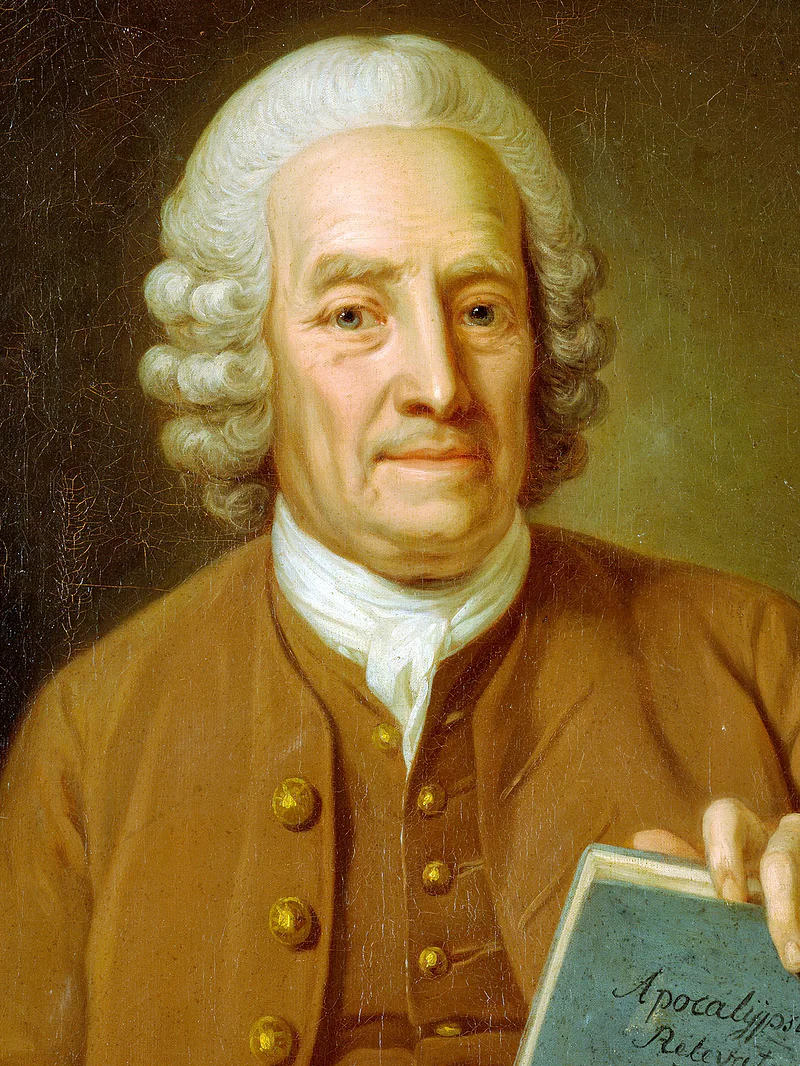
| 28 Quotes | |
| Born as | Emanuel Swedberg |
| Occup. | Scientist |
| From | Sweden |
| Born | January 29, 1688 Stockholm, Sweden |
| Died | March 29, 1772 London, England |
| Aged | 84 years |
| Cite | |
Citation Formats
APA Style (7th ed.)
Emanuel swedenborg biography, facts and quotes. (2026, February 11). FixQuotes. https://fixquotes.com/authors/emanuel-swedenborg/
Chicago Style
"Emanuel Swedenborg biography, facts and quotes." FixQuotes. February 11, 2026. https://fixquotes.com/authors/emanuel-swedenborg/.
MLA Style (9th ed.)
"Emanuel Swedenborg biography, facts and quotes." FixQuotes, 11 Feb. 2026, https://fixquotes.com/authors/emanuel-swedenborg/. Accessed 25 Mar. 2026.
Early Life and Background
Emanuel Swedenborg was born Emanuel Swedberg on 1688-01-29 in Stockholm, Sweden, into a rising clerical family that embodied the early Swedish Enlightenment's uneasy marriage of Lutheran piety and state service. His father, Jesper Swedberg, was a forceful bishop and hymn writer who defended a vivid, experiential Christianity against cold formalism, while still moving inside the courtly machinery of the Swedish realm. That combination - institutional discipline paired with a hunger for the immediate presence of God - formed the emotional weather of Swedenborg's childhood.In 1719 the family name was ennobled to Swedenborg, an ascent that placed Emanuel among the educated administrative elite that managed mines, canals, and the crown's finances in the wake of Sweden's imperial decline after the Great Northern War. He grew up amid a culture that prized practical knowledge as patriotic repair work: improve navigation, metallurgy, and public works, and the nation could recover. That civic pressure to be useful never left him, even after his intellectual life turned inward and upward.
Education and Formative Influences
Swedenborg studied at Uppsala University, absorbing mathematics, philosophy, and the new science, then traveled widely in England, the Dutch Republic, France, and Germany (1710-1715), where he encountered Newtonian physics, advanced instrument-making, and the confident empiricism of learned societies. He returned to Sweden with an engineer's imagination and a public servant's sense of mission, publishing technical proposals and cultivating patrons at court; the habit he built in these years was to treat ideas as systems that must cohere from first principles to practical outcomes.Career, Major Works, and Turning Points
In 1716 he helped launch the scientific periodical Daedalus Hyperboreus and soon became Assessor of the Swedish Board of Mines (Bergskollegium) in 1717, a post he held for decades, traveling to inspect mines and advising on metallurgy, coinage, and industrial policy. His early corpus ranged from mechanics and cosmology to anatomy: the massive Opera Philosophica et Mineralia (1734) laid out a theory of matter and the natural world; later works like The Economy of the Animal Kingdom (1740-1741) sought the soul through physiology. The decisive turning point came in the mid-1740s, after a prolonged spiritual crisis recorded in his Dream Diary and a series of visions in which he believed he was commissioned to describe the spiritual world. He resigned his post in 1747 and redirected his disciplined, report-like prose toward theological works written largely in Latin: Arcana Coelestia (1749-1756), Heaven and Hell (1758), The New Jerusalem and its Heavenly Doctrine (1758), Divine Love and Wisdom (1763), and True Christian Religion (1771). He died in London on 1772-03-29, having lived his last decades between Sweden and England, supported by a quiet network of readers.Philosophy, Style, and Themes
Swedenborg's inner life reads as a rare fusion of the laboratory mind with the confessional one. He distrusted mere enthusiasm, yet he also distrusted a church that, in his view, sealed heaven behind doctrine without transformation. His method was to extend the habits of observation and classification into the invisible: heaven and hell as real environments with laws, correspondences, and degrees. He anticipated disbelief and met it with a scientist's stubborn empiricism, writing, “I am well aware that many will say that no one can possibly speak with spirits and angels so long as he lives in the body; and many will say that it is all fancy, others that I relate such things in order to gain credence, and others will make other objections”. The sentence is psychological self-defense, but also a portrait of his temperament: he preferred argument by accumulated testimony, calmly stated, over rhetorical conquest.His distinctive theme is correspondence - the claim that nature is a readable surface of spiritual realities, and that scripture itself contains layered meanings. He insists, “For in every particular of the Word there is an internal sense which treats of things spiritual and heavenly, not of things natural and worldly, such as are treated of in the sense of the letter”. That interpretive engine let him reconcile the Enlightenment's demand for order with an older Christian symbolism, turning Bible reading into a disciplined science of the soul. Ethically, his heaven is not earned by assent but formed by love expressed as use; he defines love not as sentiment but as a transfer of life outward: “Love consists in desiring to give what is our own to another and feeling his delight as our own”. In this, the former mining assessor remains visible - salvation as productivity of the heart, an economy where the currency is service.
Legacy and Influence
Swedenborg founded no church during his lifetime, but his writings sparked the Swedenborgian or New Church movement, especially in Britain and America, and reached far beyond it into Romantic literature and modern psychology. William Blake argued with him, Ralph Waldo Emerson mined him, and later writers from Balzac to Borges treated him as a visionary cartographer of inner space; his influence also touched early spiritualism, though he himself framed visions within a moral and Christ-centered order. In an era that separated science from spirit, Swedenborg's enduring provocation is the opposite wager: that the universe is continuous from matter to meaning, and that the most practical work is the reformation of desire into intelligent charity.Our collection contains 28 quotes written by Emanuel, under the main topics: Ethics & Morality - Never Give Up - Love - Kindness - Faith.
Emanuel Swedenborg Famous Works
- 1771 True Christian Religion (Non-fiction)
- 1768 Conjugial Love (Non-fiction)
- 1766 Apocalypse Revealed (Non-fiction)
- 1764 Divine Providence (Non-fiction)
- 1763 Divine Love and Wisdom (Non-fiction)
- 1758 The Last Judgment and Babylon Destroyed (Non-fiction)
- 1758 Heaven and Hell (Non-fiction)
- 1749 Arcana Coelestia (Book)
- 1743 On the Earths in the Universe (On the Earths in Our Solar System) (Non-fiction)
- 1734 Opera Philosophica et Mineralia (Book)