
Emily Dickinson Biography Quotes 45 Report mistakes
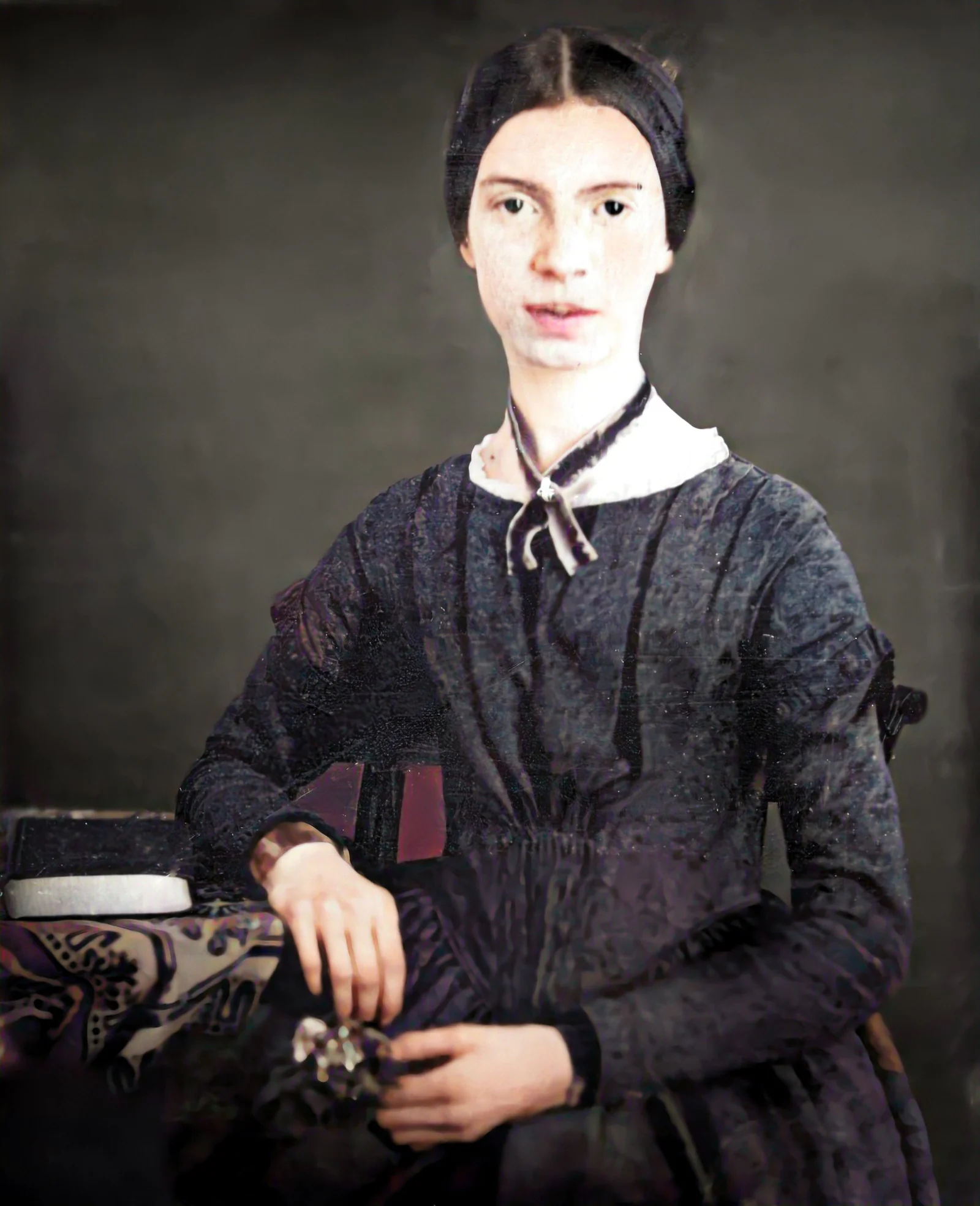
| 45 Quotes | |
| Occup. | Poet |
| From | USA |
| Born | December 10, 1830 |
| Died | May 15, 1886 |
| Aged | 55 years |
| Cite | |
Citation Formats
APA Style (7th ed.)
Emily dickinson biography, facts and quotes. (2026, February 11). FixQuotes. https://fixquotes.com/authors/emily-dickinson/
Chicago Style
"Emily Dickinson biography, facts and quotes." FixQuotes. February 11, 2026. https://fixquotes.com/authors/emily-dickinson/.
MLA Style (9th ed.)
"Emily Dickinson biography, facts and quotes." FixQuotes, 11 Feb. 2026, https://fixquotes.com/authors/emily-dickinson/. Accessed 27 Mar. 2026.
Early Life and Background
Emily Elizabeth Dickinson was born on December 10, 1830, in Amherst, Massachusetts, into a prominent New England family whose public standing sharpened her private sense of difference. Her father, Edward Dickinson, a lawyer and longtime Amherst civic leader, embodied Whig discipline, civic duty, and household authority; her mother, Emily Norcross Dickinson, was loving but often ill and emotionally reserved, leaving the daughter to cultivate a self-reliant inwardness early. Dickinson grew up in the Homestead on Main Street with her brother Austin and sister Lavinia, amid a village that was both intellectually ambitious and morally vigilant, tied to Amherst College and the era's Protestant earnestness.The social world that formed her was the mid-19th-century republic of parlors, sermons, letters, and local reputation, with the additional pressure of revivalist religion that asked for public declarations of faith. Dickinson watched, listened, and measured herself against expectations of womanhood - sociability, piety, domestic accomplishment - while keeping an almost clinical record of feeling, loss, and desire. Death visited her early imagination not only through family illness and the community's frequent funerals, but through the steady lesson that lives were narrated and judged; she responded by learning to narrate herself in secrecy, as if the truest account required concealment.
Education and Formative Influences
Dickinson studied at Amherst Academy (1840-1847), where she encountered Latin, botany, and a disciplined habit of observation that later became poetic method; the academy also fed her lifelong love of precise naming, from flowers to theological states of mind. A brief year at Mount Holyoke Female Seminary (1847-1848) exposed her to intensified evangelical pressure and a culture of spiritual classification that she resisted, returning to Amherst without the conventional conversion narrative expected of her. She read widely - the King James Bible, Shakespeare, Milton, the Metaphysical poets, and especially the Bronte sisters; she absorbed hymnal meters and the rhetoric of sermons, then turned them into instruments for doubt. Influential friendships and correspondences with figures such as Susan Gilbert Dickinson (her sister-in-law and likely her most enduring intimate audience) and later Thomas Wentworth Higginson helped shape her sense of vocation: she wanted a listener, not a tribunal.Career, Major Works, and Turning Points
Dickinson published almost nothing during her lifetime - a handful of poems, often anonymously and editorially altered - yet between the 1850s and mid-1860s she produced the concentrated body of work that would make her central to American poetry, ultimately around 1, 800 poems. The great turning point came in 1862, her annus mirabilis, when she drafted an extraordinary number of poems and began writing to Higginson, asking whether her verse was "alive" - a question that reveals both audacity and a fear of misrecognition. As she increasingly withdrew from social life, the house became a workshop: she drafted on scraps, copied clean in packets later called fascicles, and conducted major relationships through letters that blurred genres into lyrical address. After her death on May 15, 1886, Lavinia discovered the trove and fought to bring it into print, though early editions by Mabel Loomis Todd and Thomas Wentworth Higginson regularized her punctuation and diction; only in the 20th century did scholars restore the jagged, deliberate integrity of her manuscripts.Philosophy, Style, and Themes
Dickinson's inner life was not mere retreat but an ethics of attention. Her poems treat consciousness as a laboratory where belief and skepticism are tested under pressure - grief, erotic longing, natural beauty, and the terror of extinction. Nature is rarely pastoral in her hands; it is intimate yet ungovernable, a presence that refuses the human timetable and the human ego: “How strange that nature does not knock, and yet does not intrude!” That sentence captures her psychological balance between craving contact and insisting on boundaries, a stance mirrored in her own guarded availability to others: she could be intensely affectionate, yet choose distance as a form of control.Formally, she built a new music from old materials: common meter, hymn cadence, slant rhyme, and the dash used not as ornament but as a record of thinking - hesitation, acceleration, recoil. Her themes circle recurring abysses: the body, the soul, the afterlife, and the social theater of fame. “Celebrity is the chastisement of merit and the punishment of talent”. The line is not a pose of modesty so much as a diagnosis of what exposure does to a self she considered sacred, and it helps explain her preference for a private posterity over a public career. Yet her poems also court extremity and transformation, approaching death not as a moral endpoint but as a cognitive frontier: “Dying is a wild night and a new road”. In that image, her fear becomes exploratory energy - a willingness to walk into darkness as if it were another kind of knowledge.
Legacy and Influence
Dickinson's posthumous ascent reshaped modern poetry: her compressed syntax, radical lineation, and psychological candor anticipated Modernism while remaining unmistakably her own, a New England mystic of the minute particulars. Restored texts revealed her as an innovator who made privacy a method and doubt a discipline, influencing poets from Hart Crane and Marianne Moore to Elizabeth Bishop and Sylvia Plath, as well as generations of readers who recognized in her seclusion not absence but intensity. She endured because she made the smallest room - a desk, a window, a mind refusing easy consolation - large enough to contain the era's crises of faith and the timeless shock of being alive.Our collection contains 45 quotes written by Emily, under the main topics: Motivational - Truth - Wisdom - Friendship - Love.
Other people related to Emily: Helen Hunt Jackson (Writer), Tom Verlaine (Musician), Conrad Aiken (Author), Edmund C. Stedman (Poet)
Emily Dickinson Famous Works
- 1929 Further Poems of Emily Dickinson (Book)
- 1914 The Single Hound: Poems of a Lifetime (Book)
- 1896 Poems by Emily Dickinson: Third Series (Book)
- 1894 The Letters of Emily Dickinson (Book)
- 1891 Poems by Emily Dickinson: Second Series (Book)
- 1890 Poems by Emily Dickinson: First Series (Book)
Source / external links