
Emma Goldman Biography Quotes 39 Report mistakes
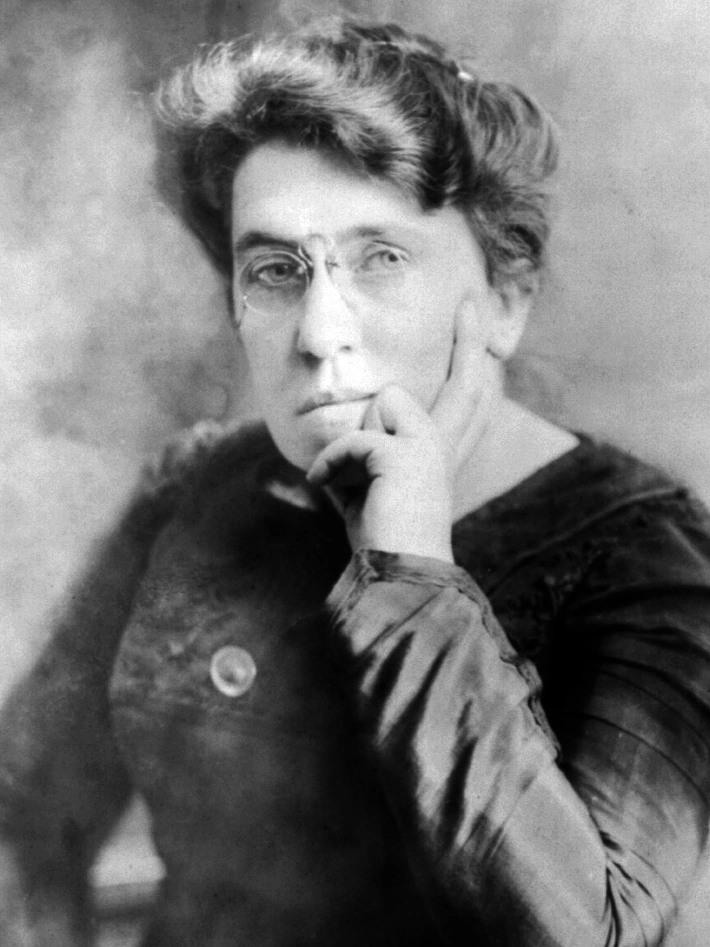
| 39 Quotes | |
| Occup. | Activist |
| From | Lithuania |
| Born | June 27, 1869 Kovno, Kovno Governorate, Russian Empire (now Kaunas, Lithuania) |
| Died | May 14, 1940 Toronto, Ontario, Canada |
| Aged | 70 years |
| Cite | |
Citation Formats
APA Style (7th ed.)
Emma goldman biography, facts and quotes. (2026, February 11). FixQuotes. https://fixquotes.com/authors/emma-goldman/
Chicago Style
"Emma Goldman biography, facts and quotes." FixQuotes. February 11, 2026. https://fixquotes.com/authors/emma-goldman/.
MLA Style (9th ed.)
"Emma Goldman biography, facts and quotes." FixQuotes, 11 Feb. 2026, https://fixquotes.com/authors/emma-goldman/. Accessed 5 Mar. 2026.
Early Life and Background
Emma Goldman was born on June 27, 1869, in Kovno in the Russian Empire (now Kaunas, Lithuania), into an Ashkenazi Jewish family marked by instability, debt, and the casual brutality of patriarchal rule. Her childhood unfolded under the long shadow of Tsarist repression, where Jews lived with legal restrictions, periodic violence, and the grinding humiliations of being tolerated but never secure. At home, her father, Abraham Goldman, expected obedience and early marriage; Goldman remembered a household where a young girl's intellect was treated as a nuisance and her body as a future bargaining chip.That early collision between a hungry mind and a closed world shaped her inner life: she grew defiant, keyed to injustice, and emotionally allergic to submission. She read what she could, argued with teachers, and fixated on the idea that freedom was not a gift but a condition to be seized. When the family moved to Saint Petersburg and later to other cities within the empire, she absorbed both the cosmopolitan ferment and the police-state atmosphere - a mix that would later make her receptive to revolutionary subcultures and distrustful of official pieties.
Education and Formative Influences
Goldman had little formal schooling by modern standards, but she educated herself through voracious reading and immersion in immigrant political life. After emigrating to the United States in 1885 and working in Rochester, New York, as a garment worker, she encountered the radical literature of anarchism, freethought, and labor revolt in Yiddish and English. The 1886 Haymarket affair in Chicago and the execution of anarchists in 1887 struck her as a moral thunderclap, converting outrage into purpose and persuading her that the American promise concealed the same coercions she had fled - only better dressed.Career, Major Works, and Turning Points
By the early 1890s Goldman was in New York City, speaking on anarchism, labor, birth control, and sexual freedom, often under surveillance and repeatedly arrested; her partnership with Alexander Berkman fused devotion, strategy, and shared risk. Berkman's attempted assassination of industrialist Henry Clay Frick during the Homestead strike in 1892 became a defining rupture: Goldman was not convicted as an accomplice, but the episode branded her publicly and forced her to reckon with the moral costs of political violence. She became one of the era's most electrifying lecturers, founded the journal Mother Earth in 1906, and wrote a body of essays later collected in Anarchism and Other Essays (1910), while also defending figures as varied as striking workers, modern artists, and marginalized sexual minorities. In 1917, her anti-conscription activism led to imprisonment under the Espionage Act; in 1919 she was deported with other radicals on the "Buford". Hopes for the Russian Revolution curdled into condemnation after she witnessed Bolshevik repression, recorded in My Disillusionment in Russia (1923) and My Further Disillusionment in Russia (1924), and her autobiography Living My Life (1931) became a landmark account of radicalism as lived experience rather than slogan.Philosophy, Style, and Themes
Goldman's anarchism was psychological as much as political: she saw domination embedded in family, church, workplace, and the internalized policeman of fear. Her prose and oratory mixed moral indictment with a novelist's eye for motive, insisting that liberation required pleasure, art, and tenderness alongside organization and courage. The famous line, “If I can't dance, I don't want to be part of your revolution”. captures her suspicion of joyless militancy - a clue to her own temperament, restless and sensuous, unwilling to trade one prison for another. She treated love and desire not as distractions but as evidence that human beings were made for more than obedience.Her themes returned to the hypocrisies that convert cruelty into virtue. She distrusted electoral salvation, arguing that power concedes nothing to ballots alone; her acid summary, “If voting changed anything, they'd make it illegal”. was less cynicism than diagnosis, rooted in years of watching police, courts, and employers close ranks when property felt threatened. She also waged a lifelong war on sexual repression and moral policing, warning that “Puritanism, in whatever expression, is a poisonous germ. On the surface everything may look strong and vigorous; yet the poison works its way persistently, until the entire fabric is doomed”. The intensity of this critique reflected her inner biography: she had felt the costs of shame in her own relationships and saw how public virtue was often private violence.
Legacy and Influence
Goldman died on May 14, 1940, in Toronto after a stroke, and was buried near the Haymarket martyrs in Forest Park, Illinois - a symbolic return to the event that forged her. Her influence persists not because she offered a tidy program, but because she expanded what counted as politics: contraception and free speech, workplace power and erotic autonomy, anti-militarism and the right to dissent even against revolutions she once defended. Later anarchists, feminists, civil libertarians, and queer activists drew from her insistence that freedom is indivisible and that a movement that cannot honor the whole human being will eventually reproduce the very tyrannies it claims to oppose.Our collection contains 39 quotes written by Emma, under the main topics: Motivational - Ethics & Morality - Wisdom - Justice - Love.
Other people related to Emma: Max Stirner (Philosopher), Johann Most (Revolutionary), Alexander Berkman (Writer), John Reed (Journalist), Voltairine de Cleyre (Activist)