
Enrico Fermi Biography Quotes 7 Report mistakes
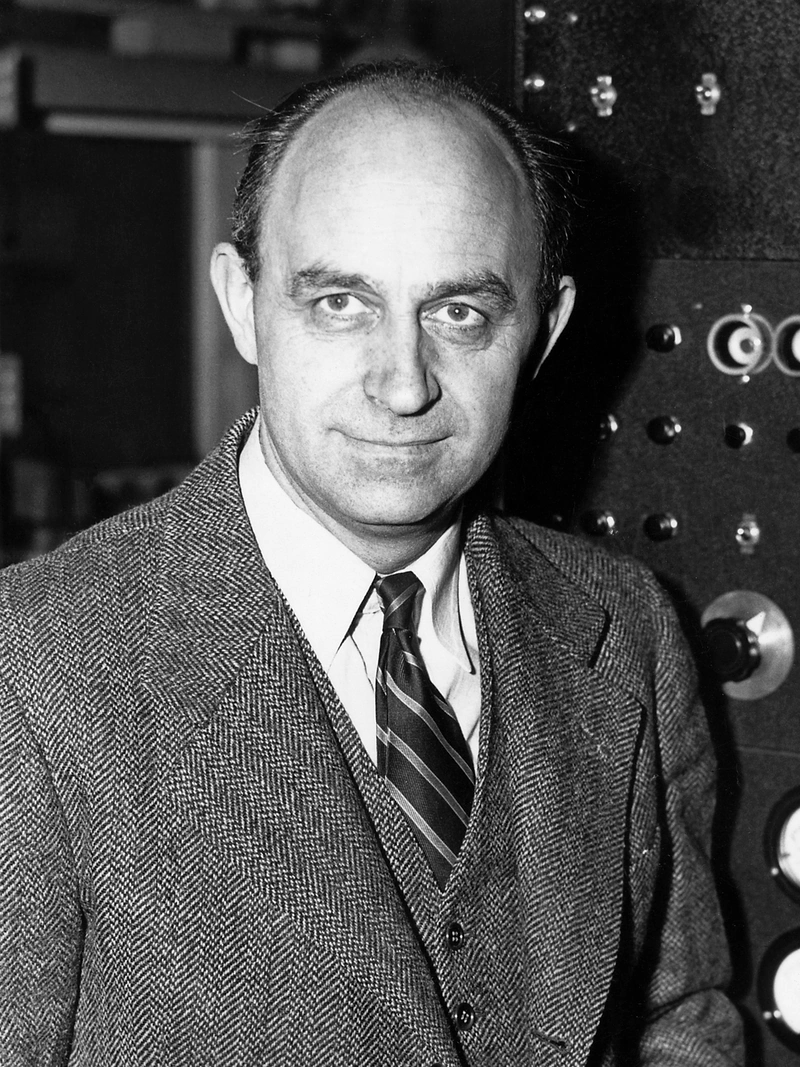
| 7 Quotes | |
| Occup. | Physicist |
| From | Italy |
| Born | September 29, 1901 |
| Died | November 28, 1954 |
| Aged | 53 years |
| Cite | |
Citation Formats
APA Style (7th ed.)
Enrico fermi biography, facts and quotes. (2026, February 11). FixQuotes. https://fixquotes.com/authors/enrico-fermi/
Chicago Style
"Enrico Fermi biography, facts and quotes." FixQuotes. February 11, 2026. https://fixquotes.com/authors/enrico-fermi/.
MLA Style (9th ed.)
"Enrico Fermi biography, facts and quotes." FixQuotes, 11 Feb. 2026, https://fixquotes.com/authors/enrico-fermi/. Accessed 6 Mar. 2026.
Early Life and Education
Enrico Fermi was born in Rome in 1901 and grew up in a family that valued study and discipline. As a schoolboy he showed remarkable aptitude for mathematics and physics, devouring textbooks and building apparatus to test ideas. He won admission to the Scuola Normale Superiore in Pisa, one of Italy's most rigorous institutions, where he refined an approach that would remain his hallmark: combine theoretical clarity with practical, quantitative tests. He earned his doctorate in the early 1920s and immediately began to publish on statistical mechanics and atomic theory.After Pisa he traveled in northern Europe to absorb the newest quantum ideas at their source. In Gottingen he interacted with Max Born, and in Leiden he learned from Paul Ehrenfest's probing style of questioning, which emphasized simple models and clear physical pictures. Encounters with Wolfgang Pauli and Niels Bohr helped sharpen his understanding of the emerging quantum theory, and he returned to Italy determined to build a modern research school.
Building Modern Physics in Italy
In 1927 Fermi was appointed to Italy's first chair of theoretical physics at the University of Rome. There he created a vibrant group later known as the Via Panisperna boys, including Edoardo Amaldi, Franco Rasetti, Emilio Segre, Bruno Pontecorvo, and Ettore Majorana. The group blended craftsmanship with theory, assembling equipment in-house and seizing on new phenomena with speed and care. Fermi's teaching emphasized order-of-magnitude estimates and back-of-the-envelope calculations, tools he wielded with legendary ease.During these years he made two foundational contributions to quantum physics. In 1926 he developed the statistics governing particles that obey the Pauli exclusion principle; independently derived also by Paul Dirac, it became known as Fermi-Dirac statistics and underlies the physics of electrons in solids. Soon after, he contributed to what is now called the Thomas-Fermi model of the atom, providing a powerful approximation for many-electron systems.
From Beta Decay to Slow Neutrons
In 1933, 1934 Fermi proposed a theory of beta decay that introduced a new fundamental interaction to account for the transformation of neutrons into protons and electrons. He incorporated Pauli's light neutral particle into the framework and helped popularize the term neutrino. Though simple in form, the theory proved immensely successful in describing decay rates and spectra, and it set the stage for the later development of the weak interaction.At roughly the same time Fermi and his Rome collaborators embarked on a campaign to bombard elements with neutrons. They discovered that slowing neutrons down dramatically increased their effectiveness in inducing radioactivity, an insight born from experiments using paraffin and other moderators. With slow neutrons they produced a wealth of new radioactive isotopes and believed they had created elements heavier than uranium. Only later, after the chemical work of Otto Hahn and Fritz Strassmann and the interpretation by Lise Meitner and Otto Frisch, did the community recognize that some of these reactions were actually nuclear fission. Fermi quickly grasped the implications for chain reactions and energy release.
Nobel Prize and Emigration
Fermi received the 1938 Nobel Prize in Physics for his demonstrations of new radioactive elements produced by neutron irradiation and for the discovery of nuclear reactions induced by slow neutrons. The political situation in Italy had deteriorated under anti-Jewish laws, which imperiled his wife, Laura Capon Fermi, and their family. Using the Nobel ceremony in Stockholm as a departure point, the Fermis emigrated to the United States. They settled first in New York, where Fermi joined Columbia University.Toward the First Controlled Chain Reaction
At Columbia, Fermi collaborated with Leo Szilard, Isidor Rabi, Eugene Wigner, Herbert Anderson, Walter Zinn, and John Dunning to probe whether a self-sustaining chain reaction in uranium could be realized. They measured neutron cross sections, studied moderators such as graphite and heavy water, and refined the theory of neutron diffusion and multiplication. With the advent of war, this work moved to the Metallurgical Laboratory at the University of Chicago under Arthur Compton, with coordination alongside General Leslie Groves of the Manhattan Project.On December 2, 1942, beneath the stands of Stagg Field, Fermi directed Chicago Pile-1, the first human-made, self-sustaining nuclear chain reaction. Using graphite as moderator and natural uranium as fuel, he achieved a multiplication factor just above unity, controlled by cadmium control rods and monitored with instruments built to his specifications. The demonstration was a turning point: proof that controlled nuclear energy was possible.
Los Alamos and the War Effort
Fermi moved to Los Alamos as a senior scientific leader, advising on neutron transport, criticality, and weapon physics. He worked with Hans Bethe, Robert Oppenheimer, and Edward Teller in an intense environment that blended theory, engineering, and rapid experimentation. At the Trinity test in July 1945, he made a famous order-of-magnitude estimate of yield by dropping small pieces of paper and watching how the shock wave displaced them, a characteristic display of his pragmatic style. After the war he received high civilian honors for his contributions.University of Chicago and a New Era of Physics
Returning to Chicago, Fermi became a central figure at the Institute for Nuclear Studies. He taught influential courses, later distilled into classic texts on nuclear physics and elementary particles. He guided experiments with cyclotrons and reactors, and he continued to refine theoretical tools such as the so-called golden rule for transition rates in quantum systems. In astrophysics he proposed a mechanism for the acceleration of cosmic rays by repeated scattering off moving magnetic irregularities, an idea that remains foundational.He served on the General Advisory Committee of the U.S. Atomic Energy Commission alongside Oppenheimer and Isidor Rabi. In the fraught debates after 1949, Fermi argued, with I. I. Rabi, against a crash program for a thermonuclear superweapon, urging careful consideration of technical feasibility and moral responsibility. Even so, he continued to contribute technical insights where his expertise could clarify possibilities and limits.
Style, Mentorship, and Character
Fermi's colleagues valued his rare combination of breadth and economy of thought. He preferred simple models, dimensional analysis, and carefully designed experiments that exposed essential parameters. Students and collaborators such as Owen Chamberlain, Jack Steinberger, Edoardo Amaldi, and Herbert Anderson recalled how he could translate a complicated problem into a tractable approximation within minutes. Richard Feynman, who interacted with him at Los Alamos, admired his insistence on quantitative checks even for bold ideas. In Rome and later in Chicago, he cultivated teams where machinists, chemists, and theorists worked side by side.Recognition and Last Years
The concepts bearing his name, Fermi-Dirac statistics, Fermi energy and surface, the Thomas-Fermi model, Fermi's golden rule, the Fermi method of estimation, and Fermi acceleration, reflect the reach of his work from the quantum scale to astrophysical phenomena. Institutions likewise honor him: the postwar Institute for Nuclear Studies in Chicago became closely associated with his legacy, and a national accelerator laboratory was later named Fermilab.In 1954, at the height of his powers as a researcher and teacher, Fermi died in Chicago of stomach cancer. He was 53. Colleagues such as Hans Bethe, Niels Bohr, and Robert Oppenheimer praised his rare balance of imagination and restraint, and Laura Fermi's memoir offered an intimate portrait of the human being behind the achievements. His example endures in the culture of physics: think clearly, measure carefully, and trust simple, testable ideas.
Our collection contains 7 quotes written by Enrico, under the main topics: Witty One-Liners - Puns & Wordplay - Science - Knowledge.
Other people related to Enrico: Subrahmanyan Chandrasekhar (Scientist), James Bryant Conant (Scientist), Felix Bloch (Scientist), Jerome Isaac Friedman (Physicist), Philip Morrison (Scientist)
Enrico Fermi Famous Works
- 1950 Nuclear Physics (Book)
- 1934 An Attempt of a Theory of Beta Rays (Essay)
- 1928 Introduzione alla fisica atomica (Book)
- 1927 Un metodo statistico per la determinazione di alcune proprietà dell'atomo (Essay)
- 1926 Sulla quantizzazione del gas perfetto monoatomico (Essay)