
Enzo Ferrari Biography Quotes 3 Report mistakes
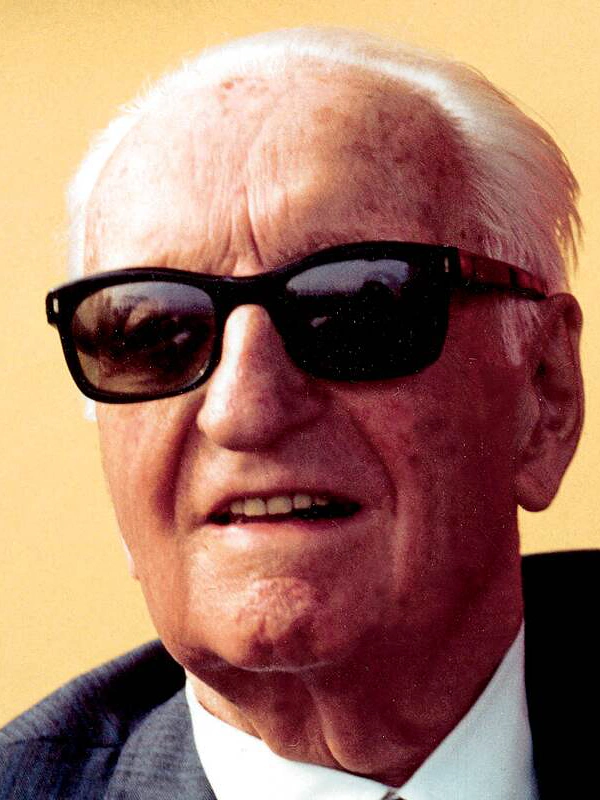
| 3 Quotes | |
| Born as | Enzo Anselmo Ferrari |
| Known as | Il Commendatore |
| Occup. | Designer |
| From | Italy |
| Born | February 18, 1898 Modena, Italy |
| Died | August 14, 1988 Maranello, Italy |
| Aged | 90 years |
| Cite | |
Citation Formats
APA Style (7th ed.)
Enzo ferrari biography, facts and quotes. (2026, February 11). FixQuotes. https://fixquotes.com/authors/enzo-ferrari/
Chicago Style
"Enzo Ferrari biography, facts and quotes." FixQuotes. February 11, 2026. https://fixquotes.com/authors/enzo-ferrari/.
MLA Style (9th ed.)
"Enzo Ferrari biography, facts and quotes." FixQuotes, 11 Feb. 2026, https://fixquotes.com/authors/enzo-ferrari/. Accessed 25 Mar. 2026.
Early Life and Background
Enzo Anselmo Ferrari was born on February 18, 1898, in Modena, in Italys Emilia-Romagna, a region where metalwork, rail lines, and small workshops seeded an early car culture. His father, Alfredo Ferrari, ran a modest metalworking business, and the boy grew up amid tools, foundries, and the practical language of machines. A formative childhood memory - widely cited in accounts of his life - was attending a motor race at Modenas Circuito in 1908, where speed and mechanical daring fused into a vocation.The First World War and influenza marked him with losses that hardened his reserve: his father and older brother died in 1916, and Enzo himself served as a military farrier before illness sent him home. Postwar Italy was economically bruised and politically volatile, and Ferrari entered adulthood with a craftsman-entrepreneurs mindset - suspicious of comfort, hungry for competence, and drawn to arenas where risk could be measured. Those early shocks helped create the emotional pattern that later defined him: private grief behind public ferocity, and a belief that only work and performance could justify survival.
Education and Formative Influences
Ferrari did not follow an academic path; his education was largely practical, shaped by shop floors, the discipline of wartime service, and the self-directed study of racing news and mechanics. After struggling to find stable employment, he joined CMN in Milan and began racing in 1919, then moved to Alfa Romeo in 1920 as both driver and factory representative. The era rewarded men who could translate instinct into engineering demands, and Ferraris formative influence was the early professional racing world itself - a traveling fraternity of mechanics, patrons, and drivers in which reliability, metallurgy, and strategy mattered as much as courage.Career, Major Works, and Turning Points
Ferraris driving career was respectable rather than legendary, but it gave him access to the real levers of victory: organization, technical development, and talent selection. In 1929 he founded Scuderia Ferrari in Modena, initially to run Alfa Romeo cars for wealthy amateurs while building a professional racing infrastructure; by the mid-1930s it had become the most formidable private team in Europe. A turning point came with his 1939 split from Alfa Romeo, after which he established Auto Avio Costruzioni; wartime constraints delayed his ambitions, but in 1947 the first true Ferrari, the 125 S with Gioacchino Colombos V12, debuted from the new Maranello works. Under Ferraris hard stewardship, the company balanced two identities: racing as the reason to exist, and road cars as the means to fund it. His teams captured major prizes across decades - including early Formula One championships in the 1950s - while the road cars evolved from spare, competition-bred machines into icons of postwar Italian industrial style.Philosophy, Style, and Themes
Ferraris philosophy began with powertrain primacy. He treated the engine not as a component but as the moral center of the car, a source of both performance and personality. This bias could become doctrine - “Aerodynamics are for people who can't build engines”. The line is more than bravado; it reveals a designer who trusted measurable force over fashionable theory and who believed that engineering should sound and feel alive. His best Ferraris - from early V12 sports racers to later grand tourers - carried that signature: mechanical intensity, high-revving urgency, and an insistence that the car communicate through vibration, noise, and response.Just as defining was his paternal, often abrasive view of leadership and customers. Ferrari sold road cars to finance racing, yet he refused to treat buyers as sovereign; he shaped demand rather than serving it. “The client is not always right”. That stance reflected his psychology: a need for control, a fear that compromise would dilute performance, and a conviction that excellence required hierarchy. His inner life was also marked by cyclical strain - the perpetual gamble of competition, deaths of drivers, and the whiplash between triumph and disaster. In a rare moment of self-description he admitted, “But each time I seemed to be climbing into a roller coaster and finding myself coming through the downhill run with that sort of dazed feeling that we all know”. The image captures his working temperament: addicted to the stakes, emotionally braced for impact, and able to convert grief and adrenaline into relentless iteration.
Legacy and Influence
When Ferrari died on August 14, 1988, in Modena, he left more than a company: he left a template for the modern performance brand, where racing credibility, engineering myth, and controlled scarcity form a single narrative. Maranello became a pilgrimage site and a benchmark, influencing rivals from Italy, Britain, Germany, and Japan in how to fuse competition programs with road-car identity. His enduring influence lies in a paradox he embodied: the most romantic of marques built through unsentimental discipline, where the designers eye was always on the stopwatch, and the man behind the legend remained, at core, a workshop strategist who believed that speed was the only honest biography.Our collection contains 3 quotes written by Enzo, under the main topics: Witty One-Liners - Customer Service - Excitement.
Other people related to Enzo: Nigel Mansell (Athlete), Brock Yates (Editor)