
Ernest Rutherford Biography Quotes 4 Report mistakes
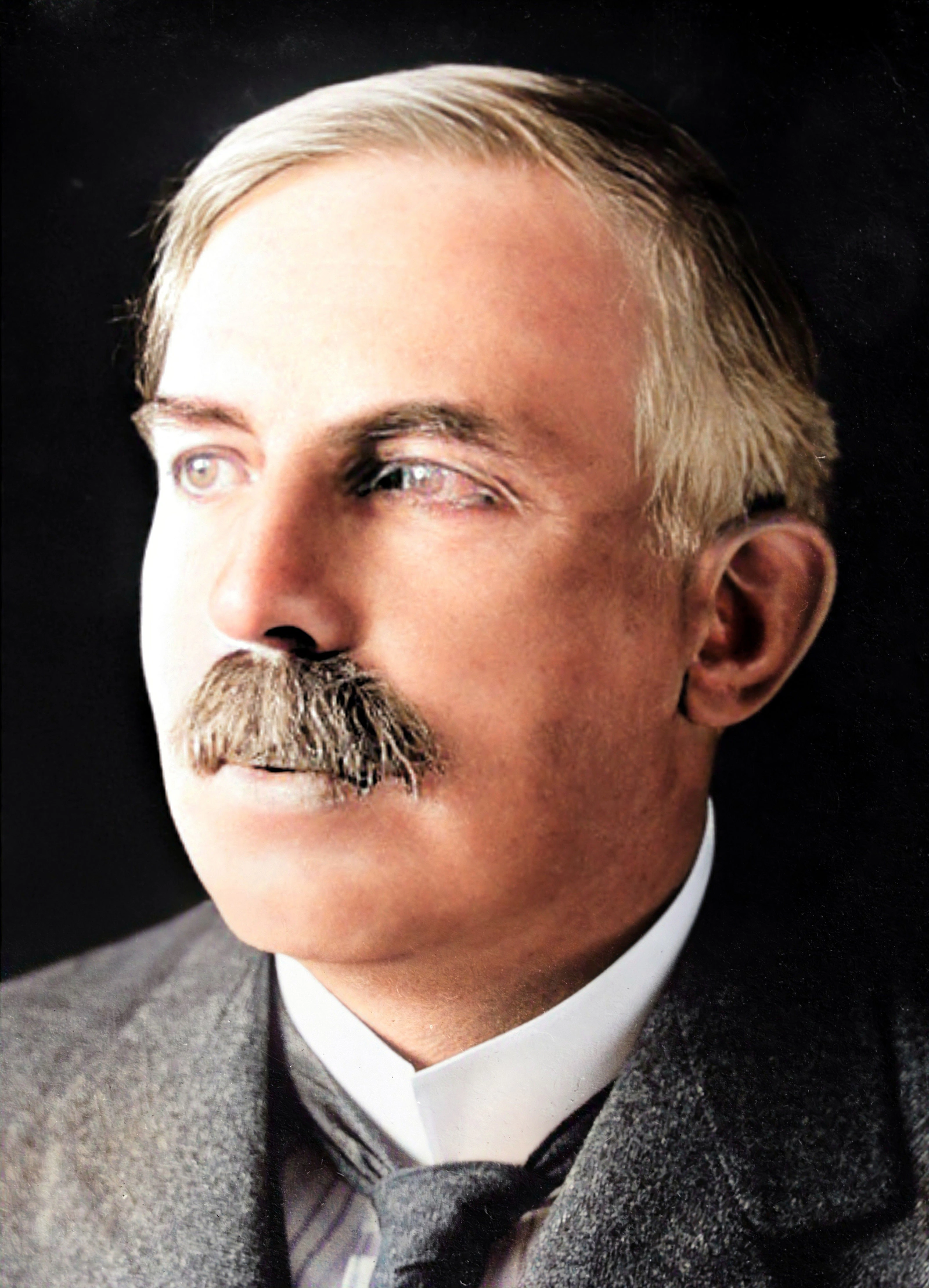
| 4 Quotes | |
| Born as | Brightwater, New Zealand |
| Known as | 1st Baron Rutherford of Nelson |
| Occup. | Psychologist |
| From | New Zealand |
| Born | August 30, 1871 |
| Died | October 19, 1937 Cambridge, England |
| Aged | 66 years |
| Cite | |
Citation Formats
APA Style (7th ed.)
Ernest rutherford biography, facts and quotes. (2026, February 11). FixQuotes. https://fixquotes.com/authors/ernest-rutherford/
Chicago Style
"Ernest Rutherford biography, facts and quotes." FixQuotes. February 11, 2026. https://fixquotes.com/authors/ernest-rutherford/.
MLA Style (9th ed.)
"Ernest Rutherford biography, facts and quotes." FixQuotes, 11 Feb. 2026, https://fixquotes.com/authors/ernest-rutherford/. Accessed 25 Mar. 2026.
Early Life and Background
Ernest Rutherford was born on August 30, 1871, in Brightwater near Nelson, New Zealand, the fourth of twelve children in a family shaped by frontier practicality and the ambitions of settler society. His father, James Rutherford, worked as a wheelwright and farmer; his mother, Martha Thompson Rutherford, a former schoolteacher, pressed education as the surest route beyond the limits of rural labor. The household was crowded, disciplined, and bookish by necessity - a place where thrift and self-reliance were not ideals but daily logistics.Late-19th-century New Zealand offered distance from Europe but not from its intellectual currents. Colonial schools emphasized examinations, and Rutherford proved a spectacular test-taker with an instinct for building and fixing apparatus as much as for solving problems on paper. The boy who could handle tools and numbers became the young man who trusted measurement over rhetoric, a habit that would define his inner life: impatience with vagueness, and a confidence that the world yielded to well-posed questions.
Education and Formative Influences
Rutherford studied at Nelson College and then Canterbury College (University of New Zealand) in Christchurch, earning degrees in the 1890s while working in laboratories that rewarded ingenuity more than polished facilities. He built early experimental devices for detecting electromagnetic waves, aligning himself with the new physics of Maxwell and Hertz just as radio and X-rays were entering public imagination. A pivotal scholarship carried him in 1895 from Christchurch to the Cavendish Laboratory at Cambridge, where J. J. Thomson's program of probing the atom matched Rutherford's appetite for direct experimental confrontation with nature.Career, Major Works, and Turning Points
From Cambridge Rutherford moved to McGill University in Montreal (1898), where he clarified the nature of radioactivity, distinguished alpha and beta radiation, and with Frederick Soddy developed the theory of radioactive decay and transmutation, reshaping time itself into half-lives and exponential laws. In 1907 he became professor at the University of Manchester, leading the alpha-scattering experiments with Hans Geiger and Ernest Marsden that culminated in the nuclear model of the atom (1911), and then achieved the first artificial nuclear transformation (1917-1919), identifying the proton in the process. Returning to Cambridge as Cavendish professor in 1919, he built an empire of experimentalists - including James Chadwick, discoverer of the neutron (1932) - and helped turn atomic physics into a disciplined, instrument-driven field. He received the 1908 Nobel Prize in Chemistry for his work on radioactive substances, an emblem of how his career crossed boundaries while remaining anchored in physical experiment. Rutherford died in Cambridge on October 19, 1937, and was buried in Westminster Abbey near Newton, a colonial-born scientist absorbed into Britain's central scientific narrative.Philosophy, Style, and Themes
Rutherford's mind worked like his apparatus: simple in outline, forceful in operation, intolerant of ornamental complexity. He distrusted inference that floated free of measurement, and he preferred experiments that cornered a phenomenon so tightly that interpretation became almost compulsory. This is the psychology behind his famous impatience with statistical rescue - “If your experiment needs statistics, you ought to have done a better experiment”. It was not anti-mathematics so much as anti-evasion: numbers were for quantifying signal, not for hiding a weak question. His laboratory culture prized sturdy setups, high count rates, and clear falsifiability, a temperament that made him an exceptional leader of teams and an aggressive editor of other people's ideas.He also carried a blunt hierarchy of explanation that reflected the era when physics was becoming the prestige language of reality. “All science is either physics or stamp collecting”. The line can sound dismissive, yet it reveals an inner drive toward unification: he wanted mechanisms, not mere catalogues. Still, Rutherford was not a metaphysician; he was a realist with a gambler's sense of odds, insisting on disciplined skepticism without nihilism - “You should never bet against anything in science at odds of more than about 10^12 to 1”. That balance - confidence tethered to probability - helped him navigate radioactivity's surprises while resisting extravagant speculation, including early doubts about immediate practical atomic power even as he laid foundations for nuclear science.
Legacy and Influence
Rutherford's enduring influence is both conceptual and institutional: the nuclear atom became the scaffold for 20th-century physics and chemistry, while the Cavendish under his command became a factory for discoveries that defined modern matter theory. His style - direct experiment, hard-edged skepticism, and fearless simplification - shaped generations of researchers and the public image of the scientist as a builder of decisive tests. Though sometimes miscast outside science, Rutherford was not a psychologist by profession; his true legacy lies in how he mapped the atom's inner structure and, through mentorship and method, taught others to make nature answer in counts, tracks, and unmistakable signals.Our collection contains 4 quotes written by Ernest, under the main topics: Witty One-Liners - Science - God.
Other people related to Ernest: Niels Bohr (Physicist), Mark Oliphant (Scientist), Edward Appleton (Scientist), Otto Hahn (Scientist), John Joly (Scientist), William Ramsay (Scientist)