
Euclid Biography Quotes 10 Report mistakes
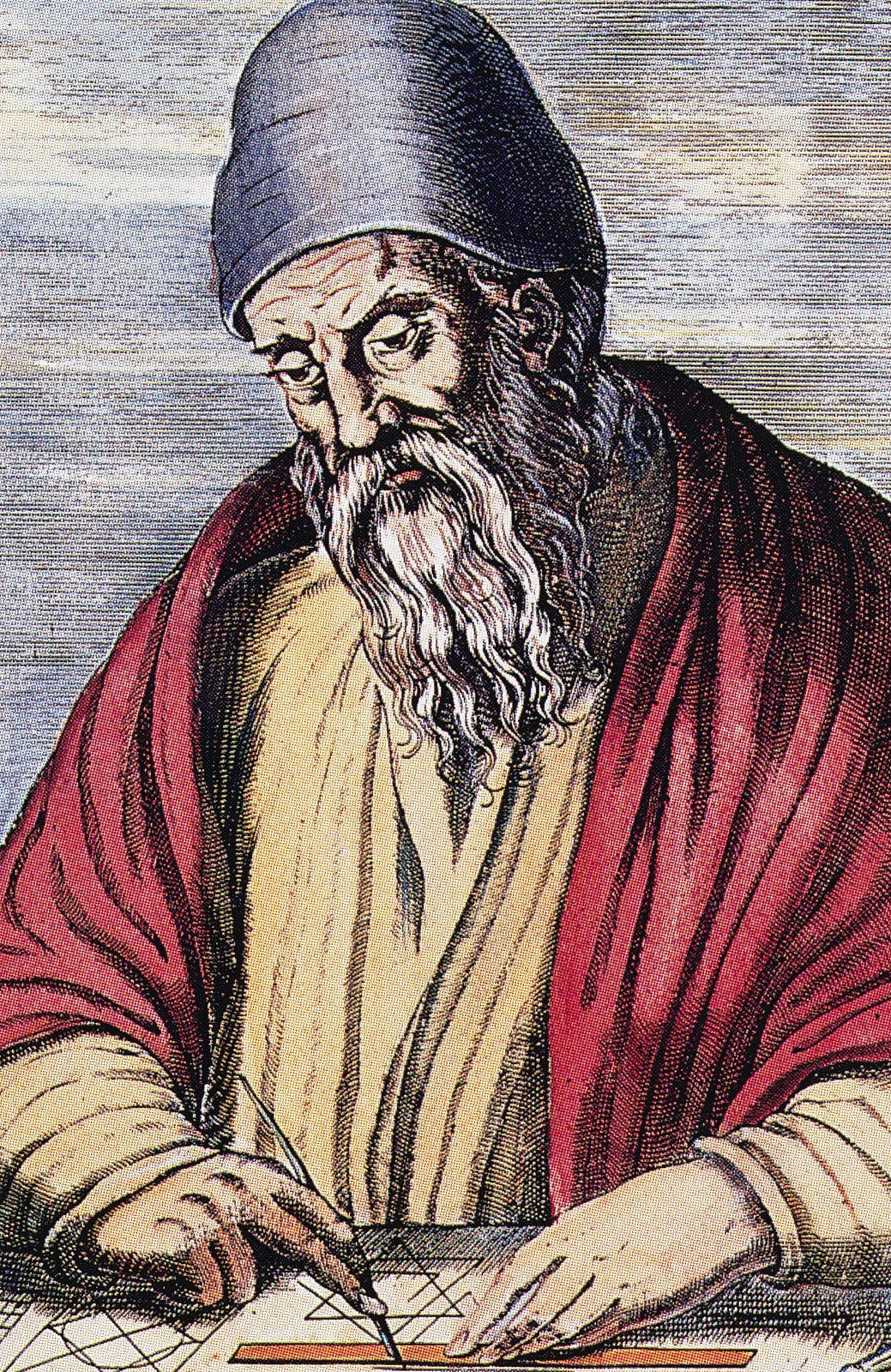
Attr: Euclid | Britannica
| 10 Quotes | |
| Known as | Euclid of Alexandria |
| Occup. | Scientist |
| From | Greece |
| Born | 325 BC |
| Died | 270 BC |
| Cite | |
Citation Formats
APA Style (7th ed.)
Euclid biography, facts and quotes. (2026, February 14). FixQuotes. https://fixquotes.com/authors/euclid/
Chicago Style
"Euclid biography, facts and quotes." FixQuotes. February 14, 2026. https://fixquotes.com/authors/euclid/.
MLA Style (9th ed.)
"Euclid biography, facts and quotes." FixQuotes, 14 Feb. 2026, https://fixquotes.com/authors/euclid/. Accessed 25 Mar. 2026.
Early Life and Background
Euclid (Greek: Eukleides), born around 325 BCE and dying around 270 BCE, stands at the headwaters of the mathematical tradition that later ages would call "classical". Almost nothing reliable is known of his family, birthplace, or early circumstances; ancient biographers already treated him less as a private man than as a public mind. What can be said with confidence is that he worked in the Greek intellectual world reshaped by Alexander the Great's conquests and the rise of successor kingdoms, an era when scholarship increasingly migrated to state-supported centers and when mathematics was becoming a disciplined, written science rather than a craft of problem-solvers.His life is most plausibly situated in Alexandria under Ptolemy I Soter, where Greek learning was being gathered, cataloged, and institutionalized. In that environment, Euclid emerges not as a wandering sage but as an organizer - a figure who could impose order on inherited results from earlier geometers and convert them into a teachable, cumulative system. The scarcity of personal detail has itself shaped his image: Euclid is often perceived through the clean impersonality of his proofs, as though the man had stepped aside so the structure could speak.
Education and Formative Influences
By later tradition, Euclid was associated with the Platonic philosophical-mathematical lineage, and it is plausible he absorbed the methods and ideals developed at Plato's Academy in Athens: rigorous definition, axiomatic reasoning, and the belief that mathematics trains the mind toward stable truth. His "Elements" preserves and refines prior discoveries attributed to figures such as Eudoxus (especially the theory of proportion) and Theaetetus (work related to incommensurables and the classification of solids), suggesting a scholar deeply versed in the existing corpus and able to discriminate what could be made foundational from what remained ad hoc.Career, Major Works, and Turning Points
Euclid's decisive achievement was the composition of the "Elements", likely written in Alexandria around 300 BCE, a 13-book synthesis that begins with definitions, postulates, and common notions and proceeds through plane geometry, number theory, incommensurables, and solid geometry. The turning point was not a single discovery but a methodological consolidation: he transformed many scattered theorems into an architecture of necessity, where later propositions lean on earlier ones with visible dependency. Other works transmitted under his name include "Data" (about what can be inferred from given conditions in geometric problems), "Optics" (treating vision geometrically, often via straight-line rays), and "Phaenomena" (on spherical astronomy), though the extent of his authorship and the precise boundaries between Euclid and his Alexandrian contemporaries remain debated.Philosophy, Style, and Themes
Euclid's inner life is easiest to read through what his writing refuses: he avoids autobiography, polemic, and even overt persuasion. The tone is spare, almost judicial. That restraint reflects an ideal of knowledge in which the mathematician is a custodian of impersonal relations, not a performer. In the "Elements", truth is something that can be rebuilt by any competent mind from minimal assumptions - a democratic aspiration within an elite educational culture. His characteristic style - definition, construction, proof, and conclusion - suggests a personality attuned to discipline, to the calming power of sequence, and to the ethics of intellectual transparency.The worldview often ascribed to Euclid is a kind of mathematical piety, the conviction that order is not imposed by humans but discovered. The later maxim, “The laws of nature are but the mathematical thoughts of God”. , while not securely Euclid's own phrasing, captures what the "Elements" made plausible to generations: that the universe can be read as structure, and that structure can be derived. Psychologically, this position offers both humility and authority - humility because the mathematician submits to necessity, authority because necessity compels assent. Euclid's themes - axioms, limits of assumption, proof as a chain of reasons - also encode a quiet warning: without agreed starting points, discourse dissolves into assertion. In that sense, his geometry is also a model of civic rationality, written for minds that must learn to accept conclusions they did not choose.
Legacy and Influence
Across two millennia, the "Elements" became one of the most copied, translated, and taught books in human history, shaping education from late antiquity through the Islamic Golden Age and into early modern Europe. Its axiomatic ideal guided thinkers from philosophers of knowledge to scientists seeking law-like description, and its number-theoretic books helped preserve core results such as the Euclidean algorithm. Even when non-Euclidean geometries and modern axiomatizations revised his foundations, they did so in dialogue with his template - proof as an explicit, checkable path from assumptions to consequences. Euclid's enduring influence lies not only in the theorems he transmitted but in the mental posture he normalized: that clarity is achievable, that disagreement can be disciplined by shared premises, and that thought can be engineered with the same care as any monument in stone.Our collection contains 10 quotes written by Euclid, under the main topics: Learning - Reason & Logic - Health - Teaching.
Other people related to Euclid: Roger Zelazny (Writer), Archimedes (Mathematician), Janos Bolyai (Mathematician), Isaac Barrow (Mathematician), Sunita Williams (Astronaut)
Frequently Asked Questions
- Euclid Greece: He was a Greek mathematician who worked in Alexandria, which was part of the Ptolemaic Kingdom in Egypt.
- Euclid full name: No full name is reliably attested in surviving ancient sources; he is known simply as Euclid.
- Euclid books: He is traditionally credited with writing "Elements", a foundational mathematical treatise.
- Euclid SCP: In SCP Foundation fiction, "Euclid" is a containment class for anomalies that are unpredictable or not reliably contained with simple procedures.
- Euclid pronunciation: Euclid is commonly pronounced "YOO-klid" in English.
Source / external links