
Eugene O'Neill Biography Quotes 9 Report mistakes
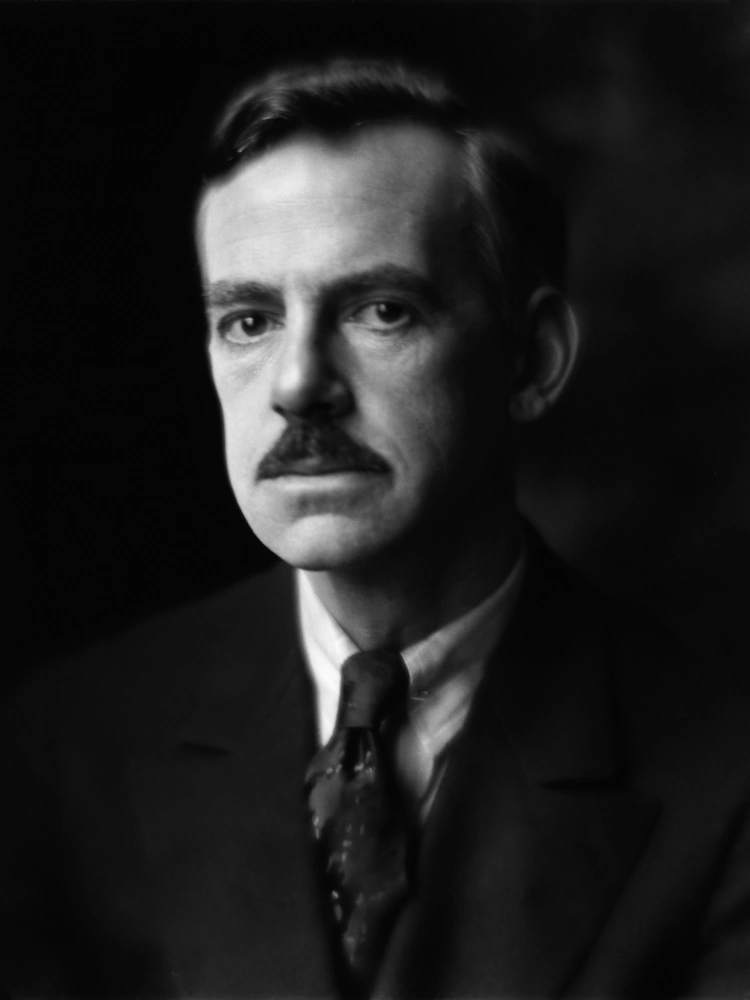
Attr: Alice Boughton
| 9 Quotes | |
| Born as | Eugene Gladstone O'Neill |
| Occup. | Dramatist |
| From | USA |
| Spouse | Agnes Boulton (m. 1929–1933) |
| Born | October 16, 1888 New York City, New York, USA |
| Died | November 27, 1953 Boston, Massachusetts, USA |
| Cause | Heart failure |
| Aged | 65 years |
| Cite | |
Citation Formats
APA Style (7th ed.)
Eugene o'neill biography, facts and quotes. (2026, February 11). FixQuotes. https://fixquotes.com/authors/eugene-oneill/
Chicago Style
"Eugene O'Neill biography, facts and quotes." FixQuotes. February 11, 2026. https://fixquotes.com/authors/eugene-oneill/.
MLA Style (9th ed.)
"Eugene O'Neill biography, facts and quotes." FixQuotes, 11 Feb. 2026, https://fixquotes.com/authors/eugene-oneill/. Accessed 12 Feb. 2026.
Early Life and Background
Eugene Gladstone O'Neill was born on October 16, 1888, in a Broadway hotel in New York City, a fitting origin for a writer who would anatomize the American theater from the inside out. His father, James O'Neill, was an Irish immigrant actor made wealthy and artistically trapped by his long-running melodramatic hit The Count of Monte Cristo; his mother, Mary Ellen "Ella" Quinlan O'Neill, came from a comfortable Midwestern Catholic family and suffered a morphine addiction that began after Eugene's birth. The family lived a touring life between trains, theaters, and boarding houses, a childhood of applause and instability that later hardened into his lifelong suspicion that public performance can be a kind of private ruin.O'Neill grew up amid piety, glamour, and shame - and with an early education in loss. His older brother Edmund died in infancy; his brother Jamie, brilliant and self-destructive, became both companion and warning. The boy absorbed the sights of port cities and backstage corridors, but also the silences of addiction and resentment. That mixture became his central subject: people bound by love yet corroded by it, haunted not only by what they did but by what their families made inevitable.
Education and Formative Influences
He attended Catholic schools and then Princeton University in 1906, but left after less than a year, drifting into journalism, drinking, and the rougher education of the waterfront. A 1912 diagnosis of tuberculosis forced a long convalescence at Gaylord Farm Sanatorium in Wallingford, Connecticut, a crisis he later treated as a second birth: reading voraciously, deciding to become a playwright, and turning his own despair into method. He studied playwriting with George Pierce Baker at Harvard (1914-1915), and found models in Ibsen and Strindberg for psychological realism, in Greek tragedy for fatal structure, and in Nietzsche, Freud, and contemporary radical politics for a vocabulary of inner conflict.Career, Major Works, and Turning Points
O'Neill emerged with the Provincetown Players during World War I, writing sea plays and one-acts that brought working-class speech and modern disillusion to an American stage still dominated by genteel comedy. Beyond the Horizon won the Pulitzer Prize in 1920, and he followed with Anna Christie (Pulitzer, 1922) and The Hairy Ape (1922), pushing into expressionism to stage class rage and spiritual homelessness. Desire Under the Elms (1924) recast Greek myth in New England soil; Strange Interlude (1928) used interior monologue to expose the mind as battlefield; Mourning Becomes Electra (1931) made the Civil War era a house of inherited vengeance. He received the Nobel Prize in Literature in 1936, yet his private life tightened into tragedy: marriages to Kathleen Jenkins, Agnes Boulton, and then Carlotta Monterey; estrangement from his children; the suicides of son Eugene Jr. (1950) and later daughter Oona's long separation after she married Charlie Chaplin in 1943. In his final years, a degenerative neurological illness left his hands too unsteady to write, even as he completed the autobiographical masterpieces he wanted published posthumously: The Iceman Cometh (written 1939, produced 1946), Long Day's Journey into Night, and A Moon for the Misbegotten.Philosophy, Style, and Themes
O'Neill wrote as if the American family were a private nation at war, governed by inherited myth and chemical consolations. His characters rarely lack intelligence; what they lack is mercy toward themselves. He returned obsessively to the paradox that people crave intimacy yet fear the exposure it brings, a psychology he distilled in the bleak epigram "Man's loneliness is but his fear of life". That fear is dramatized through confession scenes that feel like trials, where love becomes both evidence and sentence.Stylistically he refused a single school, moving from naturalistic dialogue to expressionist masks, choruses, and hallucinated stage pictures whenever realism felt too polite for the truth he was after. The recurring O'Neill trajectory is repair attempted without the tools to repair: "Man is born broken. He lives by mending. The grace of God is glue". Even his apparent atheism is less doctrine than wound, a fury at homemade consolations that cannot hold. His late plays translate this into a theology of disillusion: "Obsessed by a fairy tale, we spend our lives searching for a magic door and a lost kingdom of peace". The "magic door" is alcohol in The Iceman Cometh, dope and religion in Long Day's Journey into Night, romance and land in Desire Under the Elms - each a dream that both shelters and destroys.
Legacy and Influence
O'Neill permanently changed what American theater dared to admit: that national optimism could coexist with inherited despair, and that ordinary speech could carry tragic weight. He opened the door for Tennessee Williams, Arthur Miller, and later generations of playwrights to treat family life as destiny, addiction as metaphysics, and memory as an active antagonist. Long Day's Journey into Night became a benchmark for autobiographical drama without self-pity, while The Iceman Cometh remains one of the stage's most ruthless anatomies of illusion. His influence endures not as a style to copy but as a permission - to write past propriety into the hard, intimate places where love and ruin share the same address.Our collection contains 9 quotes written by Eugene, under the main topics: Love - Meaning of Life - God - Contentment - Aging.
Other people related to Eugene: John Frankenheimer (Director), Brooks Atkinson (Critic), Warren Beatty (Actor), Paul Robeson (Actor), John Mason Brown (Critic), Cao Yu (Playwright), Dean Stockwell (Actor), Gabriel Byrne (Actor), Jessica Lange (Actress)
Source / external links