
Eva Braun Biography Quotes 11 Report mistakes
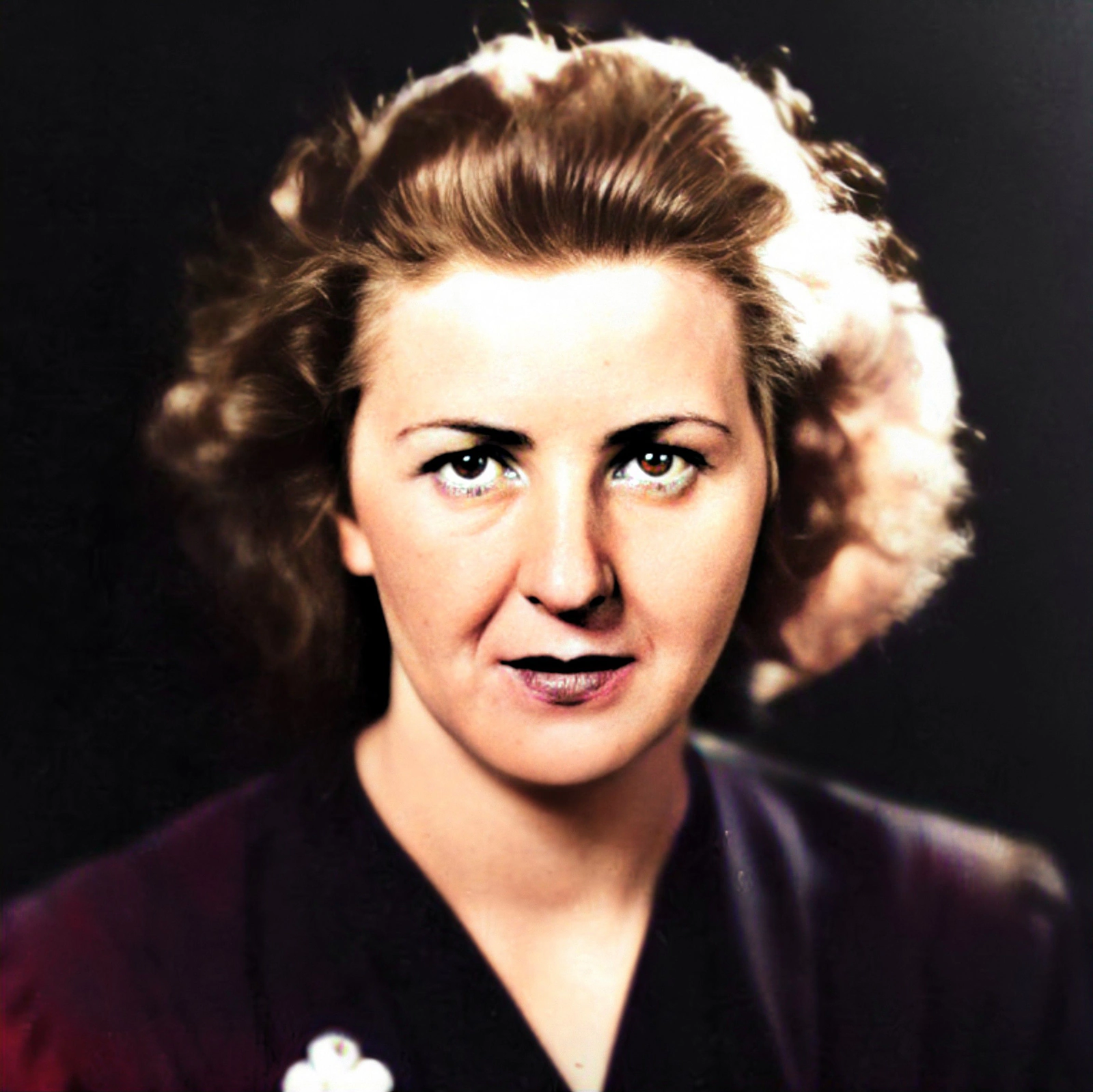
| 11 Quotes | |
| Occup. | Celebrity |
| From | Germany |
| Born | February 6, 1912 Munich, Germany |
| Died | April 30, 1945 |
| Aged | 33 years |
| Cite | |
Citation Formats
APA Style (7th ed.)
Eva braun biography, facts and quotes. (2026, February 11). FixQuotes. https://fixquotes.com/authors/eva-braun/
Chicago Style
"Eva Braun biography, facts and quotes." FixQuotes. February 11, 2026. https://fixquotes.com/authors/eva-braun/.
MLA Style (9th ed.)
"Eva Braun biography, facts and quotes." FixQuotes, 11 Feb. 2026, https://fixquotes.com/authors/eva-braun/. Accessed 26 Mar. 2026.
Early Life and Background
Eva Anna Paula Braun was born on 6 February 1912 in Munich, Kingdom of Bavaria, into a respectable lower-middle-class Catholic family trying to keep its footing amid the shocks of modern Germany. Her father, Friedrich Braun, was a schoolteacher whose insistence on discipline reflected the values of the prewar Empire; her mother, Franziska Kronberger, maintained a conventional household that prized decorum and social stability. Eva grew up with two sisters, Ilse and Margarete (Gretl), in a city that, after World War I, became both a center of everyday striving and an incubator for radical politics.Braun's adolescence unfolded during the Weimar years, when inflation, unemployment, and street violence coexisted with mass culture, cinema, and consumer aspiration. She was drawn less to ideology than to the allure of style, sport, and romantic narrative - a young woman shaped by shop windows and magazines as much as by church and school. That sensibility would later make her both unusually visible and strangely absent: present in photographs and private rituals, yet erased from public power.
Education and Formative Influences
She attended local Catholic schools and spent time at a convent institute, but she was not oriented toward academic distinction; her strengths lay in sociability, appearance, and an emerging skill with cameras and image-making. In late-1920s Munich, photography studios and illustrated journalism offered a pathway for ambitious young women who wanted wages and modernity without breaking entirely from convention. Those years formed a pattern that would define her inner life: an appetite for glamour and belonging coupled to dependence on male authority and approval.Career, Major Works, and Turning Points
Braun trained and worked as a shop assistant and photographic clerk at Heinrich Hoffmann's studio, the influential photographer closely tied to Adolf Hitler and the Nazi movement; through that workplace she met Hitler in 1929, when she was seventeen and he was a nationally prominent politician. As Hitler's power rose, Braun's relationship became a private arrangement governed by secrecy: she was kept out of official ceremonies, rarely acknowledged in public, and encouraged to remain a hidden domestic presence while the regime cultivated a myth of Hitler as a solitary leader "married" to Germany. Her two suicide attempts, in 1932 and 1935, signaled crises of attachment and control; afterward, she was drawn deeper into the protected enclave of the Berghof on the Obersalzberg, where she became a constant companion in private life, filming and photographing the circle around Hitler. In April 1945 she chose to travel to besieged Berlin rather than flee; on 29 April, in the Fuhrerbunker, she married Hitler, and on 30 April 1945 they died by suicide as the Third Reich collapsed.Philosophy, Style, and Themes
Braun left no formal philosophical writings, but her diaries and letters expose an interior world structured by longing, status anxiety, and the emotional arithmetic of an unequal relationship. She repeatedly interpreted life through the lens of romantic validation and deprivation, measuring time by attention received and withheld. “When he says he loves me, it only means he loves me at that particular instant. Like his promises, which he never keeps. Why does he torment me like this, when he could finish it off at once?” The line is not simply complaint; it is a map of dependency, showing how intimacy became a theater of postponement in which she negotiated her own worth.Her private style was modern and performative - fashion, sports, and photography as tools for selfhood - yet it existed inside an authoritarian household that demanded invisibility. The diaries oscillate between bravado and collapse: “I have now reached the happy age of 23. No, happy is not quite the right word. At this particular moment I am certainly not happy”. Even trivial episodes become moral fables of fate and resignation, as when she records, “Today I bought two lottery tickets, because I had a feeling that it would be now or never - they were both blanks. So I am not going to be rich after all. Nothing at all to be done about it”. In that voice, one hears a young woman adapting to a world where the biggest decisions - recognition, security, even proximity - were decided elsewhere, while she cultivated an outward cheerfulness that kept the household calm.
Legacy and Influence
Braun remains a figure of uneasy fascination because she embodies the domestic underside of dictatorship: the private comforts, evasions, and emotional bargains that can coexist with mass crime. Her home movies and photographs have become key visual records of Hitler's inner circle, showing leisure and intimacy in chilling proximity to state violence. Biographers and filmmakers have argued over whether she was naive, willfully blind, or complicit; the most defensible conclusion is that she was politically incurious but not untouched by knowledge, benefiting materially and psychologically from proximity to power while accepting the regime's exclusions and lies. Her story endures less as celebrity romance than as a case study in how charisma, dependency, and the desire to matter can draw an ordinary person into history's darkest rooms.Our collection contains 11 quotes written by Eva, under the main topics: Witty One-Liners - Romantic - Heartbreak - Fear - Loneliness.
Source / external links