
F. Scott Fitzgerald Biography Quotes 50 Report mistakes
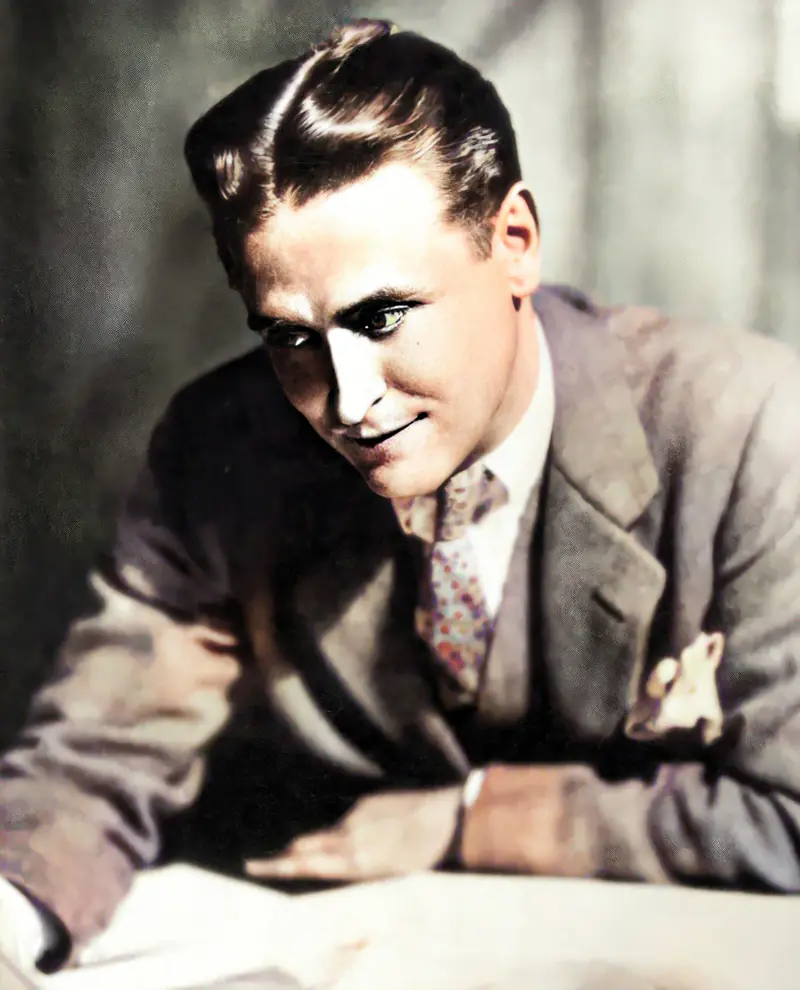
| 50 Quotes | |
| Born as | Francis Scott Key Fitzgerald |
| Occup. | Author |
| From | USA |
| Born | September 24, 1896 St. Paul, Minnesota, USA |
| Died | December 21, 1940 Hollywood, California, USA |
| Cause | Heart attack |
| Aged | 44 years |
| Cite | |
Citation Formats
APA Style (7th ed.)
F. scott fitzgerald biography, facts and quotes. (2026, February 1). FixQuotes. https://fixquotes.com/authors/f-scott-fitzgerald/
Chicago Style
"F. Scott Fitzgerald biography, facts and quotes." FixQuotes. February 1, 2026. https://fixquotes.com/authors/f-scott-fitzgerald/.
MLA Style (9th ed.)
"F. Scott Fitzgerald biography, facts and quotes." FixQuotes, 1 Feb. 2026, https://fixquotes.com/authors/f-scott-fitzgerald/. Accessed 8 Feb. 2026.
Early Life and Background
Francis Scott Key Fitzgerald was born on September 24, 1896, in St. Paul, Minnesota, into a family split between old Maryland lineage and Midwestern volatility. His father, Edward Fitzgerald, carried the romance of a faded Southern past but struggled in business; his mother, Mary "Mollie" McQuillan, came from Irish Catholic money that kept the household afloat. That mixture of gentility and insecurity - being close to comfort yet never feeling securely entitled to it - became the emotional engine of Fitzgerald's later portraits of class, desire, and self-invention.Childhood moved between St. Paul and brief periods in Buffalo and Syracuse after his father's job loss, and Fitzgerald learned early how social status could be both costume and sentence. A bright, performing child who wrote for school papers and staged his own dramas, he also absorbed the Catholic sense of guilt and the American sense of possibility. By adolescence he was already practicing the central Fitzgerald trick: converting private hunger into public style.
Education and Formative Influences
Fitzgerald attended the Newman School in Hackensack, New Jersey, where the disciplined attention of Father Sigourney Fay encouraged his ambition and sharpened his prose; he then entered Princeton in 1913. He did not graduate, pulled instead toward the Triangle Club, the Nassau Literary Magazine, and the dream of becoming famous while still young enough to enjoy it. Princeton gave him a lifelong template for American privilege - its manners, exclusions, and seductive confidence - while his uneven academic record and recurrent illness fed the fear that talent might not be enough to buy belonging.Career, Major Works, and Turning Points
In 1917 Fitzgerald joined the U.S. Army during World War I and was stationed at Camp Sheridan near Montgomery, Alabama, where he met Zelda Sayre, the flamboyant daughter of an Alabama judge; their romance, postponed by his lack of prospects, pushed him to turn his draft novel into a marketable debut. When Scribner published This Side of Paradise in 1920, it made him the emblematic voice of postwar youth and enabled his marriage to Zelda; the couple lived in New York, then Westport, amid magazine money, parties, and mounting strain. He followed with The Beautiful and Damned (1922) and a stream of stories that financed a high-cost life; in France he drafted The Great Gatsby (1925), his most compressed and haunting achievement, while friendships with writers like Ernest Hemingway sharpened his sense of craft and rivalry. The late 1920s and 1930s brought Zelda's mental collapse, Fitzgerald's alcoholism, and a career increasingly dependent on Hollywood screenwriting; Tender Is the Night (1934) transformed marital breakdown and psychiatric modernity into elegy, and his final, unfinished novel, The Last Tycoon, left a portrait of power and ruin in the studio system. He died of a heart attack in Los Angeles on December 21, 1940, at forty-four, believing his best work forgotten.Philosophy, Style, and Themes
Fitzgerald wrote with the lyric precision of someone trying to pin down a vanishing radiance before it curdled into regret. His sentences glitter, but their shine is diagnostic: he understood glamour as a form of self-defense, a way of keeping despair at bay by staging desire as spectacle. He also believed, with clinical clarity, that adulthood narrows the spirit's horizon, turning openness into concealment: "At eighteen our convictions are hills from which we look; at forty-five they are caves in which we hide". That shift from hilltop to cave is the arc traced by many Fitzgerald protagonists, who begin by naming their dreams and end by rationalizing their compromises.His psychological signature was doubleness - the ability to adore the dream while dissecting it. "The test of a first-rate intelligence is the ability to hold two opposed ideas in mind at the same time and still retain the ability to function". Fitzgerald's art lives in that tension: Jay Gatsby's pure faith versus the Buchanan world's blunt immunity; the romance of reinvention versus the social fact of inherited power. Underneath the jazz-age dazzle, he kept returning to defeat as a moral climate rather than a single event, insisting that the truest consolations are earned rather than enjoyed: "Life is essentially a cheat and its conditions are those of defeat; the redeeming things are not happiness and pleasure but the deeper satisfactions that come out of struggle". The result is fiction that mourns without surrendering to cynicism, seeing America as both promise and trap.
Legacy and Influence
Fitzgerald's reputation rebounded after World War II as The Great Gatsby became a classroom staple and a cultural mirror for every generation that rediscovers the allure and violence of American aspiration. His influence runs through modern literary realism and pop myth alike: the tragic glamour of celebrity culture, the language of parties that sound like hymns, the critique of wealth that still aches with longing. More than a chronicler of the 1920s, he became a diagnostician of American desire - how it recruits beauty, money, and romance to disguise loneliness - and his finest work remains a standard for the marriage of style to moral perception.Our collection contains 50 quotes written by Scott Fitzgerald, under the main topics: Witty One-Liners - Ethics & Morality - Wisdom - Art - Friendship.
Other people related to Scott Fitzgerald: Edmund Wilson (Critic), Arnold Rothstein (Businessman), Charles Scribner, Jr. (Publisher), Christina Ricci (Actress), Sigourney Weaver (Actress), Malcolm Cowley (Critic), Guy Pearce (Actor), Budd Schulberg (Writer), Haruki Murakami (Writer), Erich Maria Remarque (Writer)
F. Scott Fitzgerald Famous Works
- 1941 The Last Tycoon (Unfinished Novel)
- 1934 Tender Is the Night (Novel)
- 1925 The Great Gatsby (Novel)
- 1922 The Beautiful and Damned (Novel)
- 1922 Tales Of The Jazz Age (Short Story Collection)
- 1920 Flappers and Philosophers (Short Story Collection)
- 1920 This Side of Paradise (Novel)