
Federico Fellini Biography Quotes 21 Report mistakes
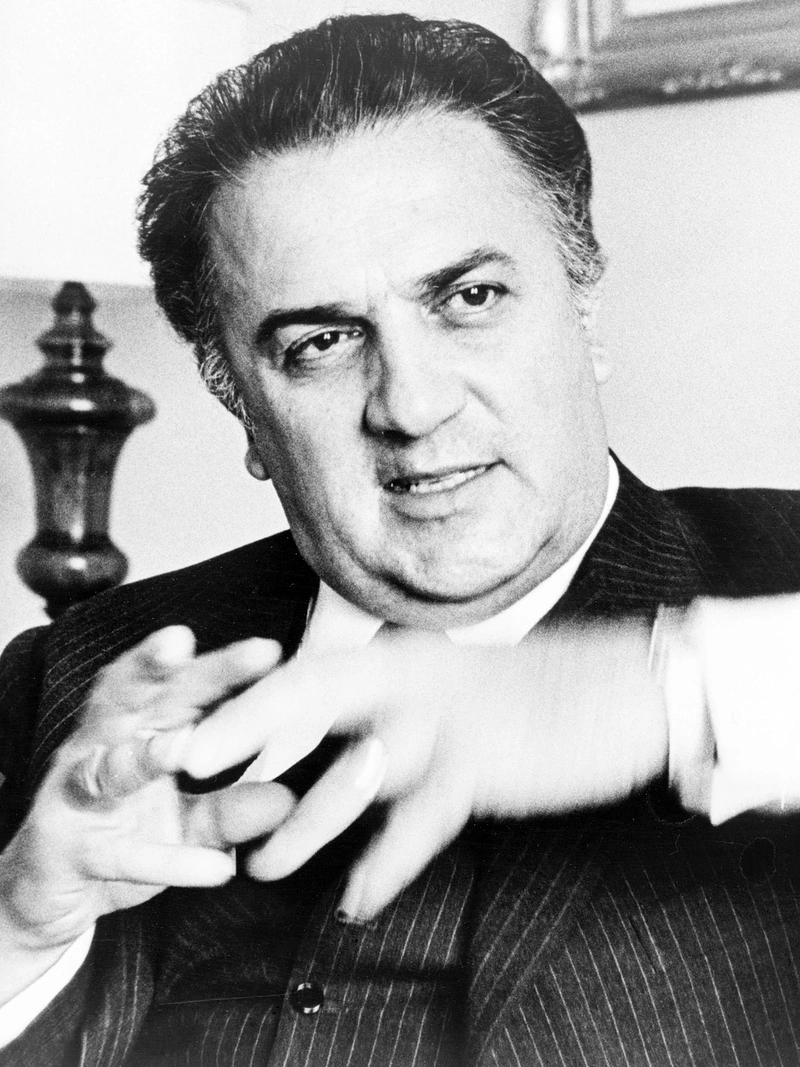
| 21 Quotes | |
| Occup. | Director |
| From | Italy |
| Born | January 20, 1920 Rimini, Italy |
| Died | October 31, 1993 Rome, Italy |
| Aged | 73 years |
| Cite | |
Citation Formats
APA Style (7th ed.)
Federico fellini biography, facts and quotes. (2026, February 11). FixQuotes. https://fixquotes.com/authors/federico-fellini/
Chicago Style
"Federico Fellini biography, facts and quotes." FixQuotes. February 11, 2026. https://fixquotes.com/authors/federico-fellini/.
MLA Style (9th ed.)
"Federico Fellini biography, facts and quotes." FixQuotes, 11 Feb. 2026, https://fixquotes.com/authors/federico-fellini/. Accessed 4 Mar. 2026.
Early Life and Background
Federico Fellini was born on 20 January 1920 in Rimini, a seaside town in Romagna whose fog, fairgrounds, and petty authorities later returned as the psychic landscape of his films. His father, Urbano, worked as a traveling salesman; his mother, Ida Barbiani, was Roman and devout, bringing a different social cadence into the household. Italy in the 1920s and 1930s was tightening under Fascism, and the young Fellini absorbed the spectacle of parades, uniforms, and public mythmaking alongside the more intimate theater of family rituals and small-town gossip.As a boy he drew incessantly, gravitating to caricature, posters, and the lurid enchantments of comics and traveling circuses. Rimini offered both the Adriatic's wide horizon and the claustrophobia of provincial judgment - an oscillation that became central to his inner life: a hunger for escape paired with an instinct to turn captivity into narrative. He later embellished his youth, but the pattern is revealing: for Fellini, memory was never a ledger; it was raw material, reshaped until it told the emotional truth he needed.
Education and Formative Influences
Fellini moved to Rome in 1939, nominally to study law, but the city quickly became his real education: Cinecitta, newsstands, music halls, and the industry of jokes. He found work as a cartoonist and humor writer, contributing to satirical publications such as Marc'Aurelio, and learned timing, exaggeration, and the psychology of types. During the war years he wrote gags and scripts for radio and film, meeting the circle around Roberto Rossellini; his collaboration on Rome, Open City (1945) and Paisan (1946) placed him at the nerve center of postwar Italian cinema, where ruin and moral urgency demanded new forms.Career, Major Works, and Turning Points
After co-writing widely and assisting on sets, Fellini debuted as director with Variety Lights (1950, with Alberto Lattuada) and The White Sheik (1952), then sharpened his voice in I Vitelloni (1953), a portrait of idle provincial manhood already haunted by self-contempt and tenderness. International stature followed with La Strada (1954) and Nights of Cabiria (1957), films that fused Catholic pity, cruelty, and clowning; he married actress Giulietta Masina in 1943, and her expressive face became a moral compass in his work. La Dolce Vita (1960) made him a lightning rod for both acclaim and scandal; 8 1/2 (1963) turned creative paralysis into a new grammar of cinema, while later works such as Juliet of the Spirits (1965), Satyricon (1969), Roma (1972), Amarcord (1973), and Casanova (1976) pushed further into dream, pageant, and memory. By the 1980s and early 1990s, films like And the Ship Sails On (1983), Ginger and Fred (1986), and Intervista (1987) read as meditations on media, aging, and the director's own legend; he received an honorary Academy Award in 1993 and died in Rome on 31 October 1993.Philosophy, Style, and Themes
Fellini's cinema is often described as baroque autobiography, but its engine is epistemological: he distrusted any strict border between fact and invention because he treated perception itself as theatrical. “Realism is a bad word. In a sense everything is realistic. I see no line between the imaginary and the real”. That position was not evasive; it was a confession about how his mind worked. He experienced the world as an ongoing masquerade in which desire, guilt, and nostalgia continually rewrote the visible. Hence the recurring processions, carnivals, ecclesiastical pageantry, and flashbulb paparazzi - public rituals that reveal private hunger.The psychology of his protagonists - Marcello adrift in La Dolce Vita, Guido trapped inside his own reputation in 8 1/2, Titta looking back through the fog of Amarcord - is the psychology of an artist who lives by transmutation. “The artist is the medium between his fantasies and the rest of the world”. Fellini staged that mediumship with a painter's eye for faces and a ringmaster's sense of timing, using Nino Rota's scores, choreographed crowds, and grotesque detail to externalize interior pressure. Yet the work is never simply escapist; it insists that vitality is an ethic as much as an aesthetic. “It is only when I am doing my work that I feel truly alive”. The line explains his lifelong return to sets and soundstages as both refuge and laboratory, where the anxiety of living could be converted into form.
Legacy and Influence
Fellini permanently expanded what mainstream narrative film could admit: dream logic without apology, autobiography without confession, satire without cynicism, and spectacle as a mode of analysis. The adjective "Felliniesque" entered global criticism because his methods proved transferable even when his sensibility was not - influencing directors from Martin Scorsese to Terry Gilliam, Pedro Almodovar, and countless cinematographers, designers, and composers who learned from his choreography of crowds and his attention to the eloquence of faces. In Italy, he became both national artist and national argument, praised for reimagining collective memory and attacked for profaning it; in either case, the debate itself testifies to his enduring power. His films remain a map of the 20th century's collision between faith and consumerism, provincial shame and metropolitan seduction, and the stubborn human need to turn life into a circus that tells the truth.Our collection contains 21 quotes written by Federico, under the main topics: Witty One-Liners - Wisdom - Truth - Art - Freedom.
Other people related to Federico: Charlie Chaplin (Actor), Anthony Quinn (Actor), Claudia Cardinale (Actress), Dino De Laurentiis (Director), Roger Corman (Producer), Vincent Canby (Critic), Tommy Tune (Dancer), Paul Mazursky (Actor), Marcello Mastroianni (Actor), Michael Tolkin (Screenwriter)