
Félix Houphouët-Boigny Biography Quotes 16 Report mistakes
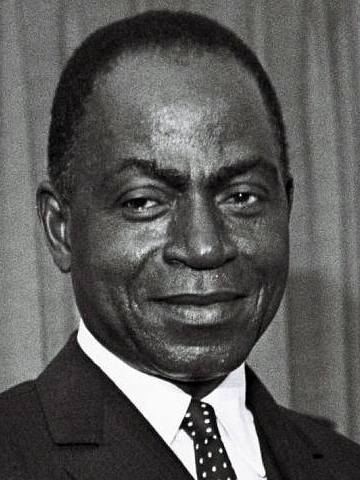
Attr: GPO, Public domain
| 16 Quotes | |
| Born as | Dia Houphouët |
| Occup. | President |
| From | Ivory Coast |
| Spouse | Marie-Thérèse Houphouët-Boigny |
| Born | October 18, 1905 N'Gokro (now part of Yamoussoukro), French West Africa (now Ivory Coast) |
| Died | December 7, 1993 Yamoussoukro, Ivory Coast |
| Cause | Cancer |
| Aged | 88 years |
| Cite | |
Citation Formats
APA Style (7th ed.)
Félix houphouët-boigny biography, facts and quotes. (2026, February 17). FixQuotes. https://fixquotes.com/authors/felix-houphouet-boigny/
Chicago Style
"Félix Houphouët-Boigny biography, facts and quotes." FixQuotes. February 17, 2026. https://fixquotes.com/authors/felix-houphouet-boigny/.
MLA Style (9th ed.)
"Félix Houphouët-Boigny biography, facts and quotes." FixQuotes, 17 Feb. 2026, https://fixquotes.com/authors/felix-houphouet-boigny/. Accessed 30 Mar. 2026.
Early Life and Background
Felix Houphouet (later Houphouet-Boigny) was born around 1905 in N'Gokro near Yamoussoukro, in the Baoule heartland of what was then French West Africa. Raised amid cocoa and coffee country, he absorbed the hierarchies and obligations of village authority as well as the disruptions of colonial rule - taxes, forced labor, and the politicization of chiefs and intermediaries. That double inheritance of tradition and coercive modernity would shape his lifelong instinct: to negotiate with power rather than romanticize confrontation.He came of age in an era when French administrators spoke the language of "civilizing mission" while extracting labor and crops, and when African advancement often required mastering the colonial system from within. Early on he learned that social prestige, access to schooling, and the ability to speak for others could be converted into political leverage. The future president's sense of destiny was not mystical so much as practical - an ambition anchored in the belief that order, growth, and recognition could be engineered.
Education and Formative Influences
Houphouet trained in colonial medical education and qualified as a medical assistant - an unusually respected position for an African in the 1920s-1930s. Clinical work exposed him to rural hardship, epidemics, and the everyday humiliations of the indigene regime, while also teaching him administrative discipline and the persuasive authority of expertise. The experience cultivated a technocratic confidence: problems could be diagnosed, treated, and managed - a mindset that later fed his preference for incremental reform, elite bargaining, and institution-building over mass insurrection.Career, Major Works, and Turning Points
After becoming a prosperous planter, he entered politics as a spokesman for African farmers and against exploitative labor practices, winning election in 1945 to the French Constituent Assembly. He helped found the Rassemblement Democratique Africain (RDA) and built the Parti Democratique de la Cote d'Ivoire (PDCI) into the colony's dominant machine, then pivoted from early confrontation to cooperation with France, securing the 1946 abolition of forced labor and later serving as a minister in several French governments in the 1950s. Leading Cote d'Ivoire through the 1958-1960 transition, he became prime minister and then, at independence in 1960, the republic's first president - a post he held until his death in 1993. His rule delivered decades of relative stability and rapid growth during the "Ivorian miracle", fueled by cocoa and coffee, foreign capital, and close ties with Paris, while also entrenching a one-party state, disciplined unions, and a security apparatus that kept opposition marginal; the 1980s commodity slump and debt crisis exposed the model's vulnerability even as he doubled down on prestige projects such as the Basilica of Our Lady of Peace in Yamoussoukro.Philosophy, Style, and Themes
Houphouet-Boigny's public philosophy was a politics of productive peace: prosperity first, pluralism later - if at all. He framed national unity as a moral economy in which citizens earned claims on redistribution by expanding the national pie, insisting, “What the Ivorian wants is the sharing of wealth and not misery, and to do so, he must, above all, contribute to creating these riches”. Psychologically, it reveals a paternal strategist who feared scarcity-driven conflict more than inequality itself; growth was not merely economic policy but a prophylactic against social fracture in a multiethnic state built from colonial boundaries.His style fused conciliation with firmness. Internationally he championed negotiation and interdependence, warning that “There will be no peace as long as force appears the only possible remedy to resolve intolerable situations”. At home, the same principle justified tight control: by keeping coercion largely indirect - party discipline, patronage, and selective repression - he sought to make force seem unnecessary, preserving the image of harmony. Underneath was an ethic of will and work, a self-portrait of the builder-president who believed transformation was manufactured, not granted: “A miracle, like a bet, is prepared, it is conditioned, it is measured, it is decided and it is realized by force of will and perseverance”. The line captures his inner life: confidence bordering on inevitability, and an engineer's impatience with romantic spontaneity.
Legacy and Influence
Houphouet-Boigny left a paradox that still structures Ivorian memory: the architect of a comparatively stable, outward-looking state and a growth model that lifted incomes, expanded education, and made Abidjan a regional hub, but also the founder of a political system that postponed competitive democracy and concentrated authority in one man and one party. His brand of "Houphouetism" - pro-Western alignment, pragmatic nationalism, and a belief that peace is earned through material progress - influenced Francophone African governance for decades, for better and worse. After his death in 1993, succession struggles, debates over belonging and citizenship, and eventually civil conflict underscored how much stability had been personalized; yet his central wager endures as a benchmark in West Africa: that legitimacy can be built through negotiated power, disciplined administration, and the promise - always fragile - of shared prosperity.Our collection contains 16 quotes written by Félix, under the main topics: Parenting - Peace - Human Rights - Legacy & Remembrance - Work.
Source / external links