
Frank Gifford Biography Quotes 8 Report mistakes
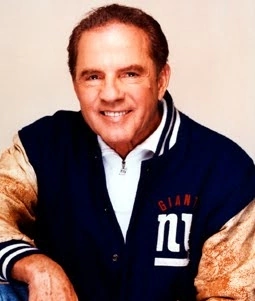
| 8 Quotes | |
| Occup. | Athlete |
| From | USA |
| Born | August 16, 1930 |
| Age | 95 years |
| Cite | |
Citation Formats
APA Style (7th ed.)
Frank gifford biography, facts and quotes. (2026, February 23). FixQuotes. https://fixquotes.com/authors/frank-gifford/
Chicago Style
"Frank Gifford biography, facts and quotes." FixQuotes. February 23, 2026. https://fixquotes.com/authors/frank-gifford/.
MLA Style (9th ed.)
"Frank Gifford biography, facts and quotes." FixQuotes, 23 Feb. 2026, https://fixquotes.com/authors/frank-gifford/. Accessed 28 Mar. 2026.
Early Life and Background
Frank Newton Gifford was born on August 16, 1930, in Santa Monica, California, and grew up during the lean, unsettled years of the Great Depression and World War II, when sports heroes were sold as proof that discipline could tame uncertainty. His family moved within Southern California, and the coastal mix of factory work, wartime mobilization, and postwar optimism shaped a boy who learned early to read rooms, measure risk, and compete without theatrics.Even before fame, Gifford had the traits that later made him both a locker-room leader and a camera-ready spokesman: a controlled intensity, a preference for polish over bravado, and an instinct to carry himself as if scrutiny were inevitable. That temperament mattered in the 1950s, when professional football was still fighting for legitimacy and its stars were expected to project steadiness as much as violence.
Education and Formative Influences
At Bakersfield High School he emerged as a standout athlete, then starred at the University of Southern California, where he played halfback and developed the versatile, open-field style that would define his pro identity. USC in the late 1940s and early 1950s sat at the center of a booming California sports culture, and Gifford absorbed its lessons in preparation, image, and the value of being useful in more than one role - runner, receiver, blocker, and, later, spokesperson.Career, Major Works, and Turning Points
Drafted by the New York Giants in 1952, Gifford became the franchise's signature offensive weapon, winning the NFL Most Valuable Player award in 1956 as the Giants captured the league title. He evolved from halfback into a do-everything threat - running, catching, and returning - and later shifted effectively toward flanker, extending his career into the early 1960s. The most dramatic interruption came in 1960, when a notorious hit by Eagles linebacker Chuck Bednarik left him badly injured; Gifford missed the rest of that season but returned in 1962, an uncommon comeback in a sport that often erased players without ceremony. He retired after the 1964 season, then built a second, longer act in broadcasting: first with CBS and, most famously, as a central on-air presence for ABC's Monday Night Football, where his calm authority balanced the show's entertainment edge and helped turn pro football into weekly national theater.Philosophy, Style, and Themes
Gifford's inner life, as it surfaced in interviews and retrospection, was defined by controlled fear - not the absence of it. He understood football as a contest whose costs were permanent, and he framed the game in survival terms rather than triumphal ones: “Pro football is like nuclear warfare. There are no winners, only survivors”. That line was not rhetorical grit; it was a public admission that the sport's glory required accepting damage, and that professionalism meant returning anyway, with fewer illusions.His style - both as a player and a broadcaster - followed from that realism. He prized structure, hierarchy, and loyalty, seeing organizations as families with complicated authority. In the Giants' world, owner Wellington Mara became a symbol of that paternal order: “We started out as boss and player, and Wellington was almost like my father”. Yet Gifford was not sentimental about greatness; he was generous, even strategic, in crediting others, which also revealed a competitive intelligence about how reputations are built. “Rosie is a Hall of Fame player, and I wouldn't be in the Hall of Fame if it weren't for him”. In that acknowledgment of teammate Rosey Grier, he offered a theory of excellence as interdependence - the glamorous runner protected by the unglamorous force - and, implicitly, a defense against the loneliness that comes with being the face of a franchise.
Legacy and Influence
Gifford died in 2015, but his influence persists in two interlocking legacies: as a prototype for the multipurpose, image-conscious NFL star and as an early architect of football's television voice. As a Giant, he helped carry the sport from regional spectacle toward modern celebrity, and his return from catastrophic injury became part of the league's mythology of resilience. As a broadcaster, he helped normalize the idea that football could be analyzed, narrated, and staged as prime-time culture, not merely reported as Sunday results - a shift that reshaped how the NFL sells itself, how players are remembered, and how the public learns to interpret violence as entertainment while still hearing, in his best moments, the sober warning beneath the shine.Our collection contains 8 quotes written by Frank, under the main topics: Witty One-Liners - Wisdom - Friendship - Sports - Father.
Other people related to Frank: Kathie Lee Gifford (Entertainer), Al Michaels (Entertainer)
Source / external links