
Frank Herbert Biography Quotes 26 Report mistakes
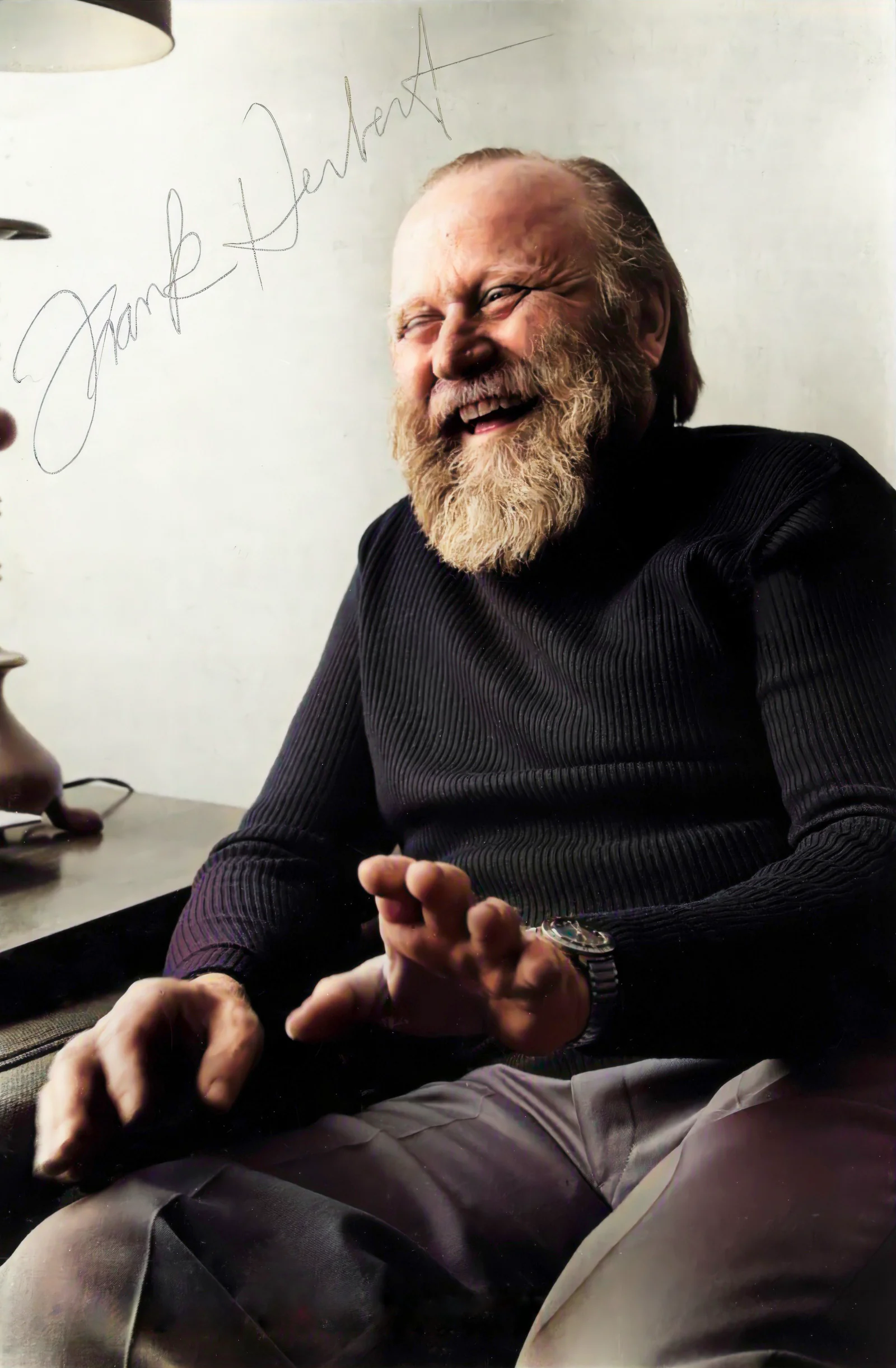
| 26 Quotes | |
| Born as | Franklin Patrick Herbert Jr. |
| Occup. | Writer |
| From | USA |
| Born | October 8, 1920 Tacoma, Washington, USA |
| Died | February 11, 1986 Madison, Wisconsin, USA |
| Aged | 65 years |
| Cite | |
Citation Formats
APA Style (7th ed.)
Frank herbert biography, facts and quotes. (2026, February 2). FixQuotes. https://fixquotes.com/authors/frank-herbert/
Chicago Style
"Frank Herbert biography, facts and quotes." FixQuotes. February 2, 2026. https://fixquotes.com/authors/frank-herbert/.
MLA Style (9th ed.)
"Frank Herbert biography, facts and quotes." FixQuotes, 2 Feb. 2026, https://fixquotes.com/authors/frank-herbert/. Accessed 6 Mar. 2026.
Early Life and Background
Franklin Patrick Herbert Jr. was born on October 8, 1920, in Tacoma, Washington, into a working-class Pacific Northwest world shaped by timber, shipyards, and the aftershocks of World War I. His parents, Frank Herbert Sr. and Eileen McCarthy Herbert, gave him a childhood that mixed Catholic cultural residues with the practical pressure of the Depression years - an early training in scarcity and consequence that later surfaced as ecological thinking rather than nostalgia. The region mattered: rugged coastlines, rain shadows, and the sense that land dictates behavior became intuitive long before he made deserts his signature.As a teenager he gravitated toward self-reliance and information - the habits of a future reporter and systems-builder. He left home young, moving through jobs and towns across the West during the late-Depression and wartime period, absorbing how institutions speak and how ordinary people improvise under stress. That itinerant apprenticeship gave him two lifelong fixations: the fragility of social order, and the private, interior motives that persist beneath public slogans. He carried those fixations into adulthood and marriage, building a family life that was often loving but strained by ambition, finances, and the solitary demands of long projects.
Education and Formative Influences
Herbert's formal schooling was irregular, but his education was voracious and largely self-directed, sharpened by journalistic practice and by mid-century intellectual currents - cybernetics, ecology, comparative religion, and psychology. After serving as a Seabee in the U.S. Navy during World War II, he worked for newspapers in California and Oregon, including the San Francisco Examiner and the Oregon Statesman, learning to interview, to verify, and to write with disciplined clarity. He married Beverly Ann Stuart in 1946; her steadiness and practical support were crucial during years when his fiction income was uncertain, and their household became a crucible where family responsibility collided with a writer's need for long, uninterrupted thought.Career, Major Works, and Turning Points
Herbert published early science fiction in the 1950s and novels such as The Dragon in the Sea (1956) and The Green Brain (1966), but his decisive turning point began with a 1957 assignment about attempts to stabilize Oregon's coastal dunes near Florence. That research - sand, wind, ecology, policy, unintended outcomes - expanded into years of reading and worldbuilding that culminated in Dune (serialized 1963-1965; published 1965). The novel's success, followed by Dune Messiah (1969), Children of Dune (1976), God Emperor of Dune (1981), Heretics of Dune (1984), and Chapterhouse: Dune (1985), made him a central architect of modern science fiction. The fame did not erase private difficulty: Beverly's death in 1974 was a profound blow, and though he later married Theresa Shackleford in 1985, he died in Madison, Wisconsin, on February 11, 1986, after surgery for pancreatic cancer, with the Dune universe still unfolding in his mind.Philosophy, Style, and Themes
Herbert wrote like a systems thinker disguised as a storyteller. His plots are engineered from pressures - ecology, economics, religion, genetics, bureaucracy - and his characters often discover that "choice" is a narrow corridor inside larger feedback loops. Yet his pessimism was never inert: he believed attentiveness could widen that corridor. The moral center of his work is less about purity than about accuracy under temptation, an ethic that echoes his journalistic roots: “Respect for the truth comes close to being the basis for all morality”. In Herbert, truth is not comfort - it is a discipline that prevents the self from surrendering to propaganda, charisma, or the narcotic of belonging.His prose style is spare, declarative, and charged with interiority - the famous "inner voice" technique that turns politics into psychology in real time. Herbert distrusted sentimentality because it masks causal chains; he insisted on consequences that arrive late and compound. The Dune saga's suspicion of saviors and its portrayal of inherited trauma aligns with his stark historical accounting: “There is no escape - we pay for the violence of our ancestors”. Power, for Herbert, is not only coercion but the capacity to define reality, a principle distilled in one of his most quoted axioms: “He who can destroy a thing, can control a thing”. Taken together, these ideas sketch his inner life - a man both fascinated and frightened by human plasticity, convinced that the mind can be trained, yet aware that training can become a prison.
Legacy and Influence
Herbert's enduring influence rests on how he fused adventure with ecology, anthropology, and political theology, making science fiction a venue for serious civic anxiety without sacrificing mythic propulsion. Dune helped shape the modern "worldbuilt" epic and inspired generations of writers, game designers, filmmakers, and environmental thinkers; it also seeded a durable skepticism toward charismatic leaders in popular culture. His reputation has been carried forward through adaptations, scholarship, and the continuation of the Dune franchise by his son Brian Herbert and collaborator Kevin J. Anderson, but Frank Herbert's core legacy remains singular: he taught readers to see societies as living systems, and to suspect any story - including their own - that promises salvation without cost.Our collection contains 26 quotes written by Frank, under the main topics: Witty One-Liners - Ethics & Morality - Wisdom - Truth - Justice.
Other people related to Frank: Brian Herbert (Author), James P. Hogan (Author), John W. Campbell (Writer)
Frank Herbert Famous Works
- 1985 Chapterhouse: Dune (Novel)
- 1984 Heretics of Dune (Novel)
- 1981 God Emperor of Dune (Novel)
- 1976 Children of Dune (Novel)
- 1969 Dune Messiah (Novel)
- 1965 Dune (Novel)
Source / external links