
Frank Lloyd Wright Biography Quotes 54 Report mistakes
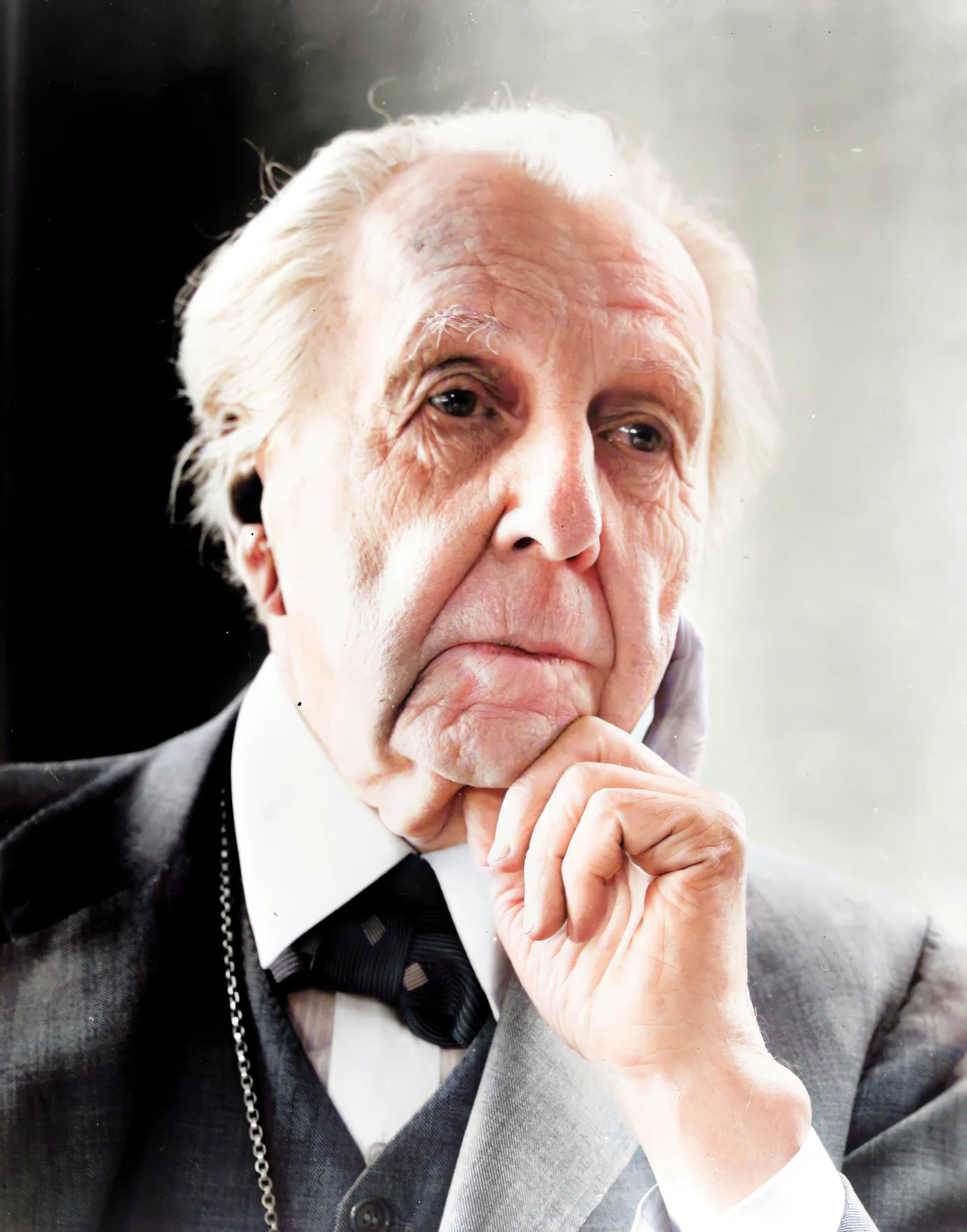
| 54 Quotes | |
| Born as | Frank Lincoln Wright |
| Occup. | Architect |
| From | USA |
| Born | June 8, 1867 Richland Center, Wisconsin, USA |
| Died | April 9, 1959 Phoenix, Arizona, USA |
| Cause | Pneumonia |
| Aged | 91 years |
| Cite | |
Citation Formats
APA Style (7th ed.)
Frank lloyd wright biography, facts and quotes. (2026, February 1). FixQuotes. https://fixquotes.com/authors/frank-lloyd-wright/
Chicago Style
"Frank Lloyd Wright biography, facts and quotes." FixQuotes. February 1, 2026. https://fixquotes.com/authors/frank-lloyd-wright/.
MLA Style (9th ed.)
"Frank Lloyd Wright biography, facts and quotes." FixQuotes, 1 Feb. 2026, https://fixquotes.com/authors/frank-lloyd-wright/. Accessed 31 Mar. 2026.
Early Life and Background
Frank Lloyd Wright was born Frank Lincoln Wright on June 8, 1867, in Richland Center, Wisconsin, in the uneasy afterglow of the Civil War and on the cusp of the industrial century that would make American cities boom. His parents, William Cary Wright, a Baptist minister and musician, and Anna Lloyd Jones, a Welsh immigrant descendant, gave him both strictness and a romantic belief in destiny. The family moved repeatedly across Wisconsin and to Iowa, and the instability - along with his parents' eventual separation and divorce - sharpened his hunger for control, order, and self-authored identity.On summers at his mother's relatives' farm in the Wisconsin River valley, Wright absorbed a landscape of limestone, prairie horizon, and changing light that later became less a setting than a moral argument: architecture should belong to its place. From early on he staged himself as a man called to remake the built world, and he carried a lifelong mix of messianic confidence and private restlessness. When he later renamed himself "Frank Lloyd Wright", folding his mother's Lloyd family into his own, it was both a filial tribute and a declaration that lineage could be designed.
Education and Formative Influences
In 1885 Wright entered the University of Wisconsin at Madison as a special student, studying engineering in a loose, practical way rather than completing a degree; the school gave him mathematics and drafting, but he wanted the city, not the classroom. In 1887 he moved to Chicago, then rebuilding after the Great Fire and humming with commercial ambition, and apprenticed under Joseph Lyman Silsbee before joining Adler and Sullivan. Louis Sullivan, the era's most eloquent apostle of modern American building, became Wright's crucial mentor: he learned structural clarity, ornament as integral pattern, and the idea that architecture must interpret its time. Wright also met the new technologies of steel, elevators, and mass production - tools he would alternately embrace and resist in pursuit of an organic ideal.Career, Major Works, and Turning Points
By 1893 Wright opened his own practice in Oak Park, Illinois, and within a decade he had redefined the American house with the Prairie School: low roofs, open plans, hearth-centered living, and bands of windows that stretched rooms toward the horizon. Key early works included the Winslow House (1893), Ward Willits House (1901), Dana-Thomas House (1902-04), Larkin Administration Building (1903, later demolished), and Unity Temple in Oak Park (1905-08), a radical reinforced-concrete sanctuary. His personal life detonated into public scandal in 1909 when he left his family for Mamah Borthwick Cheney and built Taliesin near Spring Green; tragedy struck in 1914 when a servant set fire to Taliesin, murdering Cheney and others. Wright rebuilt, worked abroad on Tokyo's Imperial Hotel (completed 1923; later largely demolished), endured financial stress and professional eclipse during the rise of European modernism, then roared back in the 1930s-50s with Fallingwater (1935-39), the Johnson Wax Headquarters (1936-39), Usonian houses for a democratic middle class, Taliesin West in Arizona (from 1937), and the Solomon R. Guggenheim Museum in New York (designed 1943; opened 1959). He died on April 9, 1959, in Phoenix, Arizona, still drafting and still arguing.Philosophy, Style, and Themes
Wright called his approach "organic architecture", but his organic was not picturesque rusticity; it was a disciplined unity of structure, site, materials, light, and human movement. He insisted that interiors were primary, writing that “The space within becomes the reality of the building”. That belief drove his spatial inventions: compressed entrances releasing into soaring living rooms, continuous floor planes, built-in furniture, and the theatrical sequencing of views, all meant to make architecture feel lived rather than looked at. In this he was both engineer and dramatist, staging domestic life as a kind of modern ritual anchored by the hearth.His aphorisms reveal a psychology of integration and defiance. Against the shallow sloganizing of modern design he insisted, “Form follows function - that has been misunderstood. Form and function should be one, joined in a spiritual union”. The word "spiritual" mattered: Wright wanted a civilization with an inner coherence, and he treated buildings as instruments of moral education, not neutral containers. Yet he was also intensely self-mythologizing, seeing the architect as a prophetic figure: “Every great architect is - necessarily - a great poet. He must be a great original interpreter of his time, his day, his age”. The poet-architect stance justified his stubbornness, his break with clients, and his willingness to wager everything - reputation, money, family - on the conviction that space, proportion, and landscape could redeem modern life.
Legacy and Influence
Wright left an American canon: Prairie houses that rewired domestic planning, Fallingwater as an emblem of site-specific modernity, and the Guggenheim as a late monument to continuous space and public spectacle. He influenced architects as different as Richard Neutra, Rudolf Schindler, Eero Saarinen, and later Bruce Goff and the Case Study generation, while his ideas about open plans, indoor-outdoor living, and integrated design seeped into mainstream building culture. His legacy is also a cautionary biography of genius - the costs of charisma, the seductions of self-belief, and the way a single imagination can bend an era's materials into enduring form.Our collection contains 54 quotes written by Frank, under the main topics: Witty One-Liners - Motivational - Truth - Wisdom - Art.
Other people related to Frank: Edward Bok (Editor), Svetlana Alliluyeva (Celebrity), Brendan Gill (Critic)
Source / external links