
Franklin D. Roosevelt Biography Quotes 70 Report mistakes
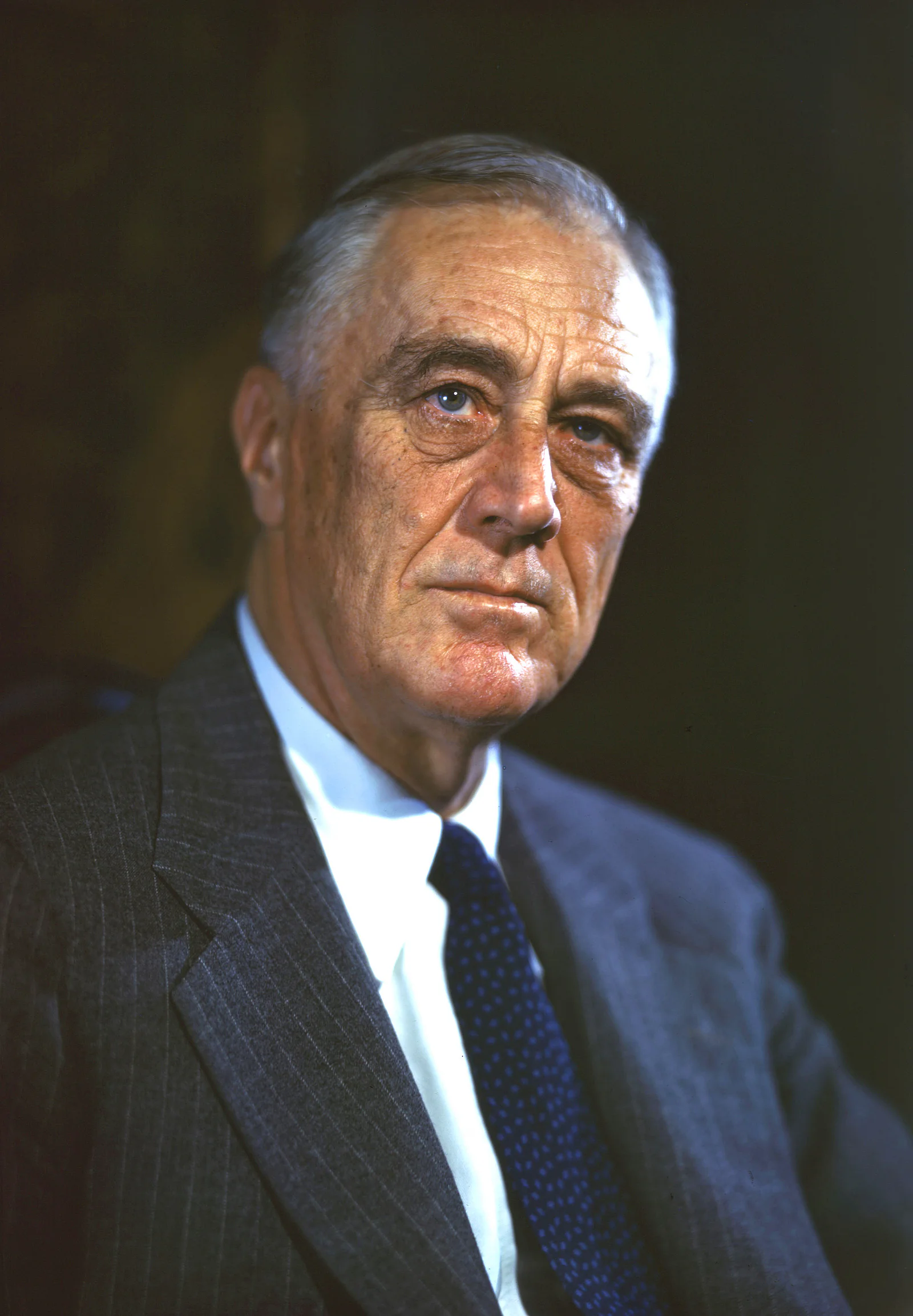
| 70 Quotes | |
| Born as | Franklin Delano Roosevelt |
| Occup. | President |
| From | USA |
| Spouse | Eleanor Roosevelt |
| Born | January 30, 1882 Hyde Park, New York, USA |
| Died | April 12, 1945 Warm Springs, Georgia, USA |
| Cause | Cerebral Hemorrhage (stroke) |
| Aged | 63 years |
| Cite | |
Citation Formats
APA Style (7th ed.)
Franklin d. roosevelt biography, facts and quotes. (2026, February 1). FixQuotes. https://fixquotes.com/authors/franklin-d-roosevelt/
Chicago Style
"Franklin D. Roosevelt biography, facts and quotes." FixQuotes. February 1, 2026. https://fixquotes.com/authors/franklin-d-roosevelt/.
MLA Style (9th ed.)
"Franklin D. Roosevelt biography, facts and quotes." FixQuotes, 1 Feb. 2026, https://fixquotes.com/authors/franklin-d-roosevelt/. Accessed 26 Mar. 2026.
Early Life and Background
Franklin Delano Roosevelt was born on January 30, 1882, at Springwood, his family estate in Hyde Park, New York, an only child raised amid the self-confidence of old money and the obligations of public standing. His father, James Roosevelt, was a wealthy landowner and businessman; his mother, Sara Delano Roosevelt, provided intense attention and a carefully managed world. The Hudson Valley, with its Dutch names, river commerce, and inherited privilege, shaped his early assumption that leadership was a duty rather than an entitlement to be defended.Yet the sheltered upbringing carried a counterweight: a lifelong need to win affection outside the family circle and to perform steadiness when anxious. Travel in Europe as a boy, and the progressive-era belief that expertise could tame social conflict, broadened his horizon beyond Hyde Park. From the start he was both patrician and improver - comfortable with hierarchy, but drawn to the idea that government could organize compassion into policy.
Education and Formative Influences
Roosevelt attended Groton School under Endicott Peabody, where the gospel of "service" was drilled into boys destined for command, then studied at Harvard (Class of 1903) and briefly at Columbia Law School before leaving for practice and politics. In 1905 he married Eleanor Roosevelt, his distant cousin and niece of Theodore Roosevelt; the union bound him to a formidable moral intelligence and to a political lineage that prized energetic government. Harvard, Groton, and the Roosevelt name together taught him how to read rooms, build alliances, and use institutions - not merely ideals - to move history.Career, Major Works, and Turning Points
Elected to the New York State Senate in 1910 as a Democrat in a Republican district, Roosevelt fashioned himself as a reformer with machine savvy; as Assistant Secretary of the Navy (1913-1920) he absorbed logistics, procurement, and the politics of readiness, then was defeated as the Democratic vice-presidential nominee in 1920. In 1921 poliomyelitis left him paralyzed from the waist down, a private catastrophe turned into discipline; he rebuilt his life through grueling rehabilitation at Warm Springs, Georgia, and returned by mastering the art of being seen as vigorous. As governor of New York (1929-1932) he tested relief and public works, and as president (1933-1945) he led the New Deal - bank stabilization, Social Security, labor protections, and regulatory expansion - while inventing a new presidential voice through the "fireside chats". He then steered the United States through World War II after Pearl Harbor, building the Arsenal of Democracy, coordinating with Churchill and Stalin, and sketching the postwar order that would become the United Nations, before dying in office on April 12, 1945, at Warm Springs.Philosophy, Style, and Themes
Roosevelt's inner life fused optimism with calculation. He believed politics was a craft of timing, pressure, and narrative - a belief captured in the hard-eyed maxim, “In politics, nothing happens by accident. If it happens, you can bet it was planned that way”. The plan was rarely a single blueprint; it was adaptive experimentation under crisis, holding the center by moving it. His charm and patrician ease masked a competitive temperament that enjoyed conflict when it clarified choices and rallied followers.His governing ethic was moral without being sentimental. During the Depression he argued that the legitimacy of capitalism depended on shared security, insisting, “The test of our progress is not whether we add more to the abundance of those who have much it is whether we provide enough for those who have little”. That sentence is also autobiography: a man born to abundance learning, through illness and collapse, to value stability for the vulnerable as a precondition for national confidence. In wartime he enlarged the same premise into global terms, claiming, “If civilization is to survive, we must cultivate the science of human relationships - the ability of all peoples, of all kinds, to live together, in the same world at peace”. The rhetoric of unity coexisted with ruthless choices - alliances with dictators, hard bargaining with Congress, and an executive style that hoarded options - but even his compromises were usually framed as steps toward a broader architecture of security.
Legacy and Influence
Roosevelt transformed the American presidency into a managerial, communicative center of national life, embedding expectations that Washington would stabilize banks, insure old age, regulate markets, and mobilize mass employment in emergencies. His coalition politics reshaped party alignments for a generation, while his wartime leadership made the United States a permanent global power with enduring institutions and obligations. Admired for empathy and stamina, criticized for overreach and wartime injustices such as the internment of Japanese Americans, he remains a case study in democratic leadership under catastrophe - a leader who turned personal paralysis and national panic into a doctrine of pragmatic action, and whose imprint still frames debates over what Americans owe one another in crisis and in peace.Our collection contains 70 quotes written by Franklin, under the main topics: Witty One-Liners - Motivational - Ethics & Morality - Wisdom - Art.
Other people related to Franklin: Lyndon B. Johnson (President), Calvin Coolidge (President), Herbert Hoover (President), Henry L. Stimson (Statesman), Grace Abbott (Activist), Nelson Rockefeller (Vice President), Sam Rayburn (Politician), Yousuf Karsh (Photographer), Claude Pepper (Politician), Arthur M. Schlesinger, Jr. (Historian)
Frequently Asked Questions
- Franklin D Roosevelt wife: His wife was Eleanor Roosevelt (married 1905–1945), a major political figure and First Lady.
- Franklin D Roosevelt Jr: Franklin Delano Roosevelt Jr. (1914–1988) was his son and later a U.S. congressman from New York.
- Franklin D Roosevelt disability: After polio, he used a wheelchair and leg braces and could stand only with support.
- Franklin D Roosevelt children: He and Eleanor Roosevelt had six children: Anna, James, Elliott, Franklin Jr. (who died in infancy), another Franklin Jr., and John.
- Franklin D Roosevelt young: He grew up in Hyde Park, New York, attended Harvard, and later studied law at Columbia.
- Franklin D Roosevelt presidency: He was the 32nd U.S. President (1933–1945) and led the New Deal and World War II efforts.
- Franklin D Roosevelt polio: He was stricken with polio in 1921, leaving him paralyzed from the waist down.
- How old was Franklin D. Roosevelt? He became 63 years old