
Franklin Pierce Biography Quotes 4 Report mistakes
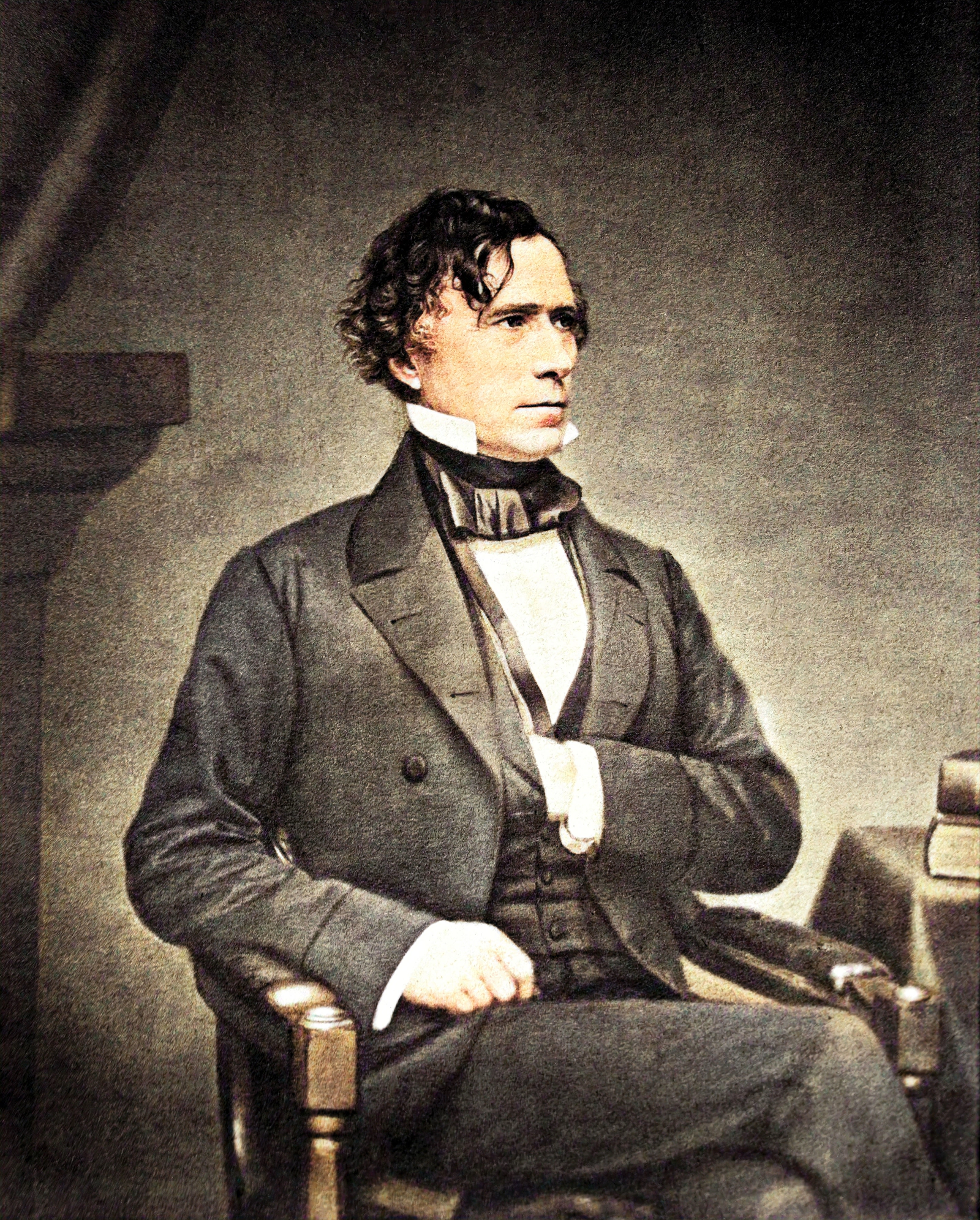
| 4 Quotes | |
| Occup. | President |
| From | USA |
| Born | November 23, 1804 |
| Died | October 8, 1869 |
| Aged | 64 years |
| Cite | |
Citation Formats
APA Style (7th ed.)
Franklin pierce biography, facts and quotes. (2026, February 11). FixQuotes. https://fixquotes.com/authors/franklin-pierce/
Chicago Style
"Franklin Pierce biography, facts and quotes." FixQuotes. February 11, 2026. https://fixquotes.com/authors/franklin-pierce/.
MLA Style (9th ed.)
"Franklin Pierce biography, facts and quotes." FixQuotes, 11 Feb. 2026, https://fixquotes.com/authors/franklin-pierce/. Accessed 6 Mar. 2026.
Early Life and Education
Franklin Pierce was born on November 23, 1804, in Hillsborough, New Hampshire, the son of Benjamin Pierce, a Revolutionary War veteran who later served as governor of New Hampshire, and Anna Kendrick Pierce. Raised in a politically active household on the New Hampshire frontier, he absorbed a sturdy sense of public service and Democratic republicanism from his father. He attended local schools before enrolling at Bowdoin College in Maine, graduating in 1824. At Bowdoin he formed friendships that would endure and shape his public life, most notably with the writer Nathaniel Hawthorne and the future poet Henry Wadsworth Longfellow. After college Pierce read law in New Hampshire and was admitted to the bar, building a practice that soon brought him prominence in Concord.Law Practice and Entry into Politics
Pierce entered state politics at a young age, winning election to the New Hampshire legislature in 1829. He quickly became a leading Democratic voice and served as Speaker of the New Hampshire House in the early 1830s. His success in state politics led to election to the U.S. House of Representatives in 1833 and then to the U.S. Senate in 1837. There he aligned with the national Democratic Party, defending limited government and the policies associated with Andrew Jackson and Martin Van Buren. In 1834 he married Jane Means Appleton, the daughter of Jesse Appleton, a former president of Bowdoin College. Reserved, deeply religious, and often ill, Jane disliked public life, a contrast that would later complicate Pierce's political career.Congressional Service and Party Leadership
Although still in his thirties, Pierce proved an able party manager. He supported Democratic measures on tariffs and banking, opposed what he saw as Whig centralization, and cultivated alliances with figures such as Levi Woodbury and William L. Marcy. In 1842 he resigned from the Senate to return to private life in New Hampshire, mindful of his wife's health and his own preference for the bar. Under President James K. Polk he accepted appointment as U.S. Attorney for New Hampshire, further cementing his influence in state and regional Democratic affairs. From Concord he helped keep the New Hampshire organization united during a fractious decade.Mexican-American War
With the outbreak of the Mexican-American War, Pierce volunteered for service. In 1847 President Polk appointed him a brigadier general. He joined General Winfield Scott's army in the campaign toward Mexico City, leading a brigade in engagements outside the capital. A riding accident that injured his knee and bouts of illness hampered him, and critics later belittled his generalship. Even so, he remained with the army through the occupation and returned to New Hampshire with credit for steady service and loyalty to the Democratic administration. The war experience deepened his commitment to national expansion and enhanced his standing among party leaders.Road to the White House
Pierce's rise to the presidency was sudden. At the Democratic National Convention in 1852, leading contenders such as Lewis Cass, James Buchanan, and Stephen A. Douglas deadlocked, and the convention turned to Pierce as a unifying dark horse. Nathaniel Hawthorne wrote a campaign biography that presented Pierce as modest, patriotic, and untainted by Washington intrigue. Pierce ran against his former commander, Whig nominee Winfield Scott, and benefited from the Whigs' internal divisions over slavery. He won decisively. His vice president, William R. King of Alabama, was sworn in while abroad due to illness and died shortly after taking office, leaving the vice presidency vacant for the rest of the term.Presidency: Domestic Affairs
Taking office in 1853, Pierce pledged to treat the Compromise of 1850 as a final settlement of the slavery question and to enforce the law, including the Fugitive Slave Act. His determination to uphold that law angered many in the North, especially when the Anthony Burns case in Boston highlighted the human costs of rendition. Pierce's administration soon confronted the most consequential issue of his tenure: the Kansas-Nebraska Act of 1854. Championed by Senator Stephen A. Douglas, the act repealed the Missouri Compromise's restriction on slavery north of the 36 30 line and applied popular sovereignty to the territories. Pierce supported the measure, signed it into law, and stood by proslavery territorial authorities in Kansas, even as violence, known as Bleeding Kansas, erupted between proslavery and antislavery settlers. The ferment broke national politics apart, contributed to the rise of the Republican Party, and left Pierce blamed across much of the North. The polarizing climate was underscored by episodes such as the 1856 caning of Senator Charles Sumner after he denounced the proslavery cause in language tied to Kansas debates.Pierce's Cabinet featured influential Democrats, among them Secretary of State William L. Marcy, Secretary of War Jefferson Davis, Attorney General Caleb Cushing, and Secretary of the Navy James C. Dobbin. He leaned on Davis for military reforms and transcontinental railroad surveys, hoping to strengthen national infrastructure. Despite occasional administrative successes, the disruptive effects of the Kansas crisis doomed efforts to present his presidency as an era of calm consolidation.
Presidency: Foreign Affairs
Pierce's foreign policy reflected expansionist ambitions tempered by diplomatic realities. His administration completed the Gadsden Purchase in 1853, negotiated by James Gadsden with Mexico's leader Antonio Lopez de Santa Anna, adding territory in what is now southern Arizona and New Mexico to facilitate a potential southern transcontinental railroad. His State Department concluded the Canadian-American Reciprocity Treaty of 1854, negotiated by Marcy and Lord Elgin, which eased trade restrictions and fisheries disputes with British North America.Events in the Caribbean and the Pacific also marked the era. The Ostend Manifesto of 1854, drafted by American ministers James Buchanan, John Y. Mason, and Pierre Soule, argued that the United States might be justified in acquiring Cuba, even by force, if Spain refused to sell it. When the document became public, it stirred outrage and fed suspicions that the administration aimed to expand slavery. In the Pacific, the Convention of Kanagawa opened limited ports in Japan to American vessels; although Commodore Matthew Perry's mission began under President Millard Fillmore, the treaty's conclusion fell during Pierce's term, and his administration supported its implementation.
Personal Life and Tragedy
Personal sorrow shadowed Pierce's public career. He and Jane had three sons, all of whom died in childhood. Their last surviving child, Benjamin, was killed in a railway accident in January 1853, weeks before the inauguration, while traveling with his parents. Jane, stricken with grief, withdrew from public life, often absent from Washington society and from her husband's official events. The bereavements deepened Pierce's reliance on friendships such as his bond with Nathaniel Hawthorne and his political closeness to Jefferson Davis and Davis's wife, Varina. Contemporaries increasingly remarked on Pierce's drinking, and later historians have linked his alcoholism to both personal grief and the strains of his presidency.Later Years, Civil War, and Death
Pierce sought renomination in 1856 but was overtaken by the political collapse around Kansas; Democrats turned to James Buchanan, while Stephen A. Douglas remained a powerful contender. After leaving the White House in 1857, Pierce traveled abroad, then returned to Concord. He and Jane spent periods away from public attention; her health remained fragile, and she died in 1863. During the secession crisis Pierce denounced disunion but criticized Republican policies and Abraham Lincoln's wartime measures as unconstitutional. His insistence on civil liberties and party loyalty, along with a private correspondence with Jefferson Davis that later became public, isolated him in the North and damaged his reputation.Pierce lived quietly in New Hampshire after the war, maintaining a small circle of friends and continuing to read law and engage in charitable works. He died in Concord on October 8, 1869, and was buried in Old North Cemetery. Many contemporaries believed his death was hastened by complications associated with long-term alcohol use.
Assessment and Legacy
Franklin Pierce's career traces the passage of a talented, affable New England Democrat into the storms of sectional crisis. He had genuine gifts: an ability to conciliate factions, a devotion to party organization, and a belief in national expansion tempered by constitutional scruple. Surrounded by significant figures, William L. Marcy at State, Jefferson Davis at War, Stephen A. Douglas in the Senate, and friends like Nathaniel Hawthorne, he presided over real achievements in diplomacy and territorial consolidation, including the Gadsden Purchase and commercial agreements with British North America and Japan. Yet the moral and political earthquake unleashed by the Kansas-Nebraska Act overwhelmed him. His enforcement of the Fugitive Slave Act and recognition of proslavery territorial governments alienated much of the North, helped fracture the Second Party System, and accelerated the rise of the Republican Party. In historical rankings he is often judged harshly, not only for policy choices that abetted sectional polarization but also for failing to find a national course that could have moderated the descent toward civil war. Even so, his life remains a revealing window into the dilemmas of leadership in an era when constitutional principle, party fidelity, and the expanding nation collided with the irrepressible conflict over slavery.Our collection contains 4 quotes written by Franklin, under the main topics: Witty One-Liners - Freedom - Peace.
Franklin Pierce Famous Works
- 1856 Special Message on the Subject of Kansas (Non-fiction)
- 1856 Annual Message to Congress (1856) (Non-fiction)
- 1855 Annual Message to Congress (1855) (Non-fiction)
- 1854 Annual Message to Congress (1854) (Non-fiction)
- 1854 Message Transmitting the Gadsden Purchase Treaty and Documents (Non-fiction)
- 1853 Annual Message to Congress (1853) (Non-fiction)
- 1853 First Inaugural Address (Non-fiction)
Source / external links