
Frederic Chopin Biography Quotes 1 Report mistakes
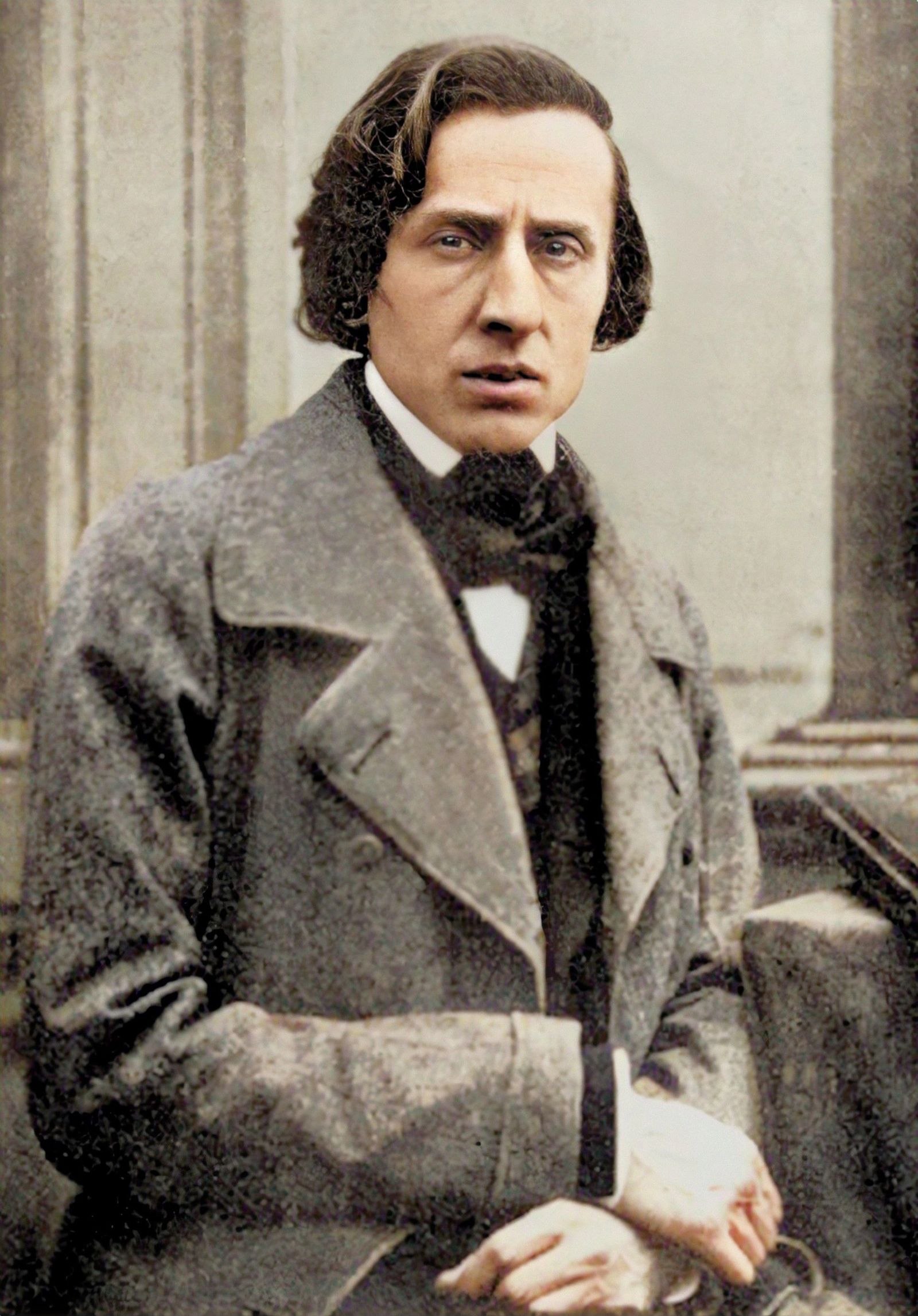
| 1 Quotes | |
| Born as | Frédéric Chopin |
| Occup. | Composer |
| From | Poland |
| Born | March 1, 1810 |
| Died | October 17, 1849 |
| Aged | 39 years |
| Cite | |
Citation Formats
APA Style (7th ed.)
Frederic chopin biography, facts and quotes. (2026, March 20). FixQuotes. https://fixquotes.com/authors/frederic-chopin/
Chicago Style
"Frederic Chopin biography, facts and quotes." FixQuotes. March 20, 2026. https://fixquotes.com/authors/frederic-chopin/.
MLA Style (9th ed.)
"Frederic Chopin biography, facts and quotes." FixQuotes, 20 Mar. 2026, https://fixquotes.com/authors/frederic-chopin/. Accessed 28 Mar. 2026.
Early Life and Background
Frederic Chopin was born Fryderyk Franciszek Chopin on March 1, 1810, in Zelazowa Wola near Warsaw, in the Duchy of Warsaw, a land reshaped by the Napoleonic era and haunted by the partitions of Poland. His father, Nicolas Chopin, was a French emigre who had become thoroughly Polonized and worked as a teacher; his mother, Tekla Justyna Krzyzanowska, came from minor Polish gentry and brought into the household a cultivated love of music and language. Soon after his birth the family moved to Warsaw, where Nicolas taught at the Warsaw Lyceum. Chopin grew up in an intellectually alert home that mixed French civility, Polish patriotism, and practical discipline. That blend became central to his identity: he would spend half his life in exile, yet remain inwardly attached to Poland with unusual intensity.
From childhood he was recognized less as a prodigy in the showman sense than as a boy of eerie refinement. He improvised early, played for aristocratic salons while still very young, and absorbed the rhythms of mazurkas and polonaises that carried the accents of village dance into urban memory. His first published work, a Polonaise in G minor written at seven, already suggested a child who understood national style as emotional code. Warsaw in his youth was not simply a capital but a pressured cultural frontier under Russian dominance, and that atmosphere marked him deeply. The vulnerability of Poland, the elegance of salon society, and the private habit of turning feeling into miniature forms all entered his character before adulthood.
Education and Formative Influences
Chopin's earliest piano instruction came from Wojciech Zywny, who introduced him to Bach and Mozart, composers whose clarity and balance remained lifelong anchors beneath his highly personal idiom. He later studied composition at the Warsaw Conservatory with Jozef Elsner, a perceptive teacher who recognized his originality and avoided crushing it with academic routine. Elsner trained him in counterpoint and large-scale musical thought, even though Chopin's genius would flower chiefly in shorter forms. He also heard the leading virtuosi of the day, especially Hummel, Field, and Paganini, and learned from Italian opera, above all Bellini, whose bel canto line he translated into keyboard singing. Just as formative was Warsaw's salon culture, where conversational nuance mattered more than brute display. There Chopin discovered the audience he was born to move: intimate circles capable of hearing shades of rhythm, pedaling, and harmonic suspense that would be lost in noisier public spaces.
Career, Major Works, and Turning Points
After successful appearances in Vienna in 1829 and 1830, Chopin left Poland just before the November Uprising against Russia; when the revolt failed, exile became permanent fact rather than youthful journey. He settled in Paris in 1831, entering a city crowded with Liszt, Berlioz, Heine, Delacroix, and the Polish emigre community. Paris made him famous, but on his own terms: he disliked the theatrical virtuoso circuit and preferred teaching, publishing, and performing in salons. In the 1830s and 1840s he created the works that define Romantic piano literature - the Ballades, Scherzos, Etudes, Preludes, Nocturnes, Polonaises, Mazurkas, Waltzes, and two Piano Sonatas, along with concertos, chamber works, and songs. His relationship with George Sand, begun in 1838, brought both companionship and friction; their disastrous winter in Mallorca coincided with the completion of many Preludes while tuberculosis worsened. Later summers at Nohant were among his most productive, yielding masterpieces including the Sonata in B minor, the Barcarolle, the Polonaise-Fantaisie, and late mazurkas of radical harmonic subtlety. The break with Sand in 1847, declining health, and a financially necessary but exhausting visit to Britain in 1848 accelerated his collapse. He died in Paris on October 17, 1849, aged thirty-nine; his body was buried at Pere Lachaise, and his heart was returned to Warsaw.
Philosophy, Style, and Themes
Chopin transformed the piano from a brilliant machine into an instrument of inward speech. His art rests on paradox: aristocratic control joined to emotional exposure, formal compression joined to harmonic daring, national memory joined to cosmopolitan finish. He distrusted bombast and built intensity through timing, tone, and implication. His rubato was not rhythmic vagueness but a breathing flexibility over an underlying pulse. He inherited classical discipline from Bach and Mozart, yet stretched tonal expectation until cadence itself seemed psychologically charged. In his hands, the etude became poetry, the dance became recollection, and ornament became revelation. The mazurkas are especially intimate evidence of his mind: not folk transcriptions but acts of remembering, where displaced accents and modal turns suggest a homeland internalized after loss.
His own reported aesthetic is captured in the claim, “Simplicity is the final achievement. After one has played a vast quantity of notes and more notes, it is simplicity that emerges as the crowning reward of art”. That sentence sounds less like a slogan than a confession of artistic conscience. Chopin knew virtuosity from the inside and refused to let it become an end in itself. His mature music seeks the moment when elaboration dissolves into inevitability - when a melodic line, a suspended harmony, or a dance rhythm seems at once inevitable and heartbreakingly fragile. Psychologically, this points to a man who concealed extremity within finish. Publicly he could seem fastidious, ironic, and reserved; musically he disclosed longing, grief, pride, tenderness, and dread with almost dangerous candor. Even the heroic Polonaises are not simple patriotic banners: they stage defiance under pressure, grandeur edged by solitude. His style is therefore inseparable from exile - a poetics of compression in which what cannot be said directly returns as cadence, accent, and color.
Legacy and Influence
Chopin's influence on piano music is so complete that it can be hard to recover how unprecedented he was. He established the modern technique of the instrument not through exercises alone but through works in which touch, fingering, pedaling, and sonority are fused with expression. Liszt admired him, Debussy and Ravel inherited his color, Scriabin absorbed his chromatic inwardness, and countless pianists have treated his scores as the supreme test of style because they punish vulgarity and reward imagination under discipline. For Poland he became more than a composer: a cultural homeland in sound during eras of political subjugation. For the wider world he remains the poet of the piano, a figure whose small forms contain epic feeling and whose refinement has never dulled his emotional force. His music still feels contemporary because it understands a modern truth - that the deepest drama often speaks softly, and that identity can survive displacement by being turned into art.
Our collection contains 1 quotes written by Frederic, under the main topics: Music.
Other people related to Frederic: Julian Sands (Actor)
Source / external links