
Frederick Douglass Biography Quotes 32 Report mistakes
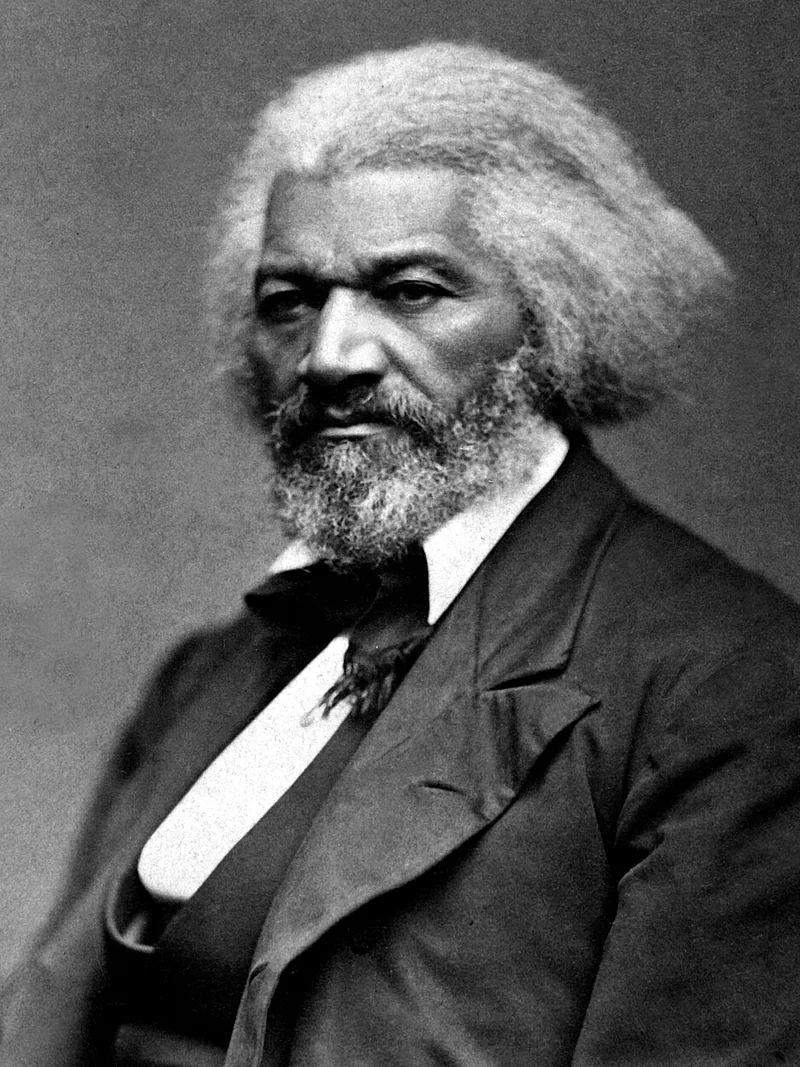
| 32 Quotes | |
| Occup. | Author |
| From | USA |
| Born | February 14, 1817 |
| Died | February 20, 1895 |
| Aged | 78 years |
| Cite | |
Citation Formats
APA Style (7th ed.)
Frederick douglass biography, facts and quotes. (2026, February 13). FixQuotes. https://fixquotes.com/authors/frederick-douglass/
Chicago Style
"Frederick Douglass biography, facts and quotes." FixQuotes. February 13, 2026. https://fixquotes.com/authors/frederick-douglass/.
MLA Style (9th ed.)
"Frederick Douglass biography, facts and quotes." FixQuotes, 13 Feb. 2026, https://fixquotes.com/authors/frederick-douglass/. Accessed 5 Mar. 2026.
Early Life in Slavery
Frederick Douglass was born into slavery in Talbot County, Maryland, likely in February 1818; he later chose February 14 as his birthday. His mother, Harriet Bailey, was enslaved, and the identity of his father was uncertain. As a child he was separated from his mother and moved between plantations and the port city of Baltimore, where he lived in the household of Hugh and Sophia Auld. Sophia began to teach him the alphabet until her husband insisted that literacy would make an enslaved boy unmanageable. Douglass continued to learn in secret, trading bread for lessons with white boys on the streets and poring over a tattered spelling book. His clandestine education became the foundation of his self-emancipation.Literacy and Resistance
As a teenager he was hired out to Edward Covey, a notorious "slave-breaker". After months of brutal treatment, Douglass fought back in a celebrated physical struggle that he later described as a turning point, restoring his resolve and sense of manhood. He was also hired out as a ship caulker in Baltimore, gaining skills and wages that were largely taken by those who claimed ownership of him. Exposure to maritime life and anti-slavery ideas deepened his conviction that he could and must be free.Escape and New Identity
In September 1838 Douglass escaped from bondage, aided by his future wife, Anna Murray, a free Black woman whose savings and practical support made the bid possible. Traveling in disguise and using borrowed seaman's papers, he reached New York and then settled in New Bedford, Massachusetts. There, a Black abolitionist family, Mary and Nathan Johnson, encouraged him to adopt the surname Douglass, taken from a character in a poem by Sir Walter Scott. He worked as a laborer and reader for the anti-slavery press while keeping a low profile to avoid capture.Abolitionist Orator and Author
Douglass soon emerged as a formidable speaker with the Massachusetts Anti-Slavery Society. William Lloyd Garrison and Wendell Phillips urged him onto abolitionist lecture platforms across New England and beyond. His searing eloquence and first-hand testimony confronted audiences with the realities of slavery. In 1845 he published Narrative of the Life of Frederick Douglass, an American Slave, Written by Himself, a book that became a landmark of American literature and a crucial document in the anti-slavery struggle. Because the Narrative exposed details that could lead kidnappers to him, he spent two years in Britain and Ireland. Supporters there arranged the legal purchase of his freedom and raised funds that later helped launch his newspaper.Editor and Political Evolution
In 1847 Douglass moved to Rochester, New York, and founded The North Star, which he edited for years, later consolidating it as Frederick Douglass' Paper. Through his editorials he debated strategies with fellow reformers, sometimes diverging from Garrison's stance that the U.S. Constitution was irredeemably pro-slavery. Influenced by political abolitionists such as Gerrit Smith, he came to argue that the Constitution could be wielded against slavery. This shift widened his alliances and deepened his engagement with electoral politics. In Rochester he delivered the oration that became known as What to the Slave Is the Fourth of July?, a searching critique of American hypocrisy coupled with a demand that the nation live up to its ideals.Associates, Reform Networks, and John Brown
Douglass worked with and debated many figures in the movement. He supported Harriet Tubman's clandestine rescues and admired her courage. He met John Brown and, while respecting his zeal, refused to join the Harpers Ferry raid, believing it doomed; afterward, he fled briefly to Canada and then to Britain until the furor passed. He cultivated relationships with women's rights leaders like Susan B. Anthony and Elizabeth Cady Stanton, having publicly backed women's suffrage as early as the Seneca Falls Convention in 1848.Civil War Advocacy
When war came, Douglass urged that it be made a war for emancipation. He met with President Abraham Lincoln at the White House, pressing for equal pay and fair treatment for Black soldiers and for protection of captured troops. He recruited men for the U.S. Colored Troops, including the famed 54th Massachusetts Infantry, and two of his sons served in the Union ranks; Lewis Henry Douglass became a sergeant major in the 54th. Douglass's wartime editorials and speeches sustained public pressure for the Emancipation Proclamation and for policies recognizing Black citizenship.Reconstruction and Public Service
After the war, Douglass demanded full civil and political rights for the formerly enslaved. He confronted President Andrew Johnson over Black suffrage and castigated the president's lenient policies toward former Confederates. Douglass supported the Reconstruction amendments and campaigned for the Republican Party as the best available vehicle for protecting those gains. In government service he held several notable posts: U.S. marshal for the District of Columbia under Rutherford B. Hayes; recorder of deeds for the District under James A. Garfield and his successors; and, under Benjamin Harrison, minister resident and consul general to Haiti, also serving as charge d'affaires to the Dominican Republic. Earlier, he had joined President Ulysses S. Grant's commission to investigate the potential annexation of Santo Domingo. These appointments reflected his standing and also exposed him to the limits of American racial progress in diplomacy and bureaucracy.Women's Rights and Wider Campaigns
Throughout his life Douglass linked abolition to a broader human rights program. He defended women's suffrage in print and on platforms, sometimes disagreeing with old allies over tactics but remaining committed to universal rights. In the 1890s he worked with Ida B. Wells against lynching and lent his name and pen to protests at the World's Columbian Exposition, where he also served as a commissioner associated with the Haitian pavilion. He insisted that the fate of Black Americans was inseparable from the health of American democracy.Personal Life
Douglass's marriage to Anna Murray Douglass, begun in 1838, sustained his early freedom struggle and the raising of their family. Anna managed household and business affairs during his long absences, including periods of danger and financial strain. After her death in 1882, he married Helen Pitts Douglass in 1884, a white suffragist and former colleague at the recorder of deeds office. The marriage provoked controversy across racial lines, but Helen shared his reform commitments and later preserved his papers and home. The family endured the 1872 fire that destroyed the Rochester home and newspaper offices; afterward, Douglass relocated permanently to Washington, D.C., where he eventually made his residence at Cedar Hill in Anacostia.Later Years and Death
Douglass continued to revise his life story across three autobiographies: the 1845 Narrative, My Bondage and My Freedom (1855), and Life and Times of Frederick Douglass (1881, revised 1892). He remained in constant demand as a lecturer, interpreting the promises and betrayals of Reconstruction for audiences across the country. On February 20, 1895, after attending a meeting of reformers advocating women's rights in Washington, he returned to Cedar Hill and died suddenly. He was buried in Rochester, a city that had anchored his newspaper and much of his antebellum activism.Legacy
Frederick Douglass fused moral witness, political strategy, and literary power in a single life. His speeches and journalism helped shape wartime policy; his diplomacy and federal service marked the entry of Black leadership into national and international arenas; and his alliances with figures such as William Lloyd Garrison, Harriet Tubman, Susan B. Anthony, Gerrit Smith, John Brown, and Ida B. Wells traced the interconnected reform networks of the nineteenth century. Above all, his insistence that literacy, civic equality, and the right to vote were inseparable from freedom set a standard that later movements for civil rights would invoke. His home at Cedar Hill, and his words in print, remain enduring places where Americans encounter the meaning and demands of democracy.Our collection contains 32 quotes written by Frederick, under the main topics: Ethics & Morality - Wisdom - Justice - Freedom - Learning.
Other people related to Frederick: Carter G. Woodson (Historian), Ernestine Rose (Activist), Ernestine L. Rose (Activist), Lucretia Mott (Activist), William Wells Brown (Activist), Steve Allen (Entertainer), Henry Wilson (Politician), Maria W. Chapman (Writer), John Albion Andrew (Politician), Timothy Thomas Fortune (Writer)
Frederick Douglass Famous Works
- 1892 Life and Times of Frederick Douglass (revised edition) (Autobiography)
- 1881 Life and Times of Frederick Douglass (Autobiography)
- 1855 My Bondage and My Freedom (Autobiography)
- 1853 Autographs for Freedom (Collection)
- 1853 The Heroic Slave (Novella)
- 1852 What to the Slave Is the Fourth of July? (Essay)
- 1847 The North Star (Non-fiction)
- 1845 Narrative of the Life of Frederick Douglass, an American Slave (Autobiography)