
Friedrich Nietzsche Biography Quotes 186 Report mistakes
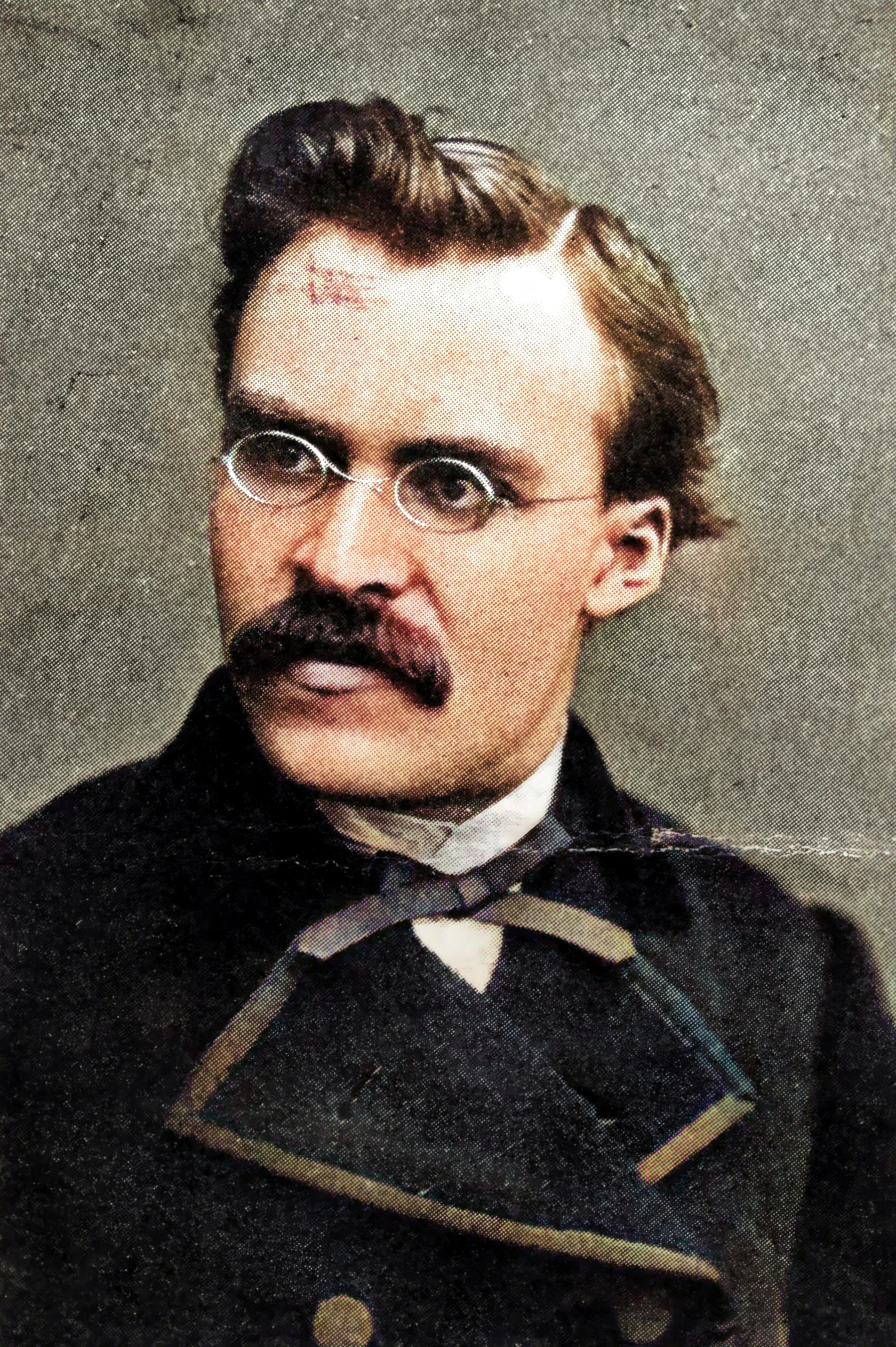
| 186 Quotes | |
| Born as | Friedrich Wilhelm Nietzsche |
| Occup. | Philosopher |
| From | Germany |
| Born | October 15, 1844 Röcken bei Lützen, Prussia |
| Died | August 25, 1900 Weimar, Saxony, German Empire |
| Cause | Complications related to a stroke |
| Aged | 55 years |
| Cite | |
Citation Formats
APA Style (7th ed.)
Friedrich nietzsche biography, facts and quotes. (2026, February 1). FixQuotes. https://fixquotes.com/authors/friedrich-nietzsche/
Chicago Style
"Friedrich Nietzsche biography, facts and quotes." FixQuotes. February 1, 2026. https://fixquotes.com/authors/friedrich-nietzsche/.
MLA Style (9th ed.)
"Friedrich Nietzsche biography, facts and quotes." FixQuotes, 1 Feb. 2026, https://fixquotes.com/authors/friedrich-nietzsche/. Accessed 27 Mar. 2026.
Early Life and Background
Friedrich Wilhelm Nietzsche was born on 1844-10-15 in Rocken, a Prussian village near Lutzen, into a Lutheran pastor's household that expected piety, learning, and restraint. His father, Carl Ludwig Nietzsche, died in 1849 after a debilitating illness; a few months later Nietzsche lost his younger brother. The early experience of sickness and bereavement did not simply darken his temperament - it trained him in the intimacy of fragility, the sense that the body can betray the mind, and that moral consolation can become a mask for fear.After his father's death, the family moved to Naumburg, where Nietzsche grew up surrounded by women - his mother Franziska, sister Elisabeth, grandmother, and aunts - in a domestic sphere that was affectionate yet tightly bounded by Protestant respectability. He was a brilliant, solitary boy, drawn to music and language, and he learned early how easily a community defines what is "normal". That awareness later sharpened into his suspicion that social belonging often purchases comfort at the cost of intellectual honesty.
Education and Formative Influences
Nietzsche received a rigorous classical education at Schulpforta (Pforta), one of Germany's elite boarding schools, mastering Greek and Latin while absorbing a disciplinarian ethos that he would both internalize and rebel against. He began studying theology and philology at Bonn in 1864, quickly drifting from Christian belief, then transferred to Leipzig, where he encountered Arthur Schopenhauer's The World as Will and Representation and felt he had found an unsentimental diagnosis of existence. In Leipzig he also discovered Wagner's music and the romantic promise of cultural renewal; by 1869, on the strength of his philological precocity, he was appointed professor of classical philology at the University of Basel at only 24, already a young man living at high intellectual speed and with a nervous system that would increasingly exact payment.Career, Major Works, and Turning Points
Basel brought prestige and a widening circle, including Richard and Cosima Wagner at Tribschen, but also the strain of lectures, migraines, digestive illness, and failing eyesight. Nietzsche served as a medical orderly during the Franco-Prussian War (1870-1871), returning ill, and soon channeled his ambitions into a new kind of writing that fused scholarship with cultural prophecy: The Birth of Tragedy (1872) praised Greek tragedy as a balance of Apollonian form and Dionysian ecstasy and presented Wagner as modern redeemer, a stance that alienated many philologists. The break with Wagner and disillusionment with German nationalism hardened through the 1870s, visible in Human, All Too Human (1878) and the aphoristic works that followed. By 1879 he resigned from Basel for health reasons and became a wandering writer across Sils Maria, Genoa, Venice, Nice, and Turin, living on a small pension and composing his major books in rapid succession: Thus Spoke Zarathustra (1883-1885), Beyond Good and Evil (1886), On the Genealogy of Morality (1887), The Case of Wagner and Twilight of the Idols (1888), and the furious late self-portrait Ecce Homo (written 1888). In January 1889, in Turin, he suffered a collapse and permanent mental incapacitation, likely linked to an underlying neurological disorder; he lived under the care of his mother and then his sister until his death on 1900-08-25 in Weimar.Philosophy, Style, and Themes
Nietzsche wrote as a psychologist of values: he treated morality, religion, and metaphysics not as eternal truths but as human inventions shaped by fear, resentment, and the need for control. His "death of God" announced a cultural event - the erosion of Christian metaphysical certainty in modern Europe - and raised the question of how to create meaning without inherited guarantees. The will to power, his most controversial concept, described not a crude lust for domination but the deeper drive of living beings to interpret, expand, and reorder their world; from this came his insistence that philosophy is always, covertly, autobiography. His style mirrors the doctrine: aphorisms, polemic, parable, and hymn-like passages that refuse system-building, because systems can become shelters for people unwilling to risk self-examination.The inner drama of his work is a struggle against both despair and herd comfort. “When you look into an abyss, the abyss also looks into you”. captures his belief that ruthless honesty is never neutral - the thinker is changed by what he studies, and moral critique can tempt nihilism. Yet Nietzsche also sought a practice of self-overcoming, a selective forgetting that makes action possible: “Blessed are the forgetful: for they get the better even of their blunders”. His diagnosis of modernity is equally personal and political, suspicious of mass emotion and ideological contagion: “Insanity in individuals is something rare - but in groups, parties, nations and epochs, it is the rule”. Across these tensions runs a single demand: become the author of your values, even if it costs you solitude, because comfort purchased by conformity is a spiritual anesthesia.
Legacy and Influence
Nietzsche's afterlife has been turbulent: his sister Elisabeth Forster-Nietzsche shaped and sometimes distorted the archive, and later political movements tried to conscript his rhetoric while ignoring his contempt for anti-Semitism and his distrust of the nation-state. Still, his influence became foundational for twentieth-century thought - existentialism, psychoanalysis, modernist literature, and later genealogy and post-structuralism - because he offered tools for reading morality as history and the self as a battlefield of drives. He remains a philosopher of perilous clarity: admired for liberating critique, feared for the same reason, and enduring because he forced modern readers to ask not only what they believe, but what in them needs those beliefs to be true.Our collection contains 186 quotes written by Friedrich, under the main topics: Witty One-Liners - Ethics & Morality - Truth - Wisdom - Art.
Other people related to Friedrich: H. L. Mencken (Writer), Max Stirner (Philosopher)
Frequently Asked Questions
- Friedrich Nietzsche, nihilism: Nietzsche is known for exploring nihilism, the belief that life lacks inherent meaning, and proposing the need to create one's own values.
- Friedrich Nietzsche (existentialism): Though not an existentialist, Nietzsche influenced existentialism with his exploration of individuality, freedom, and the construction of values.
- Friedrich Nietzsche contribution to philosophy: Nietzsche contributed to philosophy by critiquing religion, morality, culture, and science; he is known for his ideas on perspectivism and the declaration that 'God is dead.'
- Friedrich Nietzsche wife: Friedrich Nietzsche never married.
- Friedrich Nietzsche philosophy: Friedrich Nietzsche's philosophy centers on the concepts of the 'will to power,' 'eternal recurrence,' and the 'Übermensch' while challenging traditional moral values.
- Friedrich Nietzsche pronunciation: Friedrich Nietzsche is pronounced as 'FREE-drik NEET-shuh'.
- How old was Friedrich Nietzsche? He became 55 years old
Friedrich Nietzsche Famous Works
- 1888 Ecce Homo (Autobiography)
- 1887 On the Genealogy of Morals (Book)
- 1886 Beyond Good and Evil (Book)
- 1883 Thus Spoke Zarathustra (Novel)
- 1882 The Gay Science (Book)
- 1872 The Birth of Tragedy (Book)
Source / external links